Outdoor Lighting Depends on Direction
Uplighting and downlighting are the two basic directions in landscape lighting. One fixture sits at ground level and aims up, the other mounts high and aims down, and everything else in the trade is a variation on one of those two.
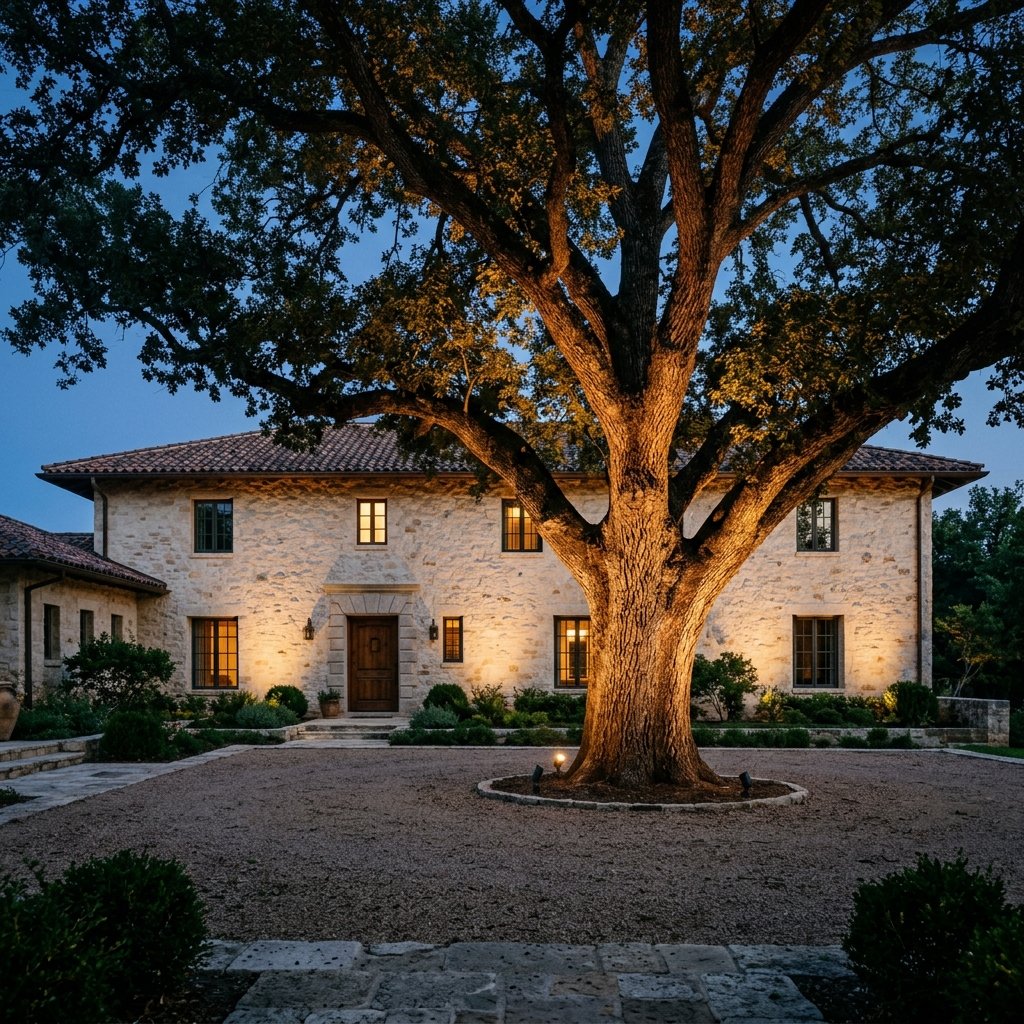
Restored heritage estate at blue hour, featuring a oak tree uplit with warm light before a stone facade.
Uplighting Reveals What's Already There
Uplighting places the fixture at ground level and aims it upward into a tree's trunk and canopy, or across a stretch of facade. The light rakes across bark texture and stone joints and catches the underside of leaves and branches, which is exactly why it works best on anything with real structural form and vertical presence worth revealing.
Downlighting Covers More Than One Effect
Downlighting is the broader category, and where the fixture sits changes the effect completely. Mounted under a porch roof, it works like practical overhead light over a patio or entry, the way a porch light always has. Moved up into a tree's own canopy, that same downward aim becomes moonlighting. I had always filed moonlighting as its own category until I looked into how the trade actually classifies it. Real moonlight never comes from below. It filters down through foliage, so a fixture aimed downward from within the canopy throws a soft, dappled shadow pattern across the ground. The pattern shifts on its own as the leaves move in the wind. It's the harder downlighting job by far, since the fixture has to be mounted and wired twenty feet or more up in the branches rather than staked into the ground, but it's the only downlighting technique that actually mimics how natural light moves overhead.
Wash Light Has a Different Job Entirely
Uplighting and moonlighting both pick out a single feature. Wash lighting does the opposite job on purpose. A wider beam angle, pulled back from the surface, spreads even illumination across something large and flat, a facade or a stretch of garden wall, so the surface becomes ambient background glow rather than a spotlighted focal point.
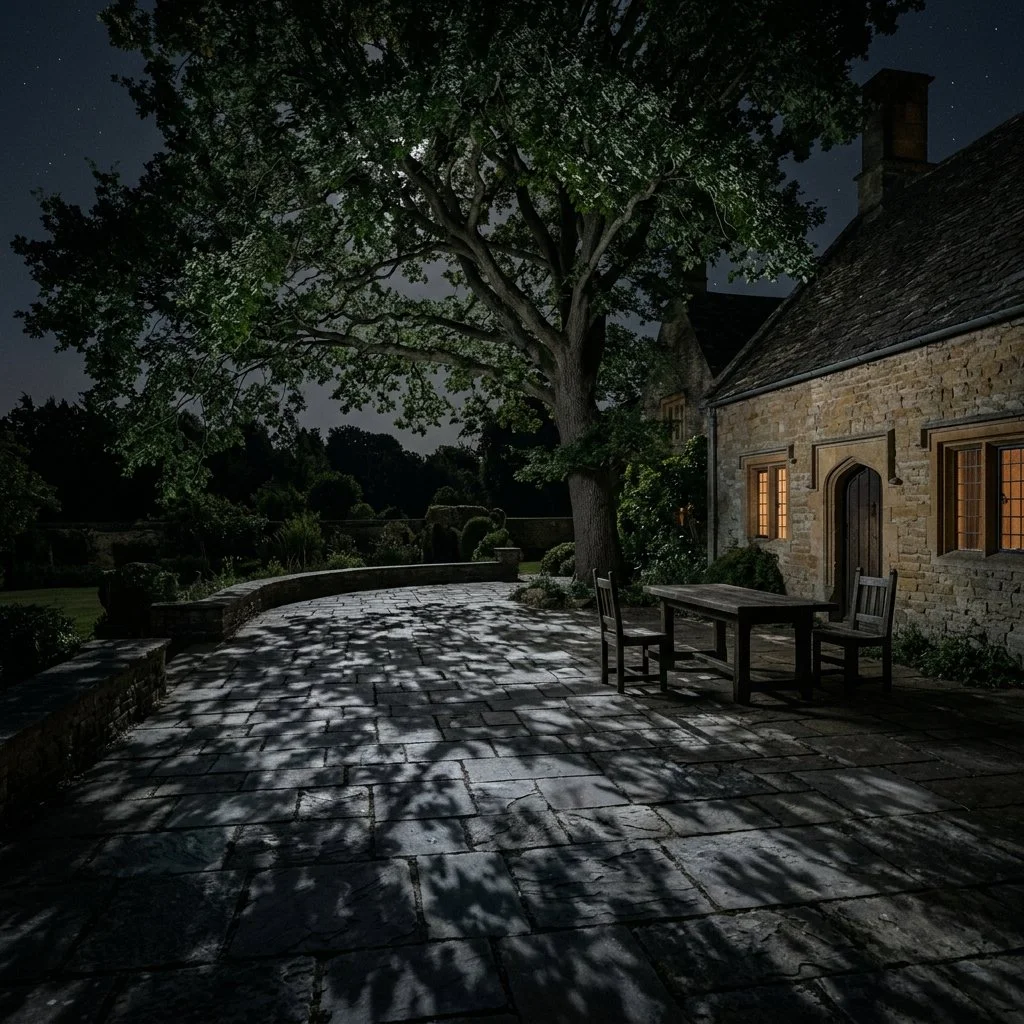
Heritage stone estate, where soft moonlight filters through a mature oak tree to project delicate leaf and branch shadows across worn stone pavers.
The Housing Has to Survive the Weather
A fixture that looks identical to another in a catalog photo can perform completely differently five years into a Pacific Northwest winter or a humid Gulf Coast summer. Most of the difference comes down to whether the metal protects itself or depends on a coating to do it. Solid brass needs no coating at all. Scratch it and there's more brass underneath, and it darkens slowly outdoors instead of failing. Copper behaves the same way. It forms its own oxide layer that shields the metal below it, which is why so many fixtures are brass bodies finished in copper.
Cast aluminum is lighter and cheaper, and a good powder coat can hold for a decade in a mild climate, less near salt air. The weak point is the coating itself. UV fades it and a string trimmer chips it. Once it's breached, the aluminum underneath corrodes into a chalky white residue. What surprised me is that the LED is often built right into the aluminum body, so when the housing goes, the whole fixture goes with it, long before the light source would have worn out. Plastic, the trade mostly doesn't bother defending.
A Garden Lit One Way Looks Flat
A landscape lit with only one of these techniques reads as flat no matter how well that single technique is executed. A real plan layers them the same way an interior lighting plan does. Uplighting picks out the trunks and stonework worth showing while wash light fills the broad surfaces behind them. Moonlighting is the one I'd hold back, because it depends on something no designer can supply. Direction decides the effect, and the metal decides whether it lasts. Neither one can make a young tree tall enough to hold a fixture twenty feet up. The fixture goes in over an afternoon. The canopy took decades.