Good LEDs Dim All the Way Down
Dimming an LED is an electronics problem. An incandescent filament simply glowed less as the power dropped, all the way down to almost nothing. An LED depends on a driver, the small electronic part inside the fixture that controls its power. Whether that driver and the dimmer on the wall are matched decides if the light holds steady near dark or starts to buzz and flicker.
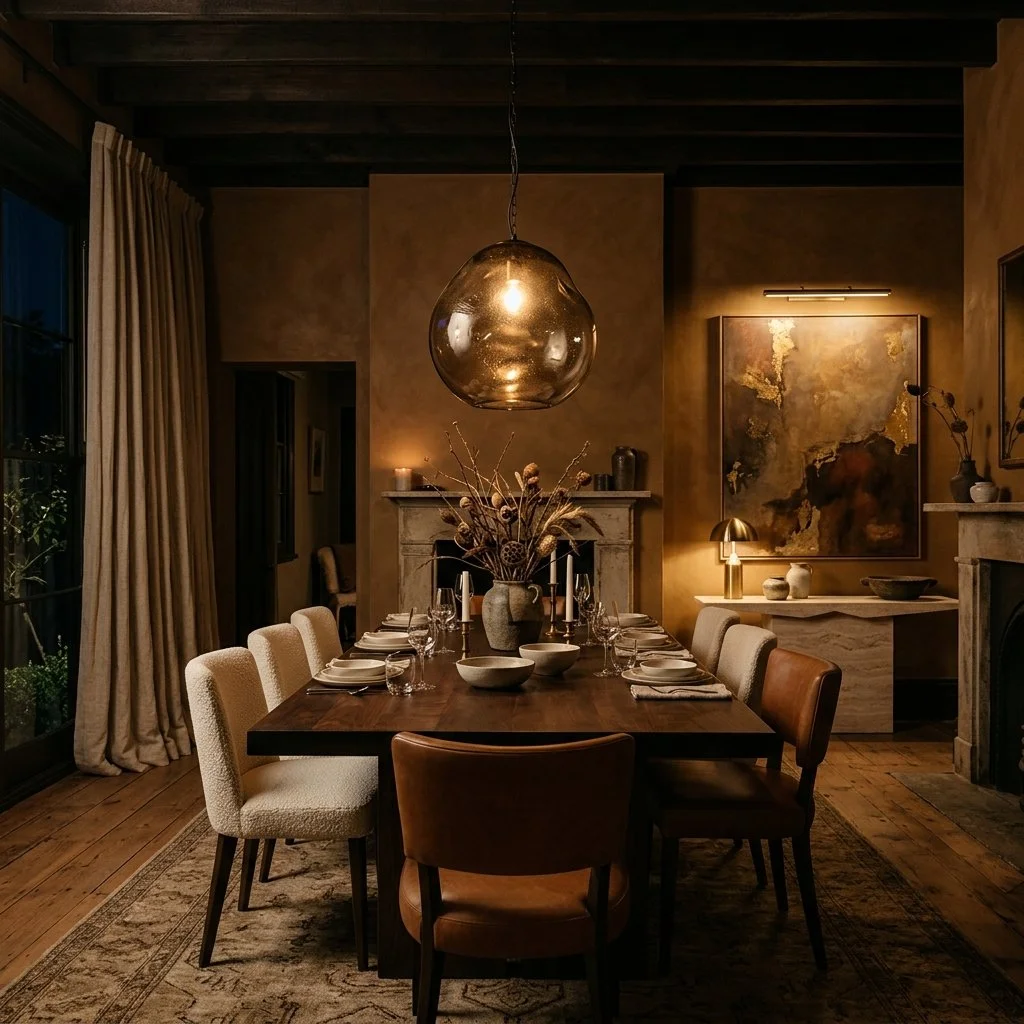
Dimly lit dining room in a restored heritage house, illuminated by a hand blown smoked amber glass pendant light.
The Dimmer on the Wall Was Built for a Filament
Most wall dimmers work by chopping up each cycle of household alternating current. A leading edge dimmer, the older TRIAC design, cuts off the front of every half cycle. A trailing edge dimmer, built around a MOSFET and sometimes sold as ELV, cuts off the back instead. Which end gets cut matters because the driver has to rebuild whatever is left into steady low voltage DC.
Leading edge switching is abrupt. The sharp jolt makes magnetic parts inside the driver vibrate at a frequency you can hear, and that's the buzz. Flicker usually has a different cause. A typical leading edge dimmer needs 40 to 60 watts of load to fire reliably, and an LED sold as a 40 watt equivalent might draw only 5 to 8. Put two or three of those on a circuit and the dimmer can't hold its switching point. The thing I kept running into while reading about this was how often the dimmer is older than every bulb it controls. The bulbs got swapped for LED, and the wall control installed for halogen stayed put.
One Percent Is Brighter Than It Sounds
Fixing the buzz gets a light working. It doesn't get it low. The eye reads dim light on a curve, not a straight line, so the bottom of the range looks far brighter than the number on the spec sheet. A driver rated to dim to 1% has a lowest setting the eye reads as roughly 10% of full brightness. I had assumed 1% meant nearly off. It means a room that still looks lit. Drivers built for deep dimming go down to 0.1%, and one lighting manufacturer's guidance puts museums and luxury interiors at 1% or lower.
Ordinary retrofit lamps, the kind that screw into a standard socket, sit at the other end of the scale. Many bottom out around 5 to 15%, and near that floor they misbehave in ways the trade has names for. Dropout is a light that cuts off before the slider reaches the bottom. Pop on is the reverse, a light that stays dark until you push the slider well up and then jumps to life.
Warm Is a Separate Question
Low and warm are two different specifications. Incandescent always warmed as it dimmed. An LED holds the same color all the way down unless the fixture blends in a second channel of warmer diodes as the level drops. The usual range starts near 2700 to 3000K at full brightness and falls toward 1800K at the bottom. That evening shift toward amber sends the body's clock less of the signal it reads as daytime, which is why warm dimming belongs in the same conversation as circadian lighting. A fixture can dim deep without warming, and a warm dimming fixture can still drop out well before the bottom. Each one has to be asked for on its own.
The Pairing Is What Gets Specified
None of these numbers belong to a single part. The driver and the wall control behave as a pair, and the fixture inherits whatever that pair can do. Testing funded by the Department of Energy at Pacific Northwest National Laboratory found that dimming performance swings widely with the exact pairing, and the worst problems show up near the low end. A "dimmable" label on the box covers none of that.
This matters most for a fixture made by hand. A glass pendant blown in a studio can look splendid at full brightness. At 3% on a weeknight, how it looks depends on a driver the glassblower may never have chosen. The question worth putting to whoever supplies it is which dimmer that driver was actually tested with, and how low the two go together before the light drops out.
The Dimmer Is Moving Into the Fixture
Wall dimmers keep getting better at the matching problem. Phase selectable models let the installer switch between leading and trailing edge on site, and adaptive models adjust to whatever load they find on their own. At the high end, the bigger shift is that the wall dimmer is going away. Some lighting systems put the dimming intelligence inside each fixture and send the control signal wirelessly, so there's no separate dimmer to pair it with, and the best of them dim down to 0.1%. One benefit I hadn't thought of is practical: when a table shifts or the art on a wall changes late in a project, the lights can be regrouped without rewiring.

Cozy bedroom corner at dusk, where the textured walls are softly illuminated by a warm glowing alabaster and aged brass wall sconce.
What Replaces the Slider
The control on the wall is changing shape too. A touch bar is the closest replacement for the slider: a smooth, flat strip you run a finger along to set the level, with a line of light showing where it sits. Some smart dimmers pair a lit bar with buttons that treat a tap differently from a long press. In whole house systems the slider often disappears entirely. A wall keypad with a few buttons calls up preset scenes, a dinner setting or a late evening setting, and each button sets every light in the room to a level someone programmed in advance. For the low end, this matters more than it looks. Once a scene is saved at 3%, nobody has to hunt for that level by hand again. The bottom of the range gets chosen once, carefully, and after that it's just a button.
The Level You Never Notice
A dining room at eleven at night is where all of this shows. If the low setting holds steady, with no hum from the wall and no flutter in the glass, the pendant glows the way its maker meant it to and nobody at the table thinks about the dimmer. If it doesn't hold, the dimmer is the only thing anyone notices. Both outcomes trace back to one decision made long before dinner, how the light and whatever controls it were matched