Belgian Flax Isn’t Belgian Linen
Belgian Linen™ is a registered trademark. The Belgian Flax & Linen Association grants it only to cloth woven at a mill in Belgium with at least 85 percent of its weight in flax grown in the EU. “Belgian flax linen” is a phrase, not a label, and the retailers who explain it say it usually means European flax that was spun and woven in China or India. The hangtag names the field and says nothing about the loom. The association makes the same point on its own site, where it warns that fabric carrying the Belgian Linen name or logo is not genuine when the essential processing happened somewhere else.

A contemporary dining room with walls covered in tightly stretched pale linen panels, a dark oak table, and floor to ceiling glass.
What Is the Difference Between Belgian Linen and Belgian Flax Linen?
The difference is the loom, and the rule says less about the flax than most people assume. The trademark asks for flax grown in the EU, not flax grown in Belgium, so a bolt woven in Flanders from fiber grown in Normandy qualifies. Several retailer guides that rank for this question describe Belgian Linen as made entirely in Belgium, from field to fabric. The association’s published rule says nothing of the kind.
What the rule does provide is a paper trail. Only member mills can apply, and they must disclose where their fabric came from. Each certified batch then receives a unique ID, which the association says lets buyers trace the cloth to its origin. A workroom or brand that wants to print the label on its own drapery or upholstery applies for a use permit through the mill that wove the cloth.
A European Flax Tag Only Covers the Fiber
Masters of LINEN™ belongs to the Alliance for European Flax Linen & Hemp, the body founded in 1951 as CELC. The certification is open only to European mills that turn flax into yarn or cloth. The Alliance describes it as a guarantee that every growing and processing step was done by a European company. The Belgian association states that all Belgian Linen™ also carries Masters of LINEN™ certification, so the two labels often travel together.
The Alliance’s other label is the one that gets misread. Masters of FLAX FIBRE™, known for years as European Flax™ before the Alliance renamed it, certifies that the fiber grew in Western Europe and tracks it through each company that handles it afterward. In 2026 the Alliance’s directory listed Qilu Hongye Textile Group in Shandong, China, certified since 2025 for flax spinning, along with other Chinese holders certified to produce linen fabric. A European flax tag can be completely accurate on cloth spun and woven in China.
Where Normandy’s Flax Goes
The Alliance’s certification documents put Europe’s share of the world’s long flax fiber at three quarters. How much of it stays in Europe is another matter. In 2025 Il Sole 24 Ore interviewed Thierry Goujon, general manager of Terre de Lin, the Normandy cooperative the paper called Europe’s largest flax producer. He said Chinese and Indian textile companies bought 90 percent of the cooperative’s flax. Terre de Lin kept the rest for the European spinning and weaving mills that remain, to keep them from going extinct.
Spinning has started to come back in small steps. Safilin, a French spinner founded in 1778, moved its spinning to Poland in the 1990s. It later opened a mill in Béthune, in the region where the company began. Il Sole reported that most of its production remained in Poland.
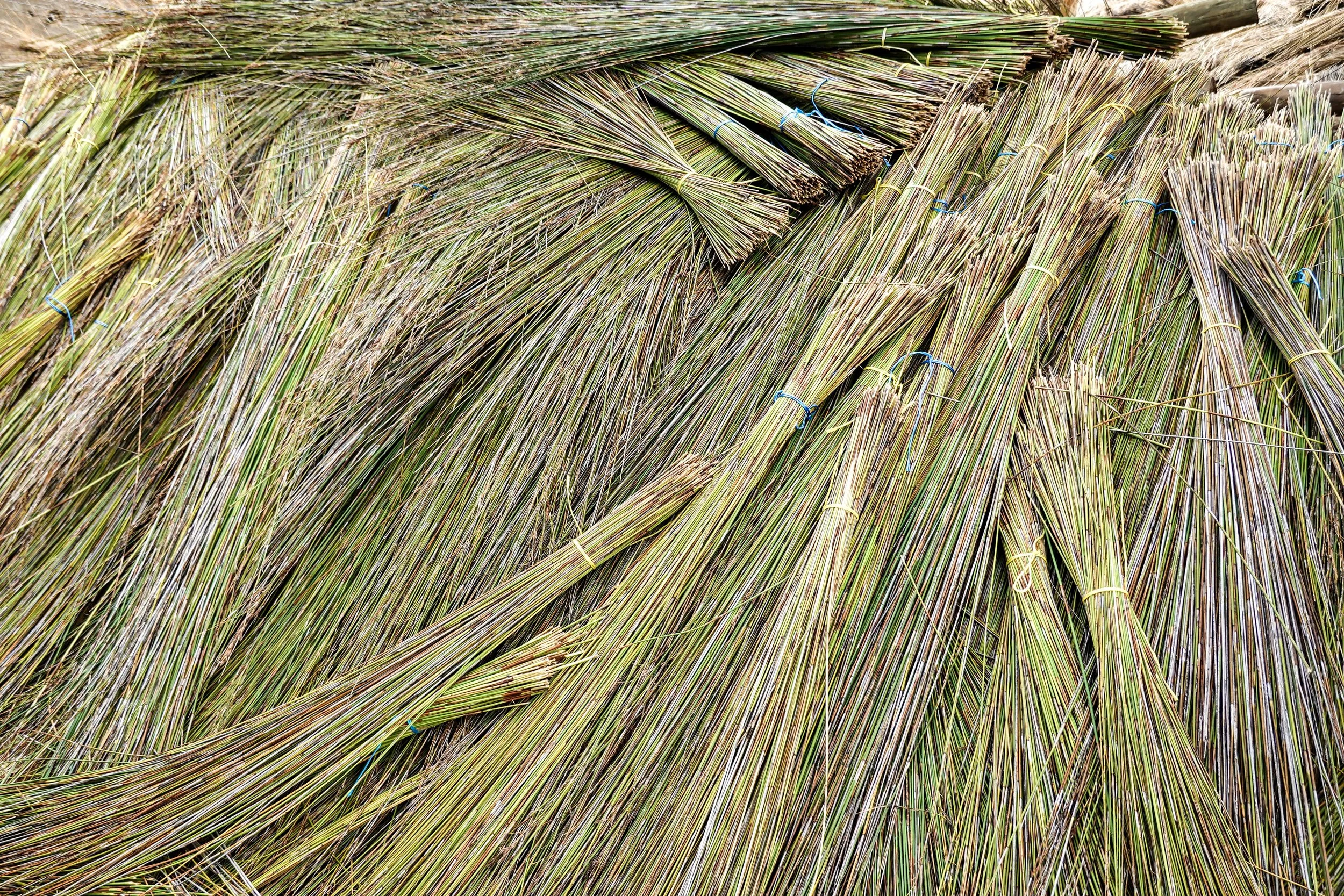
Pulled flax stalks lying in long rows across a field, turning gray as they ret.
The Golden River Story Runs Backward
In the nineteenth century, Kortrijk, on the Lys (the Leie in Dutch), was one of Europe’s most important linen towns. Its flax was retted by sinking bundles of stalks in the river until the fiber loosened from the woody core, and the Lys became known as the Golden River. The usual story credits something special in the water. Writing in The Low Countries in 2024, art critic Virginie Platteau put it the other way around, the retting probably turned the river yellow, and the river did nothing special for the retting.
The old claims about the water disagree with each other too. A Keystone stereograph caption from the early twentieth century, held in Cornell’s archives, says the Lys suited retting because it was free of minerals that might stain the fiber. Visit Gent describes the same water as rich in lime. I trust that disagreement more than the legend.
Put the Label Itself in the Spec
Each label answers a different question, so the decision belongs at the sampling stage, before anyone falls for a swatch. If the client is paying for Belgian weaving, the spec names Belgian Linen™, and the supplier provides the batch ID before the order is placed. If the point is European work from the field to the finished cloth, Masters of LINEN™ is the label that covers it. A Masters of FLAX FIBRE™ tag on its own is a fiber certificate, and a spec that stops there leaves the weaving open.
The mills behind these labels had to disclose or document their flax to earn them, and they are the makers I’d rather point a designer toward. Both the Belgian Flax & Linen Association and the Alliance publish lists of their certified members, which makes either one a sensible first call.
