Wood Furniture Fails From Neglect, Not Age
Two bottles both labeled "wood oil" work by opposite chemistry, and a white water ring means something very different from a black one. What walnut and oak each actually need, and how often to do it.
Two bottles on a hardware store shelf both say "wood oil." One is mineral oil, the kind sold for butcher blocks. The other is tung or linseed oil, sold for furniture. They look almost identical and do opposite things. Mineral oil never hardens. It sits in the wood's pores as a liquid indefinitely, which is exactly what you want on a cutting board you'll re-oil for the rest of its life. Tung and linseed oil cure. Exposed to air, their molecules cross link into a solid film inside the wood itself, the same reaction that dries a coat of paint, and once that film has fully hardened it actually resists water and wear instead of just temporarily repelling it. Use the wrong one on a table and you'll spend years reapplying something that was never going to build up, or wonder why a "protective" oil never actually protected anything.
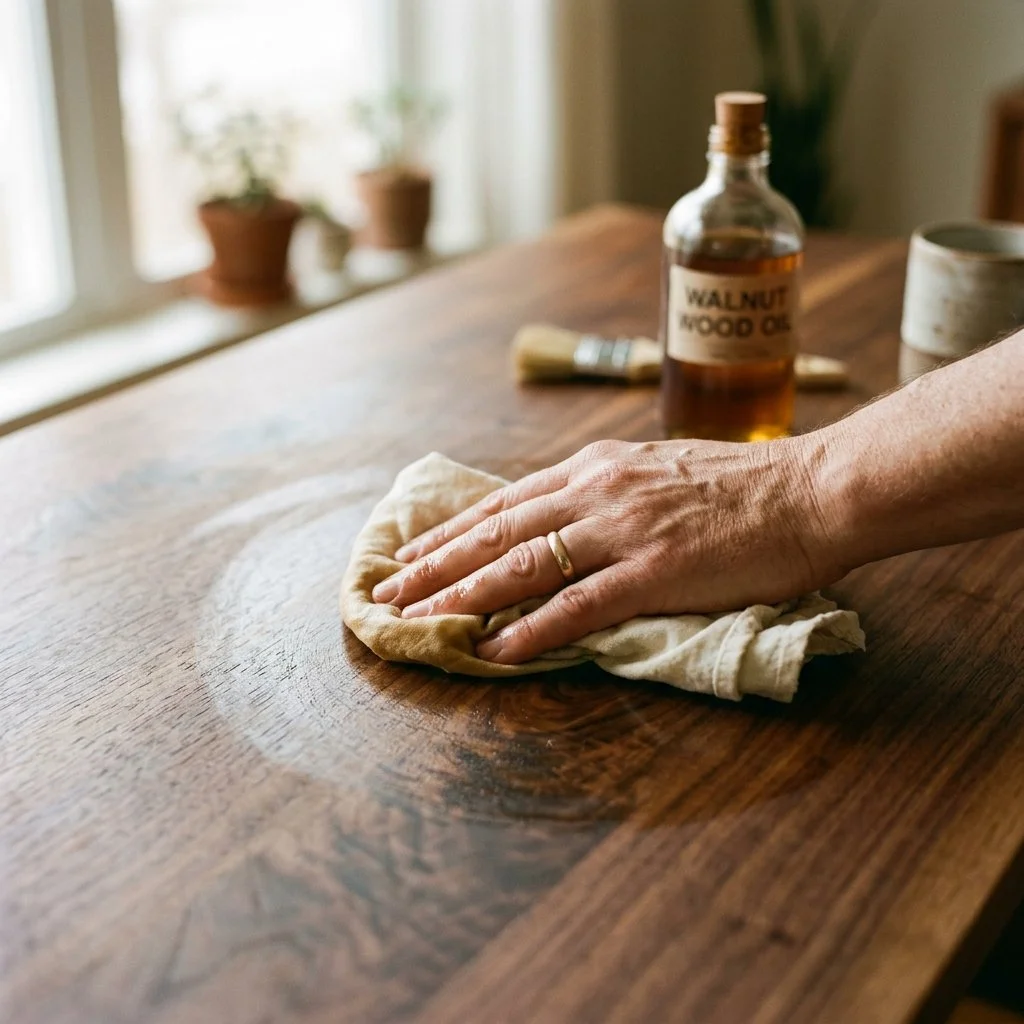
A hand applying oil to a wood tabletop with a soft cloth.
Humidity Moves the Wood Before You See a Crack
Wood is hygroscopic. It pulls moisture from the air in summer and gives it back in winter, and the wood itself expands and contracts with that exchange whether or not you notice. Most guidance settles on keeping indoor humidity between 40 and 60 percent for solid wood furniture. Below that, the wood shrinks and finish cracks appear at the joints first, since that's where two pieces of wood are fighting each other for space. Above it, finishes soften and mold risk climbs. A drawer that suddenly sticks in August or a tabletop that opens a hairline seam in January isn't a defect. It's the wood doing what wood does, and a humidifier in winter does more for a piece's long term health than any amount of oil.
Read the Ring Before You Reach for Anything
A cloudy white ring under a glass and a dark brown or black one are not the same injury. White means the moisture only got as far as the finish. It's trapped in the lacquer or varnish layer, hasn't touched the wood, and usually lifts with gentle heat, a hairdryer held low and moving, or a warm iron over a folded cloth. A dark ring means water pushed all the way through the finish and into the wood fibers, where it reacted with the wood's own tannins. That one needs sanding and refinishing, not a hairdryer. The color tells you which repair you're actually facing before you touch anything.
Walnut and Oak Ask for Different Things
Walnut is one of the softer hardwoods used in furniture, which is part of why it takes an oil finish so well: the oil penetrates easily and the wood forgives the occasional dent. That's the piece that wants oiling worked in roughly once a year, more in a dry climate or near a heat vent, less if the room stays humid. White oak is denser, and its pores are naturally water resistant, so it tolerates a paste wax finish that simply sits on the surface rather than soaking in. Trying to oil a wax finished piece, or wax an oil finished one, mostly just builds up residue neither wood asked for.
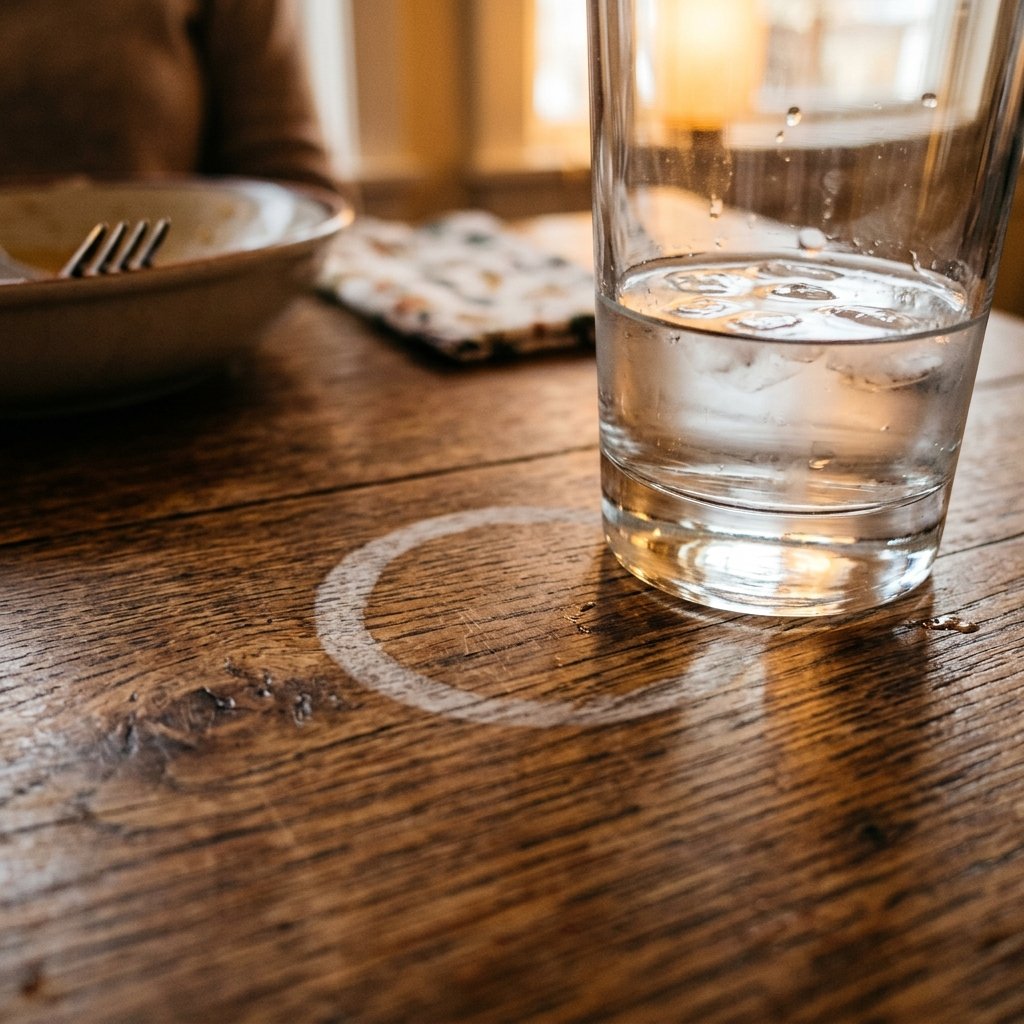
Wood table surface with a faint water ring near a glass.
A Six Month Habit, Not a Sunday Project
Dust weekly with a dry or barely damp cloth. Wipe with the grain, not against it. Skip ammonia and silicone based polishes. They clean well the first time and leave a cloudy buildup that eventually needs stripping off with mineral spirits before anything looks right again. Keep the piece out of direct, sustained sunlight, since UV fades color and can craze a finish over years the same way it darkens a walnut floor unevenly under a rug. Every six months to a year, depending on how hard the piece is used, oil or wax again, whichever the finish calls for. That's the whole schedule. It's shorter than most people expect, and most of the damage I've read about in wood happens between reapplications, from a house that stays too dry all winter, not from the wood simply getting old.
Aging and Failing Are Not the Same Thing
Solid wood is built to change. A joint gives slightly with the seasons, and the color shifts in ways that have nothing to do with dirt. That's aging, and it's the reason solid wood earns the word heirloom in the first place. A joint that's cracked from a winter with no humidifier and a black ring from a glass left out overnight are a different thing entirely. That's neglect, and neither one was inevitable. The wood was never asking for much. It wanted the air kept steady and the right oil or wax applied on schedule, not attention only once something had already gone wrong.

A Stone Sealer Stops Stains, Not Etching
A sealer slows stains but does nothing about etching, and sources disagree on how often to apply it. How to test the seal with water, what finish hides what, and what to do about a stain that has set.
Pour a puddle of water about three inches wide on a stone counter and leave it. Stone care companies and suppliers both describe this as the test for whether a seal is still working, and they do not agree on a date. One stone care company says a good sealer lasts three to five years on a stone floor. A supplier says a marble counter wants sealing about once a year. Part of the gap is that one is describing a floor and the other a counter, and no calendar knows how a particular slab is used.
A large kitchen with a light stone island and dark stone counters in warm afternoon light.
How the Puddle Test Works
Clean the stone and let it dry first, because soap residue and cooking oil skew the result. Test several spots, since a seal wears unevenly across a slab. The sources I read give a wait of ten to thirty minutes. Water that holds a rounded bead means the sealer is working. A dark ring means the stone is taking it in and needs sealing again. One guide adds a few drops of mineral oil left for ten minutes, because some stones shed water and still drink oil.
Look for a penetrating sealer. It soaks into the pores and leaves no film, so the stone keeps its finish. Topical coatings sit on the surface instead, and stone care sites warn that they change the look of the stone and have to be stripped before the next coat. A stone guide notes that a new counter may have no sealer at all, or only a light coat from the fabricator. I would ask what was used and run the puddle test the week the slab goes in.
Stain and Etch Are Different Damage
A stain is color that has moved into the pores. Etching is a chemical change. Acid meets the calcium carbonate in marble or limestone and dissolves a thin layer of the surface. What is left is a dull, lighter patch.
A sealer fills the pores, so it slows staining and gives a spill time to be wiped up. It cannot touch etching, which happens on the surface the moment the acid lands. A sealed slab etches as readily as a bare one, and even the companies that sell sealer say so.
Finish decides how much of the damage shows. Honed marble hides etching and scratches because a matte surface already scatters light, but it is more porous, so it stains sooner and wants sealing more often. Polished marble stains more slowly, and every etch shows as a dull patch against the gloss. A stone expert quoted by Houzz summed up the tradeoff as less staining and more etching for polished.
A light etch on polished marble can sometimes be buffed out with a polishing powder. A deeper one needs a stone restorer to hone the surface again, which removes a thin layer of the stone itself.
A Poultice Draws the Stain Back Out
When a spill happens, blot it and do not wipe, since wiping spreads it. Plain water and mild soap, rinsed several times, is the first step. For a stain that has set, the Natural Stone Institute describes a poultice: a liquid chemical mixed into a white absorbent powder such as kaolin or diatomaceous earth until it is as thick as peanut butter. It goes on up to half an inch thick under a cover of plastic and sits for a day or two while it draws the stain up out of the stone. Some stains need repeat rounds, and some never come out completely.
The chemical has to match the stain, and the Institute's guide sorts stains by type. A restorer quoted by This Old House has seen a light yellow stain turn deep purple under the wrong chemical, and he tests every poultice on a hidden spot first.
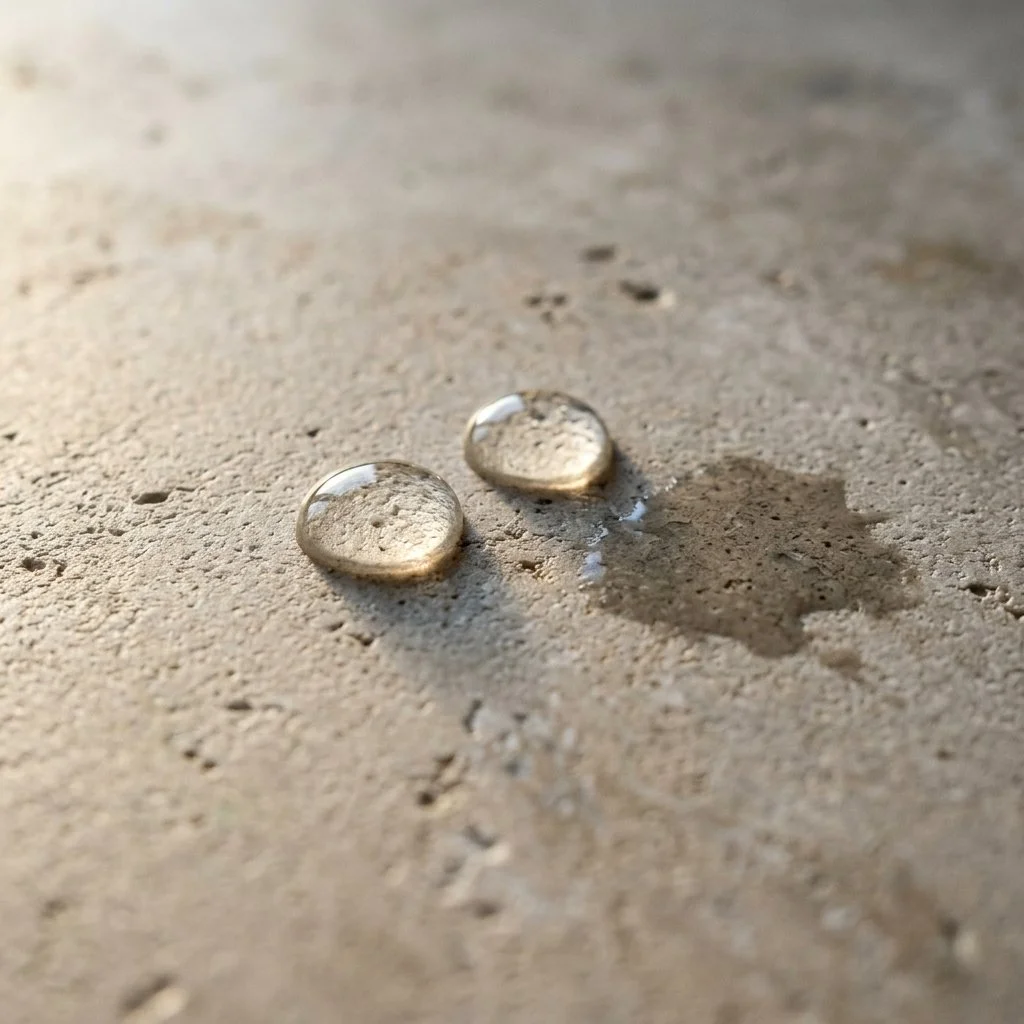
Stone counter with two rounded water beads and one darker patch where water has soaked in.
Soapstone Skips Most of This
Soapstone is a metamorphic rock rich in talc, and most guides call it dense enough that it never needs sealing. Acid does not etch it, which is why science labs have used it for counters. It scratches easily, though one guide says the scratches sand out in an afternoon.
The oil is where sources disagree. Rubbed in, mineral oil darkens soapstone toward charcoal and evens the color. A fabricator's guide calls that purely cosmetic and says the stone darkens on its own within months or a couple of years. A sealer maker says the stone lightens without regular oiling and wants heavy coats at least every six months. I read it as a look you choose.
Choose the Mark You Can Live With
Every stone here gets marked somehow, and the choice is which mark. One supplier's guide says polished white marble in a heavily used kitchen will have etch marks within weeks, and that honed is the alternative. The same polished stone as a bathroom vanity or fireplace surround sees little acid and is far more forgiving. That is the conversation to have with a client before the slab is cut, since a sealer will not have it for them.
What Outdoor Pieces Need Before the First Frost
Most damage to outdoor pieces starts with water sitting where it shouldn't. What to do about planters, glass tops, teak, iron, and bronze before the first frost, and what comes indoors.
Most damage to outdoor pieces starts with water sitting where it shouldn't, and fall is when it gets the chance. I read care sheets from furniture makers, a bronze foundry, and garden suppliers before writing this. They disagree about teak. On almost everything else they say the same few things.

Courtyard featuring ochre walls, a stone archway, a glass top table with honey brown wood chairs, and potted olive trees along a stone paved floor.
A Pot Cracks When the Water Inside the Clay Freezes
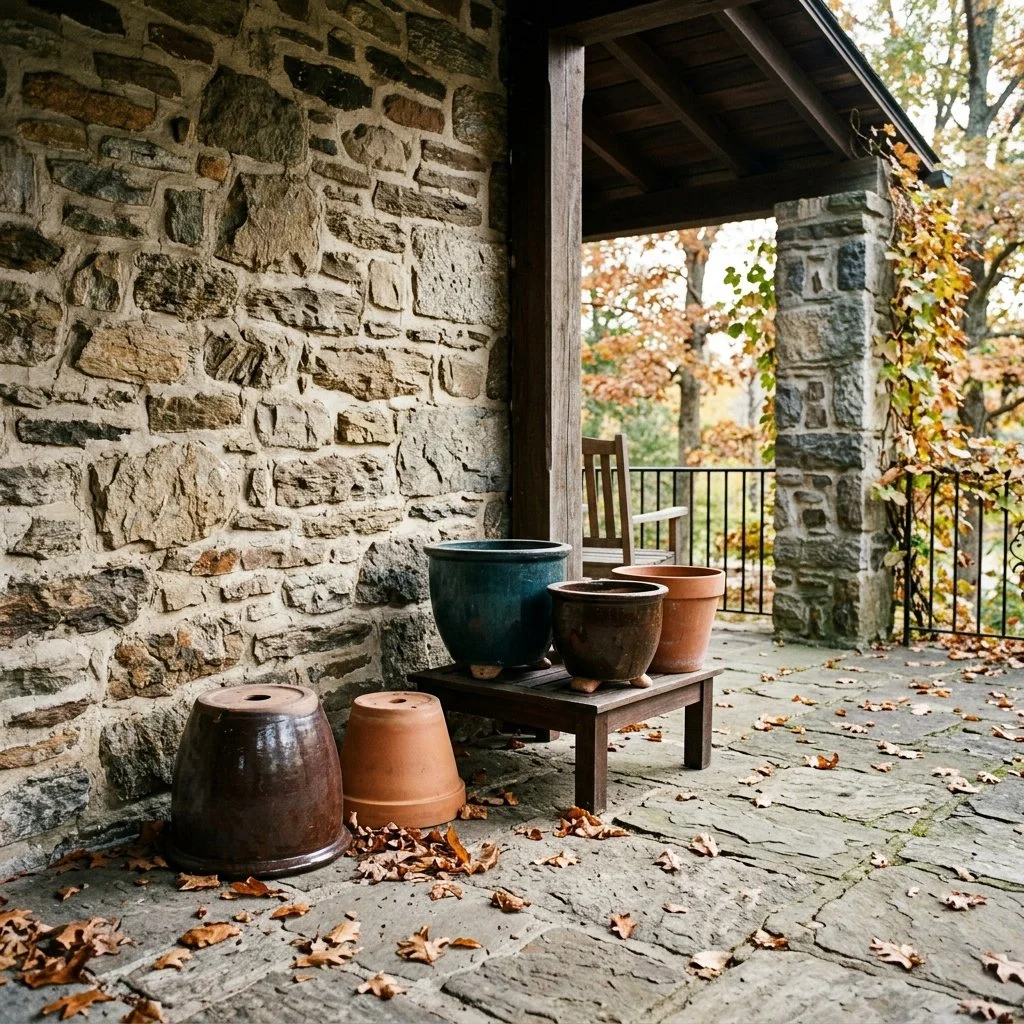
Terracotta takes on water the way a hard sponge does, and when that water freezes it expands and cracks the wall. The advice is consistent. Empty the pots in fall and store them upside down where rain can't collect. A pot that has to stay outside goes up on feet or bricks with the drainage hole left open, because a pot standing wet can freeze to the ground and break when you lift it.
Glazed planters follow the same rules. Makers of glazed pots fired at high heat say in their own care pages that no planter is completely frostproof, and the ones that survive winter are the ones that drain. The fine cracks that can show in a glaze are surface deep, according to one supplier, and don't weaken the pot.
Glass Needs Air Under the Cover
Tempered glass tops need very little. The makers I read say to wipe them with a mild cleaner and a soft cloth, dry them after rain, and skip cream cleaners, which scratch. One maker's guide points out that a potted plant set on the glass can leave scratches or lime deposits, and that a mild vinegar solution lifts the deposits. A scratch from dragging something rough across the top can't be removed. A cover helps in winter, but the same guide says to hold it up off the glass, since condensation trapped underneath grows mildew.
Teak Needs a Decision
Left alone outdoors, teak turns silver grey within about a year, according to the sellers I read. They also say the change doesn't affect how long the wood lasts, and that the small surface cracks that appear are cosmetic. Keeping the honey brown means a sealer or teak oil once or twice a year, with sanding first. One woodworker on a trade forum warned that once you stop renewing a finish, the wood spends a few bad years black and mildewed. Choose before the first winter.
Iron and Bronze Get a Thin Coat Twice a Year
Most care sheets for wrought iron are written for painted frames, and they agree that a chip is where rust starts. Touch it up right away with a rust inhibiting primer, then paint, and never leave the frame standing in water. For raw or blackened iron, one hardware maker recommends wax or oil in spring and fall.
Outdoor bronze follows the same calendar. One sculpture foundry recommends a coat of wax in early fall and again in late spring, and another says once a year is the minimum. Wax slows the way a patina changes outdoors, and one seller notes it can be skipped if you want the natural patina. Bird droppings and tree resin harm the surface, so they come off promptly with warm water and a soft cloth. Skip the pressure washer and any wax that contains silicone. Polishing bronze to a shine works against a patina that is meant to look dull outdoors.
Empty planters on a covered porch, one turned upside down, others raised on feet.
What Comes Indoors
Cushions go in clean and completely dry, in breathable bags or a lidded box off the floor, because damp fabric closed up for months grows mildew. Wool throws go in clean too, since moths go for body oils and food stains, and a block of cedar in the bag helps.
Two Dates a Year
Nearly all of this fits into two dates. In early fall, the pots get emptied and the metal gets waxed. In spring, everything comes out from storage for a look at chips before summer. Before you specify any of it for a client, ask the maker for the care sheet in writing and read what it says about frost.
Maintenance Is the Real Luxury Signal
Luxury is never passive. It is a living practice. Discover why the quiet act of maintenance is the most profound expression of a refined home.
Most of what makes a room feel handled has nothing to do with the furniture in it. It's whether the pillows still hold their shape, whether the rug edges lie flat, whether the brass lamp has gone dull from six weeks of fingerprints. I spent decades around people trained to notice small deviations before they became real problems. A crooked stack of books isn't a crisis. It's just the first sign that nobody's been paying attention.

Granite kitchen island integrated with a solid wood dining table extension, mixed material transitions.
The Five Minute Reset
None of this takes long. A pass through the rooms people actually walk through, straightening what's crooked and clearing what's piled up, resets a space faster than any redesign would. Skip it for a month and the room doesn't collapse. It just starts to look like nobody lives there on purpose.
Materials Don't Forgive Neglect
Honed marble holds up beautifully and holds a grudge just as hard. Marble is calcium carbonate, and calcium carbonate reacts with acid on contact, not overnight. A splash of lemon juice or wine left on a Carrara countertop for even a few seconds can etch a dull ring into the stone that no amount of polishing removes. Sealing helps against staining, but it's worth being honest that it doesn't stop etching. The acid still gets in. The only real defense is wiping spills fast and keeping citrus and vinegar off the surface entirely.
Belgian linen asks for the opposite kind of attention. It wrinkles by design, so ironing it flat fights the fabric instead of working with it. Steam it, let it settle, and it looks more like itself for having some life left in it. Walnut wants oil worked into the grain roughly once a year, more often in a dry climate or near heat vents, or it dulls and starts to look thirsty.
Skip the technique if you're already deep into it. What matters here is the principle underneath: the materials people pay the most for are usually the ones that punish inattention the fastest.
A Rough Schedule, Not a Rulebook
I don't keep a chore chart on the fridge, but I do think in three timeframes.
Daily is the surface pass. Straighten what's crooked. Clear what's accumulated. Leave the rooms looking like someone was in them on purpose.
Weekly is the sensory layer: fresh linens on the bed, water changed for cut flowers, whatever scent you use in the house refreshed before it fades into the background and you stop registering it.
Seasonally is the real work. Rotate rugs a quarter turn so the sun doesn't bleach one section faster than the rest. Reseal stone. Check upholstery seams and wood joints for the kind of wear you won't notice until it's a repair instead of a fix.
None of this needs a schedule taped to a wall. It needs to actually happen.
The Parts You Can't Photograph
A room can look flawless in a photo and still feel wrong to stand in. A lamp on a warm dimmer changes a room more than a new chair would. An open window for ten minutes clears out staleness that no candle covers up. Furniture pulled six inches off the wall so people can actually face each other changes how a living room functions, not just how it looks in a listing photo.
None of that shows up on camera. It shows up the moment someone sits down.

Living space featuring a marble faced fireplace, honed stone coffee and side tables, and a hand woven wool area rug.
Where to Start
Walk your own rooms and notice where your eye snags. Maybe it's a lamp base gone tarnished, or a rug that's been sitting crooked since you last vacuumed. Pick one thing. Fix it this week. The habit matters more than finishing the whole list on day one.
What This Actually Signals
A maintained home tells a specific story, someone here paid attention today, not just on move in day. That's harder to fake than good taste, and it's why a modest home that's cared for often reads as more expensive than a lavish one that isn't. The furniture was a decision made once. The care is a decision made daily.