Terrazzo Is Chosen by What’s Under It
Terrazzo is marble or other stone chips set in a binder and ground flat once it cures. The binder matters more than the chips, and on a new project the choice is epoxy or cement. Epoxy wants a flat concrete slab that stays dry. Cement tolerates a slab with moisture coming up through it, and it is the one that goes outdoors.
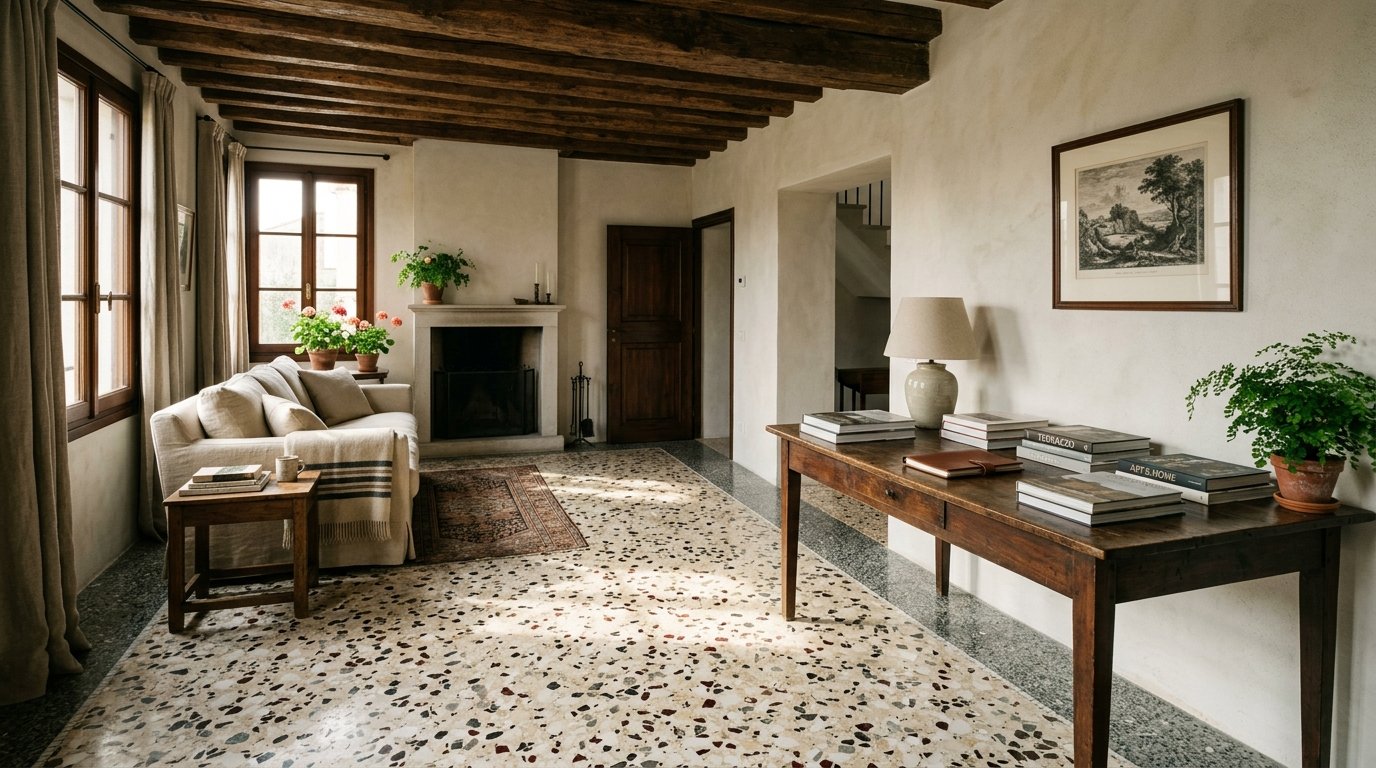
A restored salon with exposed timber ceiling beams and a continuous terrazzo floor of large stone chips with a darker border.
Epoxy Terrazzo or Cement Terrazzo?
Epoxy accounts for the large majority of interior terrazzo, according to a continuing education course from the National Terrazzo and Mosaic Association, the US trade group. It goes down as a resin layer about 3/8 inch thick and can be tinted to almost any color. Its weak point is the slab. Joshua Boncosky of Concord Terrazzo told Architizer that moisture rising through an old slab with no vapor barrier can break the bond, and that the missing barrier is often found too late. The NTMA’s own guide describes epoxy as a system for interior slabs.
Cement terrazzo is sold as systems sorted by thickness. A monolithic floor bonds straight to the slab with a half inch topping. A sand cushion floor sits free of the slab on an isolation sheet and a dusting of sand, under a mortar bed reinforced with wire, about three inches deep in the NTMA’s guide. That depth rules it out for most renovations, and Cameo Morningstar of Terrazzo & Marble Supply told Architizer that very few tradesmen were still doing cement work at all. Outdoors, the NTMA points to rustic terrazzo, a cement system left textured instead of ground, for pools and patios.
Venice Laid It on Wood
The floors that made terrazzo famous were bound with lime and laid over timber. Historian Giulia Ceriani Sebregondi’s study of Palazzo Donà, built from 1610 to 1612, shows Venetian palaces framed with closely spaced wooden beams to keep weight off the soft ground. Lime gave those floors some flex. Architect Paola Marpillero credits that elasticity with letting the floor adapt to what is under it, and a Houzz guide ties it to bending wooden supports and a city that keeps settling. Cement began replacing lime in the nineteenth century, by Marpillero’s account.
A restored house with timber floors puts the same question to a designer today. How much does the structure deflect, and can the binder move with it? That answer belongs to the structural engineer, and I’d want it in hand before a terrazzo contractor prices the job.
Friulian Hands Built the Trade
On February 9, 1583, the Venetian Council of Ten allowed master Sgualdo Sabadin of Provesano and his fellow Friulian terrazzo workers to found a guild school dedicated to St. Florian. The first chapters of the guild’s statutes followed in September 1586, according to historian Javier Grossutti. Craftsmen from a handful of foothill villages in Friuli, Sequals and Fanna among them, held Venice’s terrazzo trade almost entirely. Grossutti points out that none of those villages was ever where they practiced it.
From the 1830s, he writes, they carried the craft across Europe, and at the turn of the twentieth century to American cities. By 1931, most of the roughly 12,000 Friulians living in the United States worked in mosaic or terrazzo, according to the program for a 2006 study day in Cavasso Nuovo. Giandomenico Facchina, a mosaicist from Sequals, decorated the Paris Opéra and helped many emigrant Friulian terrazzo workers into French work, according to the Friuli mosaic school. Italian names ran through American terrazzo for so long that the NTMA later profiled Grossutti’s research into why.
What Venetian Means on a Spec Sheet
In the NTMA’s data sheet, Venetian terrazzo is a chip size, a coarse mix of #3 to #8 aggregate instead of the usual #1 and #2, in epoxy or cement. The larger stones need a thicker pour, and the sheet notes the slab may need to be recessed to take it. In tile catalogs the phrase is a product name, and several porcelain lines borrow it, the same idea as porcelain slab.
In Venice the word still names a method. Seminato is stone scattered by hand into the fresh bed before the floor is rolled and ground. Brothers Stefano and Marco Vianello lay it in Venetian palaces and teach it, and the Cologni Foundation’s master craftsman register describes Stefano’s work as the dry technique of seminato and rolling. Their Homo Faber profile says the same texture can never be made twice. If you seed terrazzo by hand, in Venice or anywhere else, I’d like to hear from you.
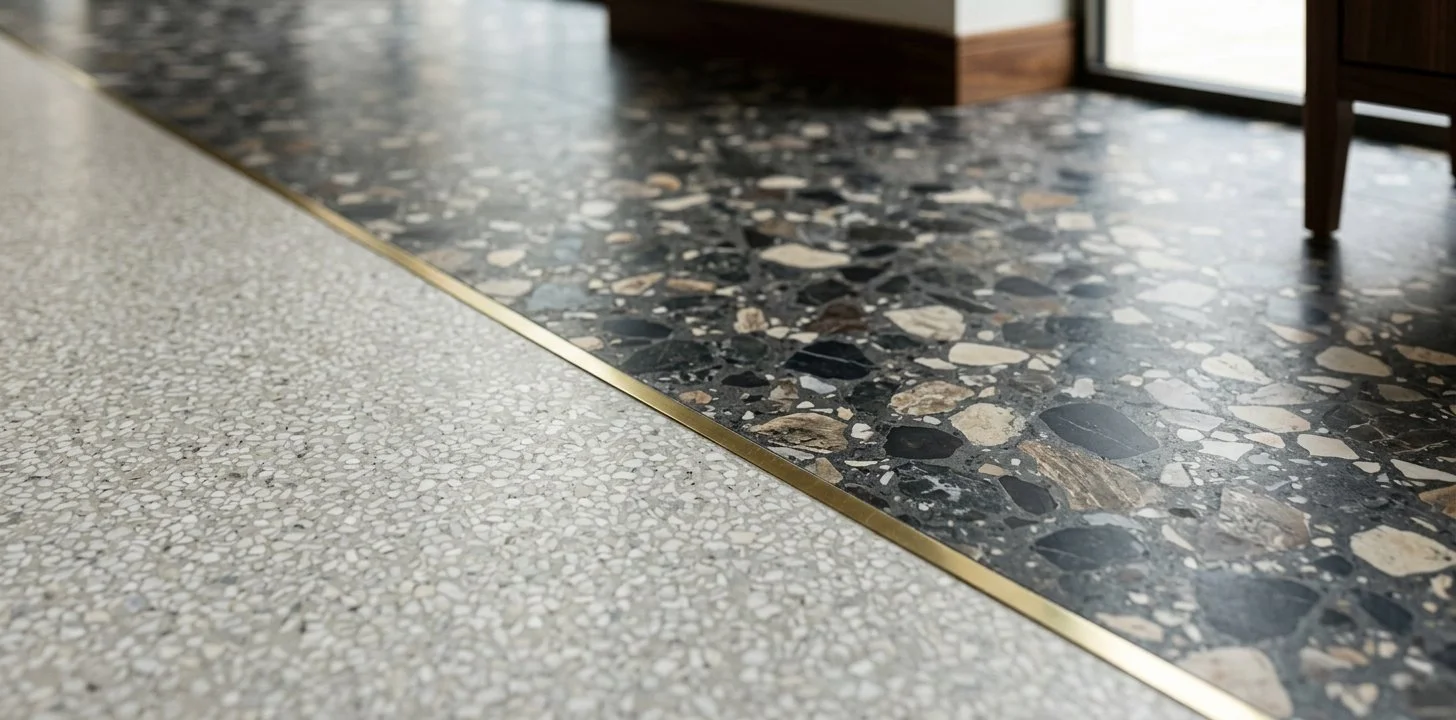
Close view of a terrazzo floor where a thin metal divider strip separates two different stone chip mixes.
The Strips Are There for the Cracks
Metal divider strips became available in the 1920s, according to the Terrazzo Tile and Marble Association of Canada. Their job was to contain cracking by giving the floor room to move, and the earliest strips are said to have been wood, according to the NTMA’s history of the strip. Architizer’s spec guide puts cement terrazzo at three to five foot squares between strips, while epoxy can run twenty or thirty feet. The NTMA’s Venetian sheet adds that the strips must match the height of the stones.
A strip has to land on every joint in the slab below, whatever the pattern says. A border drawn without the slab’s joint plan can end up with a zinc line crossing the room where nobody wanted one. Get that plan from the engineer or contractor before the pattern is final.
Start From the Slab Up
Before a single chip sample comes out, I’d want the slab’s joint plan and an answer on whether moisture comes up through it. On a timber floor, the engineer’s word on deflection matters more than either. Once those are known, the binder mostly chooses itself, and color becomes the easy part. Venice built in that order, timber first and stone last.