Leather on Walls and Furniture
A leather wall today is usually built from tiles or panels of real hide, flat or padded, glued or clipped to the wall. Spinneybeck, a leather house just outside Buffalo, New York, makes its wall tiles from full grain, vegetable tanned belting leather about three millimeters thick. The same hides go onto furniture, wrapped around a wood or steel frame and stitched by hand.
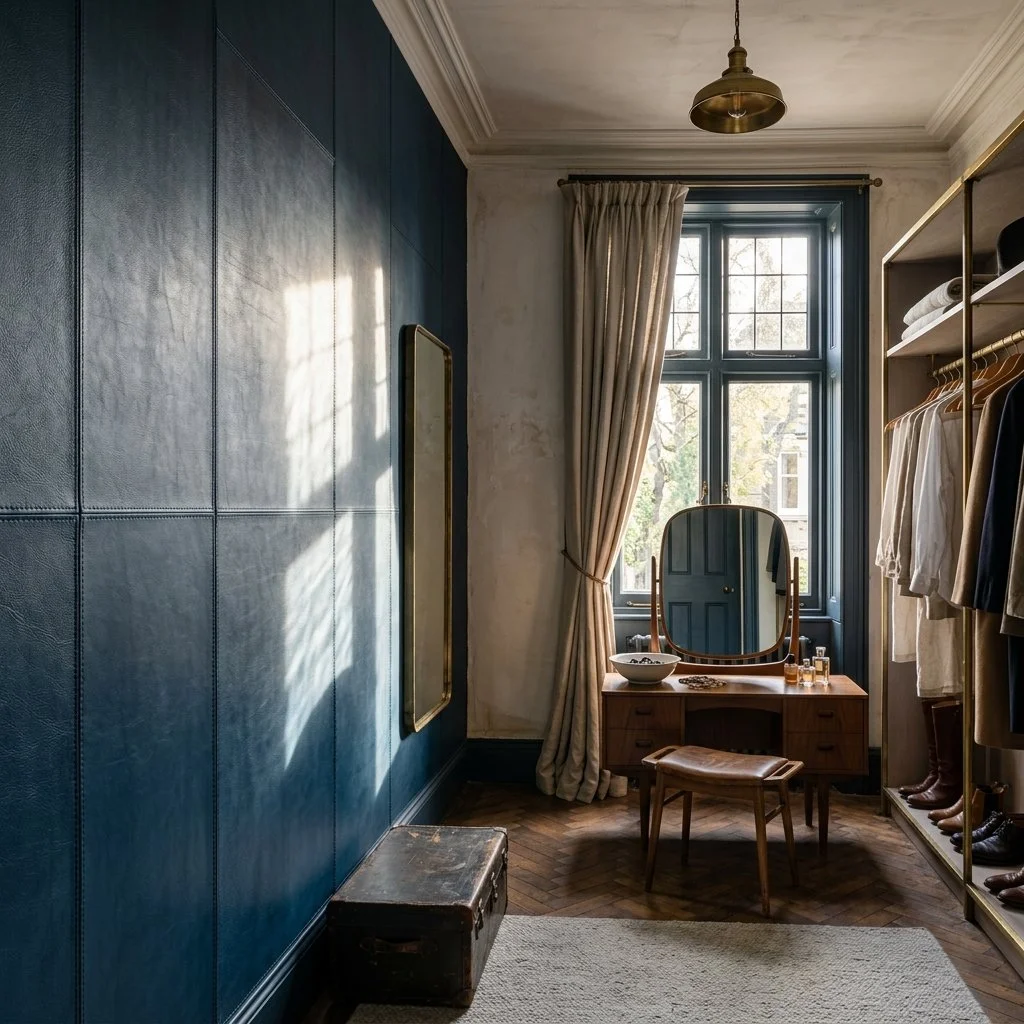
Flat ink blue leather wall panels in a dressing room, afternoon light falling across the seams.
Older Than Printed Wallpaper
Spain had leather walls long before printed wallpaper. The craft came from North Africa, and its Spanish name, guadamecí, points back to the Libyan town of Ghadames. Córdoba made it under Moorish rule, and by 1569 Venice had given its leatherworkers guild status inside the painters’ guild. The panels were embossed and silvered, sometimes painted. The antiques trade notes that the gold on old Spanish leather was usually silver leaf under a yellow varnish, since gold leaf was never laid on leather. Printed wallpaper arrived from around 1650 and undercut it on price, and leather walls held on mostly in very grand houses. In 2020, Arab News described José Carlos Villarejo García as the last artist working Córdoba’s Umayyad guadamecí technique, in a museum he founded there in 2006.
Some makers lay leather on floors too. Alma in London has made leather floor tiles, and Cuir au Carré has paired calf leather walls with buffalo leather floors. Freund, a leather surface maker, has marketed leather floors and ceilings to designer hotels.
Are Leather Wall Panels Fire Rated?
In commercial interiors, wall panels are tested under ASTM E84, the standard that measures how fast flame spreads across a surface. Class A is the top result. The rating can change from one leather to the next, even inside one supplier’s range. Garrett Leather, a US supplier, published Class A ratings for some of its leather lines and Class B for others, and asked designers to name the rating when they ordered. Where a rating matters, ask for the test report tied to the exact leather and color going on the wall.
Sunlight Changes a Leather Wall
A wall sits in the light all day, which a chair rarely does. Fritz Hansen’s care guide notes that dyed aniline leather fades in sunlight while natural, undyed aniline darkens. The European guide for upholstery leather, EN 13336, recommends a lightfastness of at least 3 on the blue wool scale for aniline, 4 for semi aniline, and 5 for pigmented leather. Supplier spec sheets often list that number. For a sunny wall, I’d ask for it before I’d ask for the color name.
Furniture Wrapped by a Saddler
Furniture Wrapped by a Saddler
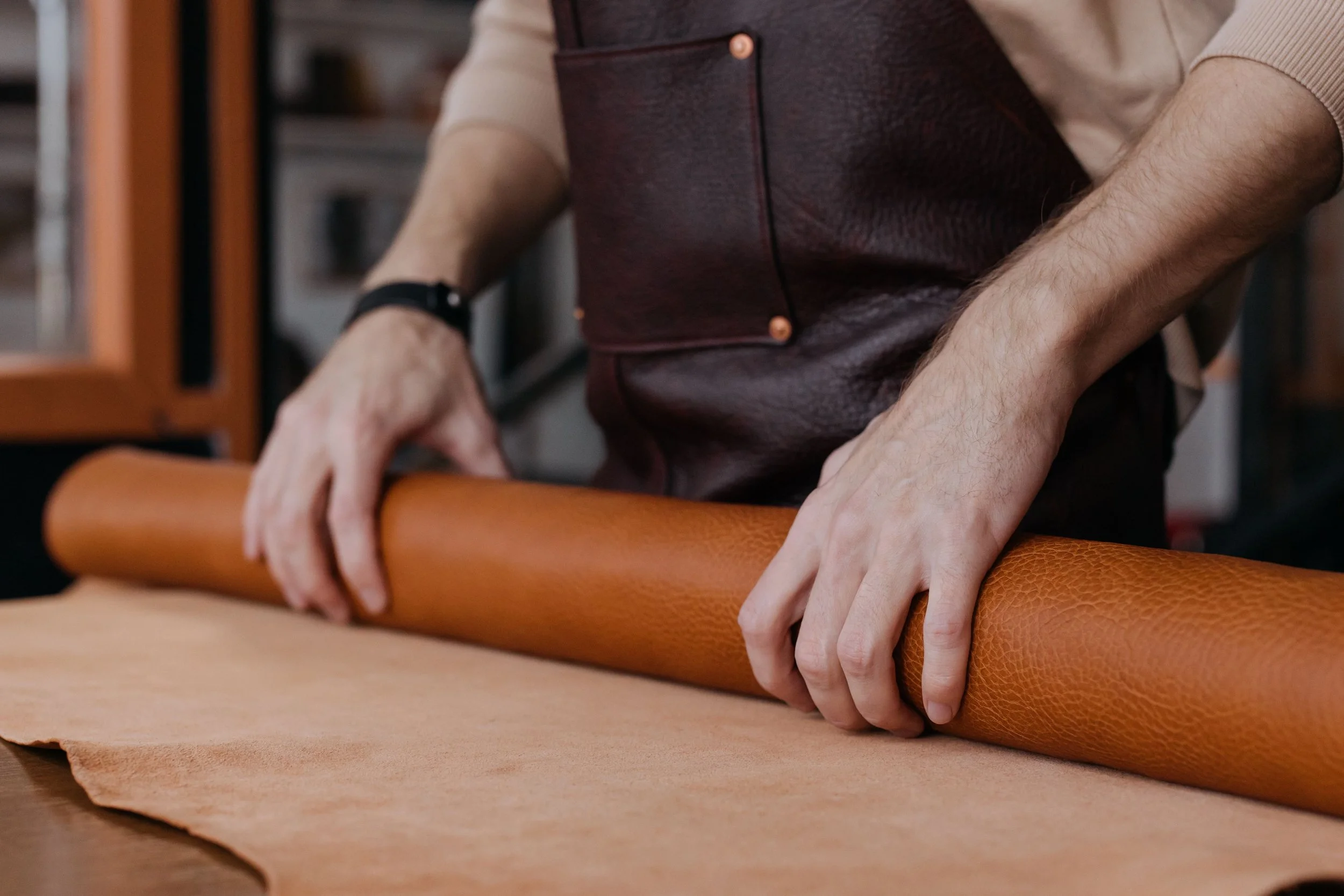
Wrapping furniture in leather is closer to tailoring than to upholstery. Soane Britain has its leather pieces made by a traditional saddler in Suffolk, who chooses the hides for each design and wraps the wood or metal frame himself. He stitches the seams by hand and burnishes the edges. The pairing of designer and craftsman goes back at least to Jean-Michel Frank, who worked with the cabinetmaker Adolphe Chanaux from 1929. Their desk from around 1930 has a leather top and drawers covered in leather on a lacquered steel frame. A wrapped piece needs both trades, someone who builds the frame and someone who knows hide.
Start With the Hide
For a wall, the path runs through a leather house with an architectural line, one that sells panels by the square foot and can send the fire report along with the sample. For a wrapped desk or bed, it runs through a cabinetmaker who works with a saddler, and the saddler should see the hide before anyone cuts it. Either way, ask where the hides come from. Cattle hide is a byproduct of beef and dairy, historically worth 6 to 8 percent of the animal’s value by the US leather trade council’s figures. A supplier who can name the tannery and the country of origin knows the material all the way back.