What a Lighting Designer Draws
An electrician's plan shows where the power goes. A lighting designer's plan shows where the light lands and exactly what puts it there. Both are drawn over the same floor plan, and on a custom house the designer often sees the first one and has to decide whether the second is worth paying for. I wanted to know what actually changes on paper. So I went looking for the documents themselves instead of the usual line about one trade being creative and the other technical.
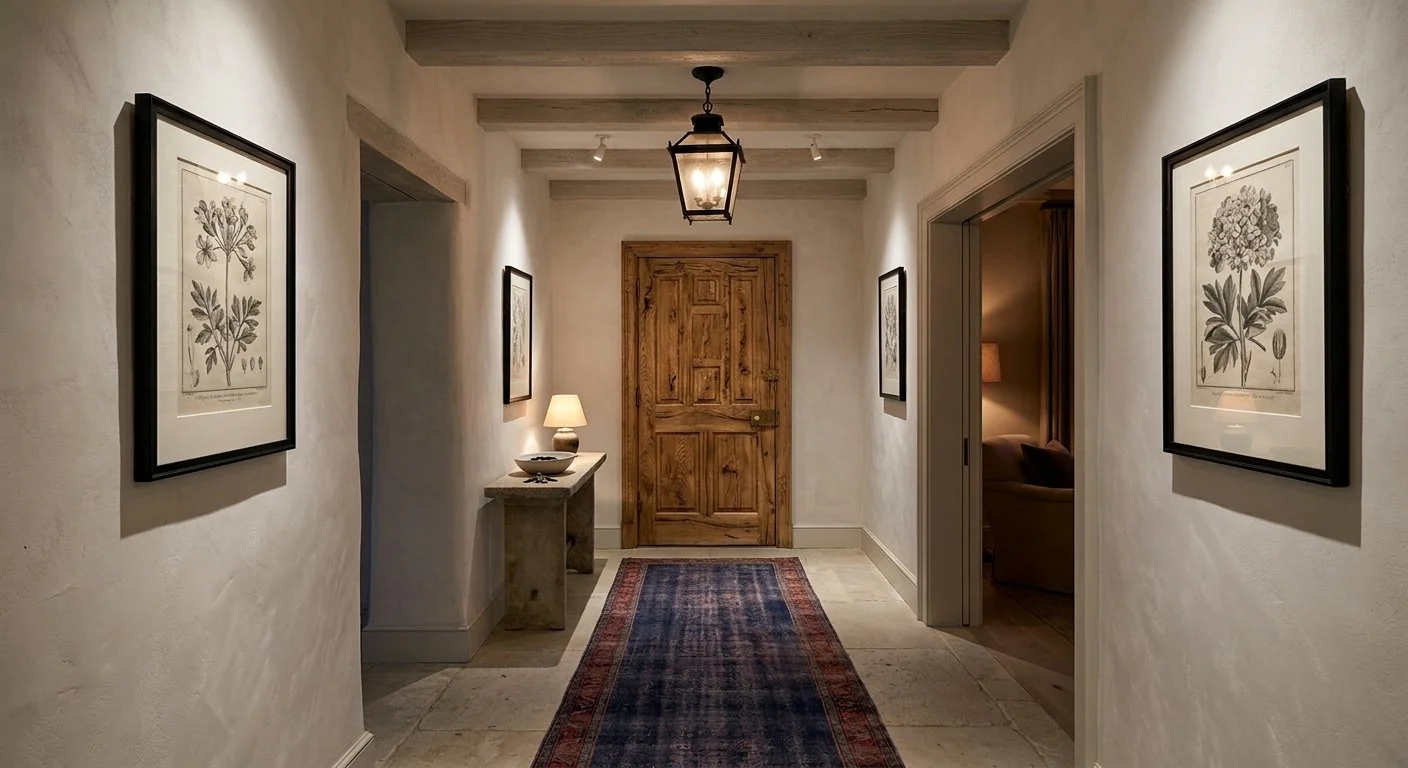
A hallway in a restored heritage home with limewashed plaster walls, exposed ceiling beams, a vintage runner rug, and a rustic wooden front door centered at the far end.
What Does an Electrician's Lighting Plan Show?
An electrician's plan marks the outlets and switches on the floor plan, all wired to code. The National Electrical Code asks for surprisingly little: one lighting outlet with a wall control in every habitable room, and outside the kitchen and bath, a switched receptacle can stand in for it. A living room can meet code with a lamp plugged into the wall. The electrician owns the wiring and the electrical loads, which is real work, and nothing in the code asks for more.
The Documents a Lighting Designer Delivers
The core drawing is a lighting plan laid over the architectural blueprints. It marks the exact location and mounting of every fixture, along with its circuit. That plan has to agree with the reflected ceiling plan, which carries everything else on the ceiling, the air diffusers and smoke detectors included. Coordination is how a row of downlights ends up centered on a beam line instead of pushed off it to clear a vent nobody planned around.
Every distinct fixture gets a type label, and those labels lead to the luminaire schedule, the full list written for the electrician and contractor. The schedule is also where color temperature gets held at one number across every fixture type, so the downlights and the picture light read as the same warm white.
Then come the calculations. The IES residential recommendations put general kitchen lighting at 20 to 50 footcandles and the surfaces where food gets prepared at 50 to 100. A lighting designer checks the plan against targets like these before anything is ordered. Newer AI tools can render a convincing picture of a lighting effect with no photometric file or CAD drawing behind it, which is fine for showing a client a mood and no substitute for the math.
One piece of advice from veteran lighting designer Peter Romaniello stuck with me. If an architect hands over only a reflected ceiling plan, he says to ask right away for elevations, sections, and the floor plan, and possibly the furniture plan too. Light gets aimed at walls and tables, and neither appears on a ceiling drawing.
Where the Scenes Get Written Down
The electrician's plan shows a keypad as a symbol on a wall. The lighting designer writes down what each button does. That document is the control narrative, and it tells the rest of the team how the system should behave and which presets the house expects. The IES keeps it firmly separate from the sequence of operations, the detailed account of how each control responds.
In a house with a Dinner button in the dining room and a Night button by the bed, the narrative is where someone decides what those words mean. Dinner might mean the table at full brightness with the kitchen behind it dimmed low. Night might mean the hallway glowing just enough to reach the bath. The warmer evening scenes that support sleep get set here too.
Where Substitutions Happen
A symbol labeled pendant can be filled by any pendant. A schedule line naming the studio and the exact model is much harder to swap. In one trade discussion of independent practice, a lighting designer described the projects that go wrong. The contractor swapped in inferior products, or installers who didn't know the products put them in incorrectly. That designer's answer was to supply and install the fixtures personally, which is its own argument and leads straight to how a lighting designer gets paid. This is the part I care about most, because it decides whether a maker's work survives the job. For a pendant blown by hand in a small studio, that schedule line is what protects it from a lookalike.
Ask How the Lighting Designer Is Paid
When the International Association of Lighting Designers formed in 1969, its founders barred members from selling lighting products, so a fixture choice couldn't be bent by a markup. In 2024 the association changed its bylaws. Member firms can now earn royalties on product design and profit on procurement. Critics worry that even a disclosed royalty arrangement could tilt a design decision away from the client's interest. Neither business model is wrong. A designer bringing one onto a project should still ask plainly whether the fee comes from the client alone or partly from the fixtures being specified.
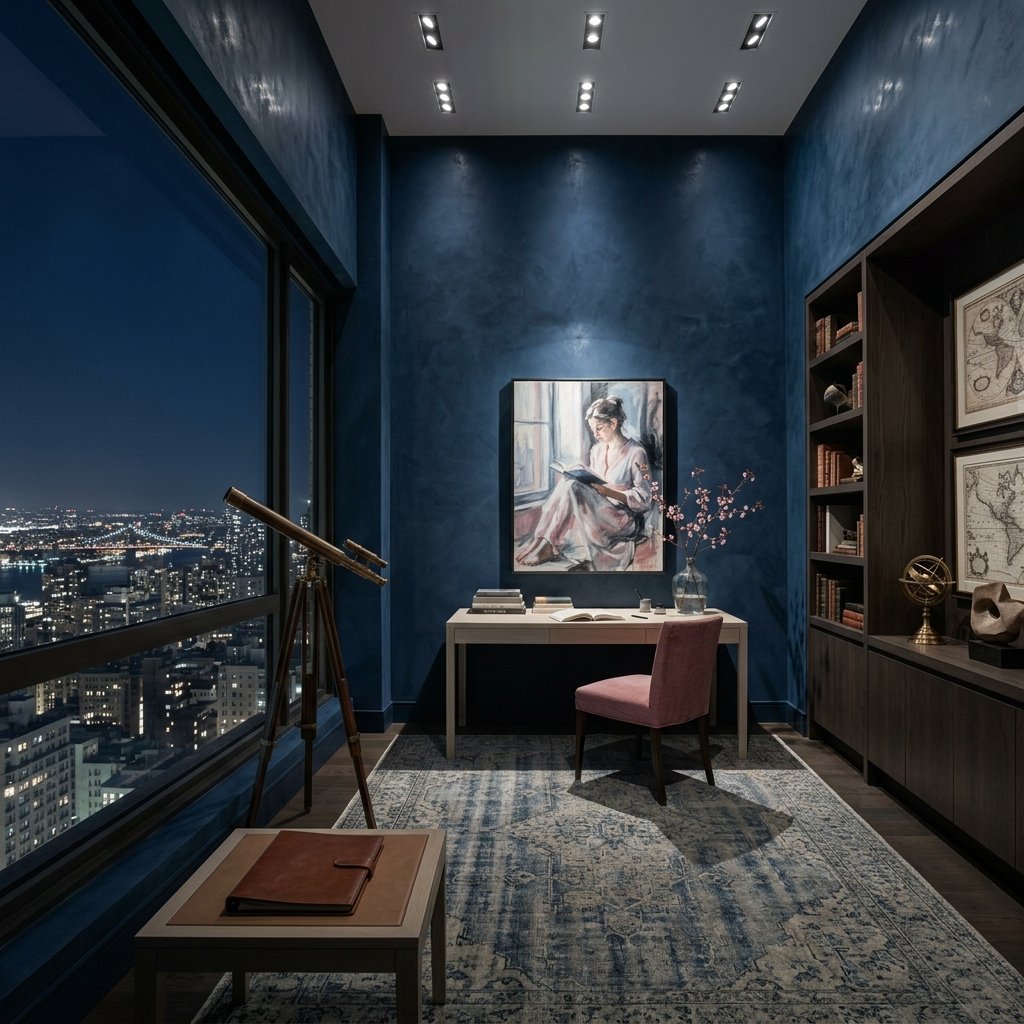
Study featuring ink blue limewash walls, a pale oak desk lit by a spotlight beneath a painting, and a faded rose linen desk chair.
The Visit After Dark
Adjustable downlights are built to be aimed precisely, even after installation. Lighting meant to be seen at night is easiest to judge at night, once daylight stops competing with it. An electrician's work is finished when every fixture turns on. Aiming each one at the painting or the stone wall it was drawn for is a design decision. It's worth writing an aiming visit into the lighting designer's contract before the job starts instead of hoping for one at the end.
The Electrician Builds What Gets Drawn
An electrician will build what's on the page, and build it safely. The real difference between the two plans is how much is on that page. A plan with switch symbols and a code minimum gives every room light. A plan with a luminaire schedule and a control narrative behind it gives a house where the light was decided room by room before the first fixture went up. Most of what a client ends up loving about a house at night was settled on paper months earlier.