A Murano pendant is a light whose glass was blown in a furnace on Murano, the island in the Venetian lagoon. A good order for one names the glass technique in Italian and the furnace that blew it.
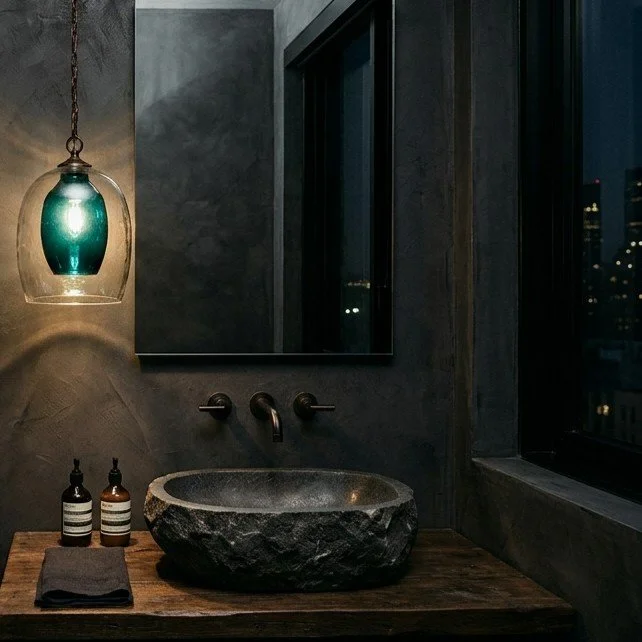
A blown glass pendant with a teal core inside clear glass over a stone sink in a powder room.
Free Blown or Mold Blown
“Mouth blown” can mean glass shaped freely in the air or glass blown into a mold, and the order should say which. The Metropolitan Museum of Art notes that Roman mold blown storage jars came out uniform in size, shape and volume, and the same logic applies to a set that has to match. Ask for the size range the furnace expects across the set either way. The Met also notes that a mold lasted only until its decoration wore or it broke, so for a set that may need a reorder later, ask how many more pieces the mold can make and whether a new mold would match.
How Do You Know Murano Glass Is Real?
Murano has a mark of origin, Vetro Artistico Murano, set up under a Veneto regional law in 1994 and managed by the Promovetro consortium. Lighting is among the products it covers. Firms are authorized by the Region after inspection, and the label carries the firm’s code. Since 2016 the label has also carried a serial number and a scannable code for the individual piece.
The Region’s list of licensed firms, dated March 2025, did not include Venini or Salviati, two of the island’s best known houses. Both have marked their glass under their own names, Venini with an acid etched stamp on the base, according to Appraisily, an appraisal service, and Salviati with signatures, stamps and labels over the decades, according to the collectors’ reference 20th Century Glass. A missing regional label proves nothing by itself. On a lighting order, put the furnace’s name on the invoice, and use the Region’s list as a directory of furnaces that have accepted its inspection.
The Technique Names to Write on the Order
The Met describes sommerso, Italian for “submerged,” as colored glass coated with clear glass. Its example is a piece Carlo Scarpa designed for Venini around 1934, with gold leaf held in a thick clear layer over a colored base.
The Toledo Museum of Art credits pulegoso to Napoleone Martinuzzi, who developed it in the late 1920s while he was Venini’s artistic director, by adding substances such as bicarbonate of soda or gasoline to the melt. The bubbles leave the glass partly opaque with an uneven surface, so a pulegoso shade diffuses the light. Incalmo demands precision, the Corning Museum of Glass defines it as fusing two or more blown pieces into one, with edges that have to meet at exactly the same diameter, so raise it early when asking for a quote.
The Color Is Made in the Furnace
Much of the color in Murano glass is made at the furnace, in the molten glass itself or in colored layers like the sommerso core. The Museum of Fine Arts, Boston’s materials database notes that gold ruby glass, colored with colloidal gold, changes shade with the temperature at which the glass is worked. A color chip can’t stand in for the glass, then. Approve a blown sample, and ask the furnace to keep it as the color standard for production.
Who Makes a Custom Murano Pendant
At Venice Glass Week in 2026, twelve chandeliers paired designers and artists with Murano glassmakers, among them Norman Foster with Salviati and Bethan Laura Wood with Gambaro & Tagliapietra. A custom pendant can follow the same split, the designer brings a dimensioned drawing, and a named furnace makes it.
Among the firms on the Region’s list is Signoretto Lampadari, a family run chandelier maker on Murano that customizes pieces to each client’s needs, according to its profile on Venice Original, a Venetian artisan sales site.
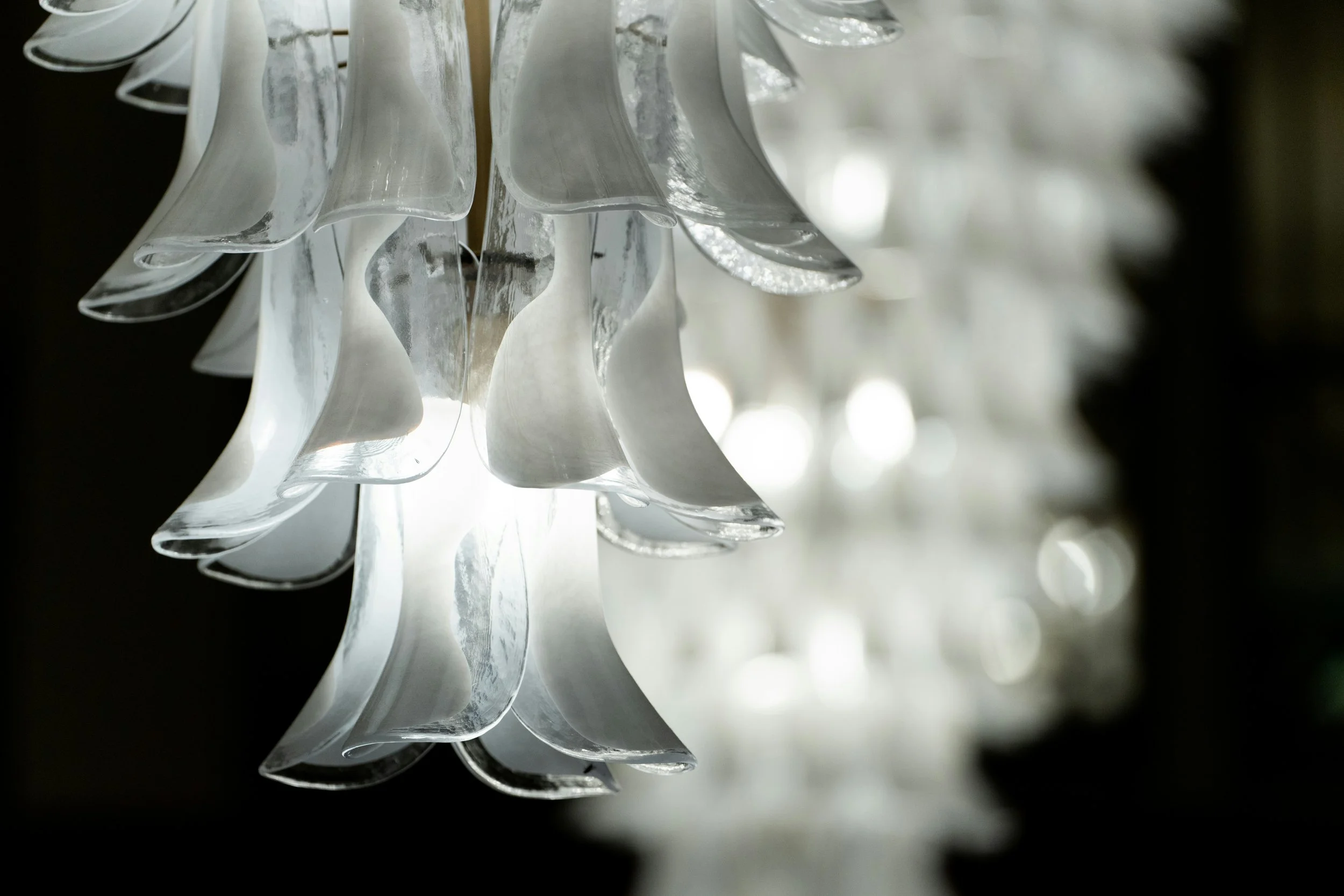
Close view of layered blown glass.
What the Code Requires
The U.S. National Electrical Code requires light fixtures to be listed by a Nationally Recognized Testing Laboratory such as UL, Intertek (ETL) or CSA, so ask whether the finished fixture will carry a listing and get the answer on paper before the deposit. The code also requires a fixture over 50 pounds to have its own support unless the ceiling box is listed and marked for that weight, so get the finished weight from the furnace before the ceiling is framed.
Keep the Paper With the Glass
Hand the invoice and the label’s code, if the piece has one, to the client at the close of the job. They are what a future owner or restorer will have to go on.
*Any Murano furnaces that make lighting can reach me through the contact page.