Friday, France’s Brigade Protocol
French kitchens are defined by restraint, rhythm, and respect for process. This guide explores how culinary tradition influences layout, tools, and everyday function, where elegance is found in practicality rather than decoration.
Most kitchens are where the week’s exhaustion meets domestic labor, resulting in "The Friday Night Frantic." But there is a secret to bypassing it. In Paris, the kitchen follows the Brigade de Cuisine, a system most think is only for restaurants, but is actually the most effective way to reclaim a personal Friday. This is the Culinary Pivot, a rhythmic sequence that silences the outside world and turns preparation into your ultimate engine of focus.
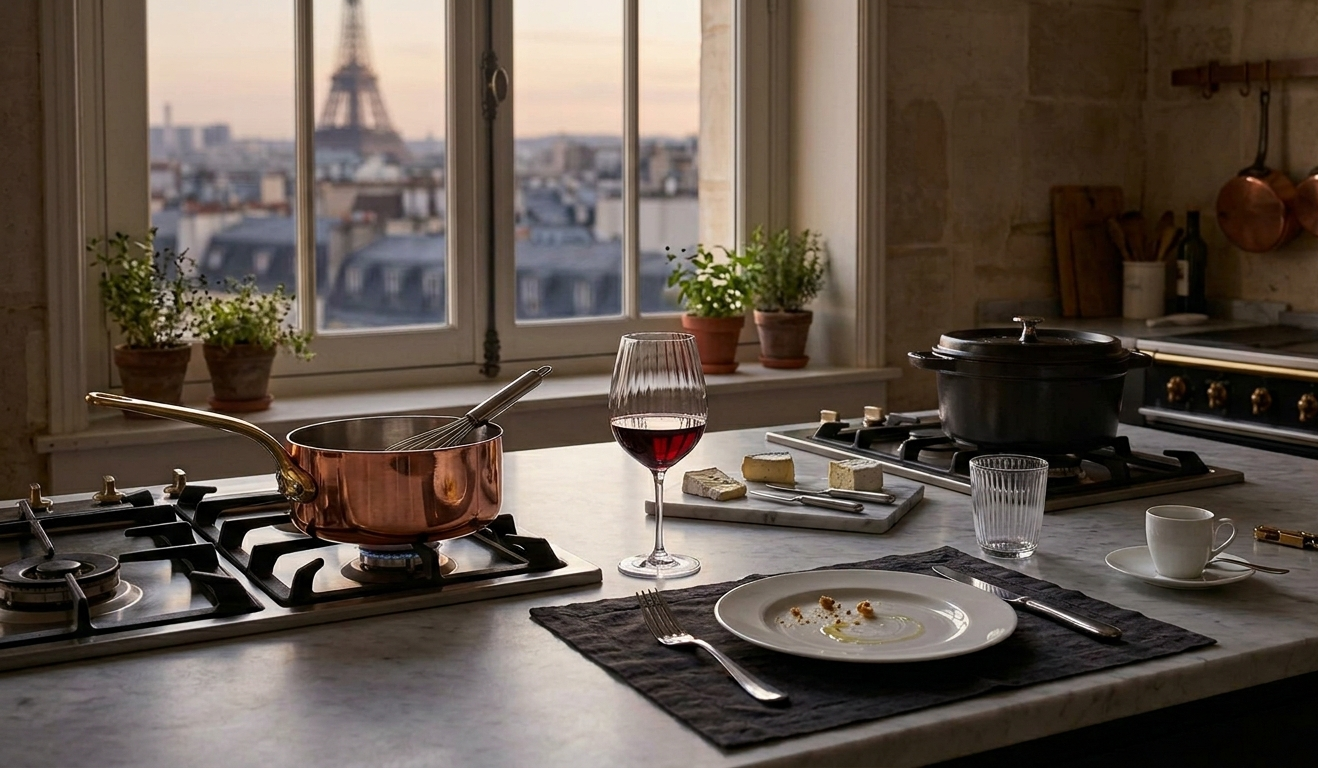
Marble countertop holds a polished copper saucier on a gas range, a ribbed wine glass, a marble cheese board, and a place setting with a porcelain espresso cup.
The Architecture of Authority: A Quiet Shift
To master the Friday ritual, you don’t need a larger kitchen, you need the Brigade as a mental framework.
The Station Logic: Assign dedicated tools to specific tasks. The Brigade isn't about stress, it’s about Flow.
The Result: It ensures every transition, from the first pour to the final espresso, is executed at the frequency of the evening, silencing the "Frantic" before it begins.
The Saucier: The Hidden Advantage
If there is a secret to French flavor, it’s not the recipe, it’s the mechanical advantage of high conductance copper.
The Ritual: Whether for a butter heavy emulsion or a wine dark reduction, the Copper Saucier is your silent partner. Unlike thin walled steel that causes localized hot spots, copper distributes heat evenly, allowing you to adjust the temperature in real time.
The Acoustic: Listen for the "Glide", the smooth, drag free sound of a whisk against lined copper. That sound is your signal, you are off the clock and under your own command.
The Seven Tiers: A Protocol of Movement
Parisian discipline requires a strict protocol of layers. We don't just eat, we transition through a landscape of sensations that force a deliberate, unhurried pace:
The Apéritif: The evening begins with the sound of the pour. It is a moment of crisp clarity that signals the work is done.
The Starter: Focus is directed entirely to texture. The weight of the steel in your hand serves as an anchor, drawing your attention away from the digital and onto the plate.
The Main: The heat remains constant, allowing for a slow, deep pace. The tools are engineered so you never have to fight the protein, the knife does the work for you. This steady foundation is the perfect setup to transition into the high output searing required in Thursday Night’s Seoul Performance.
The Palate Cleanser: A pallet reset. The cool weight of crystal against the palm creates a necessary break in the tempo.
The Fromage: The transition to marble. This is about respecting the integrity of the dairy, no crushing, no smearing, just clean, sharp cuts.
The Dessert: The reward. It is the satisfying "snap" of a crust that marks the final transition toward the lounge.
The Cafe: The final, silent stir. The weight of the porcelain is the last tactile signal that the sequence is complete.
The Kit
The Copper Saucier: 2.5mm high conductance copper for the ultimate thermal "Glide."
Ribbed Wine Suite: Lightweight, high clarity glasses for ritualized aeration.
The De Gaulle Opener: The iconic brass "arms up" corkscrew for the wine ritual.
The Full Cycle Cutlery Set: Heavy gauge stainless steel with balanced handles for every tier.
The Fromage Suite: Marble boards and a 3-piece knife set (wire, spreader, point).
The Dutch Oven Anchor: Heavy weight enameled cast iron for high thermal mass cooking.
The Espresso Suite: Heavy wall porcelain cups and weighted, petite after dinner spoons.
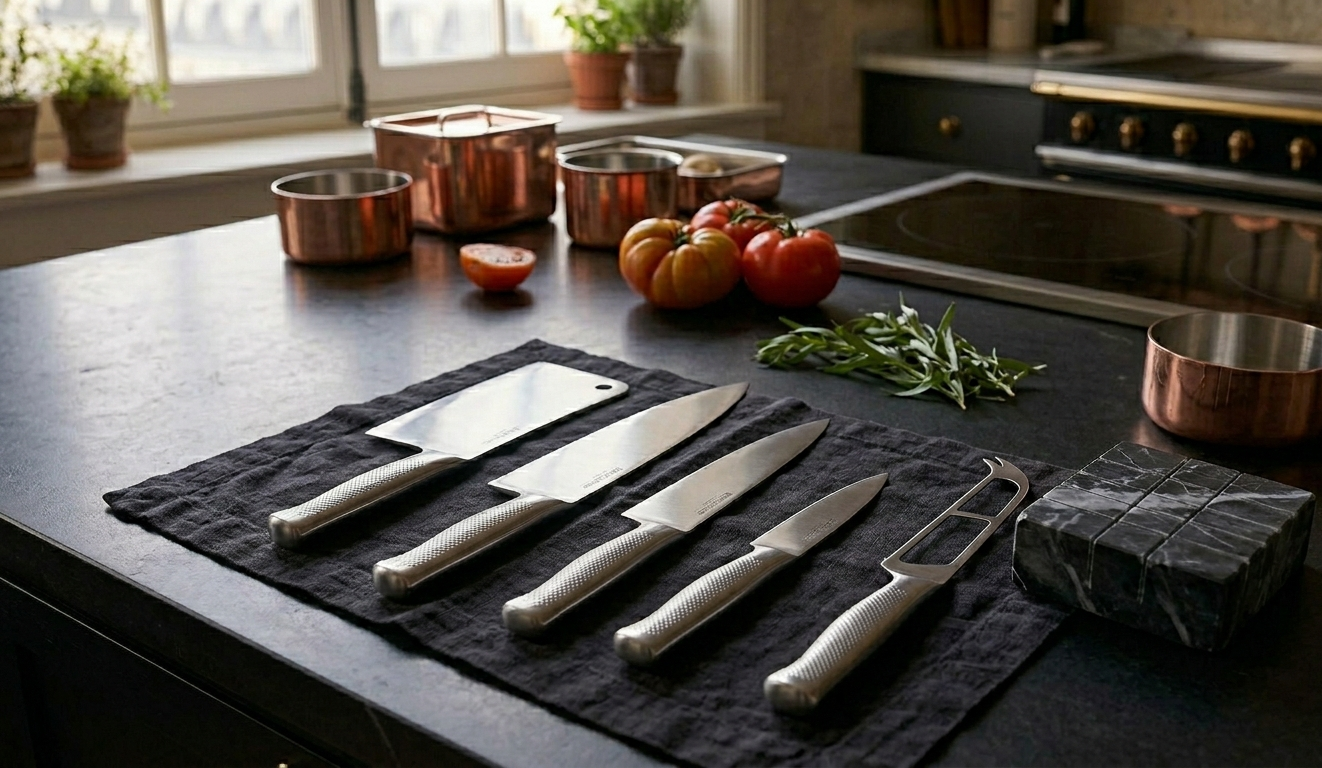
Kitchen setting featuring a set of premium, heavy gauge stainless steel kitchen knives laid out on a dark linen cloth.
A Legacy of Intent
France teaches us that luxury is not an indulgence, it is a sequence. By replacing the chaos of the week with the disciplined layers of the Brigade, we reclaim Friday as a highvfrequency event. From the first reduction to the final espresso, this is the precision of the self.
Saturday, The Nordic Standard
Scandinavian kitchens prioritize clarity, light, and function over excess. This journal explores how Nordic principles shape minimalist dining spaces built from natural materials, soft tones, and intentional simplicity.
In the North, the transition from Saturday afternoon to evening is not marked by a clock, it is marked by the deliberate extinguishing of glare. When the sun retreats, the Nordic home undergoes a physical transformation, shifting away from the high contrast light of the day into a deep, amber toned rest. We call this Visual Silence, a process of filtering the environment until the space itself allows the nervous system to stop scanning and start settling.
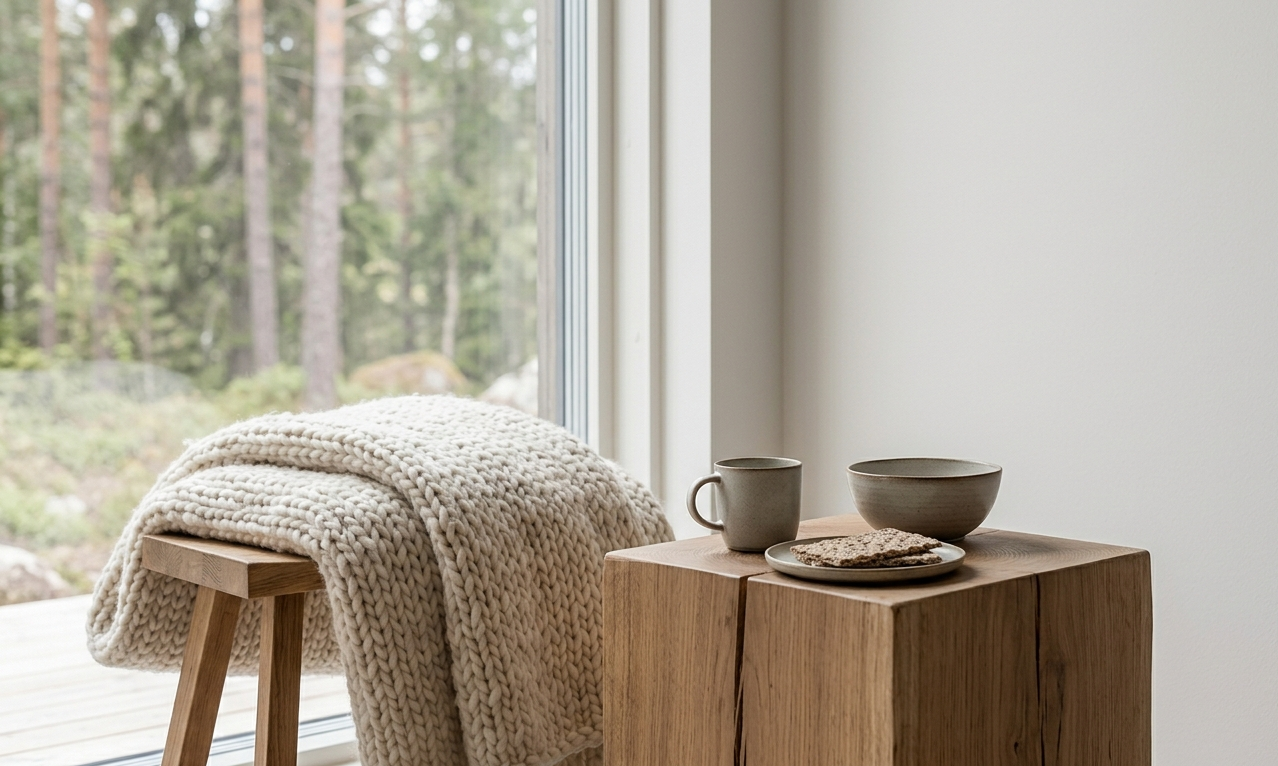
Woolen throw blanket, with ceramic dishes and bread atop a solid wood side table.
The Physics of Warmth: The Amber Tier
Overhead lighting often works against the body's natural rhythms, keeping the brain in a state of alertness. To properly shift the room's frequency, one must use Heavy Weight Brass Taper Holders.
What they are: These are forged from solid brass, providing a heavy, grounded base. That weight is functional, it creates an unbreakable "anchor" for the flame, preventing the visual instability of a wobbling candle.
The Ritual: Pair these with hand dipped beeswax tapers. Unlike petroleum based paraffin that burns with a harsh, soot heavy flicker, pure beeswax burns with a slow, steady, and warm glow that matches the body’s desire for rest. By positioning this light at eye level, you mimic the warmth of a hearth, signaling to the brain that the day is complete and it is time to produce melatonin.
The Smörgåsbord: A Landscape of Layers
The Saturday table is an evolving architecture of Assembled Abundance. To maintain the communal rhythm, the meal is served in tactical layers. While the preparation for this assembly relies on the rigorous, high efficiency structure of the Friday, France’s Brigade Protocol to organize the labor, the serving itself is designed to slow the pace down.
The Foundation: Knäckebröd and cultured butter. To keep this portion grounded, use a Raw Grain Wood Board, the only surface capable of absorbing candle glow without the "visual noise" of reflective, sealed finishes.
The Cold Tier: Gravlax served on Chilled Matte Ceramic Platters. Gravlax is a traditional Nordic curing method where salmon is buried in a mixture of salt, sugar, and fresh dill. Over several days, this process breaks down the muscle fibers, resulting in a dense, silky texture. Chilling the stoneware is essential to maintaining the crispness of this delicacy, while the matte finish acts as a necessary filter to eliminate the distracting glare found on standard, mass produced dinnerware.
The Warm Tier: Classic meatballs in Deep Dish Stoneware. These serve as thermal batteries for the table, without the mass of stoneware, the meat loses temperature too quickly, forcing a "hurried" eating pace that ruins the evening’s flow.
The Hydration Cycle: Every Nordic table utilizes a dual carafe system of still and carbonated water. These must be paired with Heavy Bottomed Glassware, which acts as a lens to scatter the amber light, turning the act of hydration into a visual anchor.
The Fika After Glow: The Final Reset
The evening finds its completion in the transition to Fika.
Understanding Fika: Fika is not just a coffee break, it is a mandatory cultural reset. It is the practice of leaving the "doing" behind to prioritize the "being." It is the moment you stop navigating the demands of the world and start inhabiting your own space.
The Coffee Ritual: Serve strong, black coffee in Hand Thrown Ceramic Mugs. The deliberate density of the clay provides the tactile "anchor" needed to settle the hands.
The Sweet Infrastructure: Whether it’s cardamom buns or waffles, this final stage serves as a reward. It signals a physical shift from the structured dining table to the soft, unhurried space of the lounge, which is best anchored by a Heavy Knit Woolen Throw to finalize the acoustic and visual insulation of the room.
The Kit
The Low Profile Amber Lamp: A hand spun matte piece to ground the room’s light level.
Heavy Weight Brass Taper Holders: The essential counterweight to ensure flame stability.
The Matte Smörgåsbord Set: Specifically formulated for temperature retention and light absorption.
Raw Grain Oak Bread Boards: The only surface capable of neutralizing glare during bread service.
Heavy Bottomed Glass Carafes: Designed to stabilize and scatter candlelight refraction.
Hand Thrown Ceramic Mugs: High density vessels to ensure the heat duration of the Fika ritual.
The Woolen Anchor: A heavy knit throw, the final, acoustic layer of the lounge.
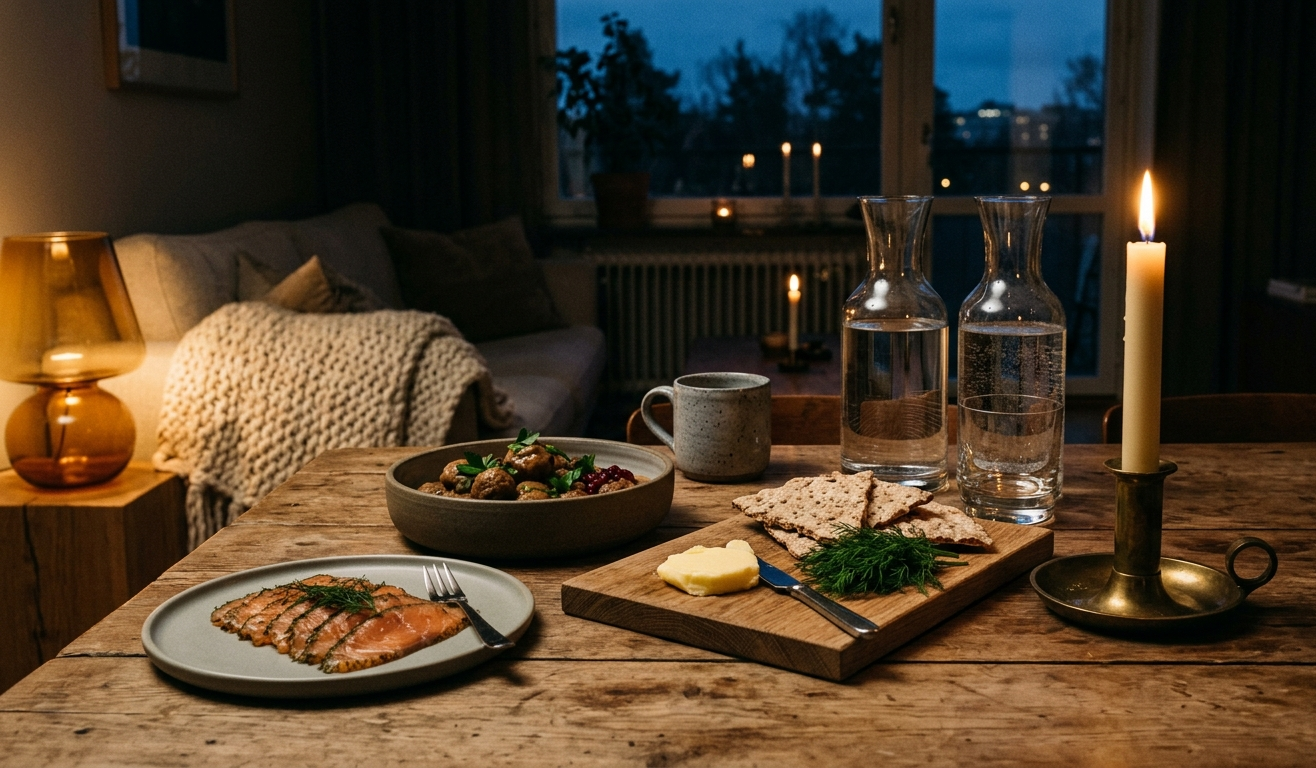
Nordic table setting with ceramic platers, wood bread board, water carafes, and a brass candle taper.
A Legacy of Intent
The North teaches us that peace is not found in the absence of things, but in the deliberate management of light and texture. By silencing the aggressive glare of the modern world and anchoring your evening in the honest weight of brass, stoneware, and wood, you transform your home into a high resonance sanctuary. This is the pulse of the Nordic Saturday, a life reclaimed through the steady, amber glow of intention.
Sunday Reset, The Cretan Table
Greek kitchens reflect a slower rhythm of living, where meals are shared and materials are natural. This journal entry explores how Mediterranean traditions shape rustic ceramics, olive wood tools, and linen textures within timeless coastal interiors.
Most modern homes are built for speed, leaving spaces that feel cold and disconnected. In the Cretan valley, the table is a source of strength. The Sunday Reset is the anchor for your nervous system, the moment the week begins and the chaos of the previous one is left behind. To reclaim your pace, build the infrastructure of a better meal.
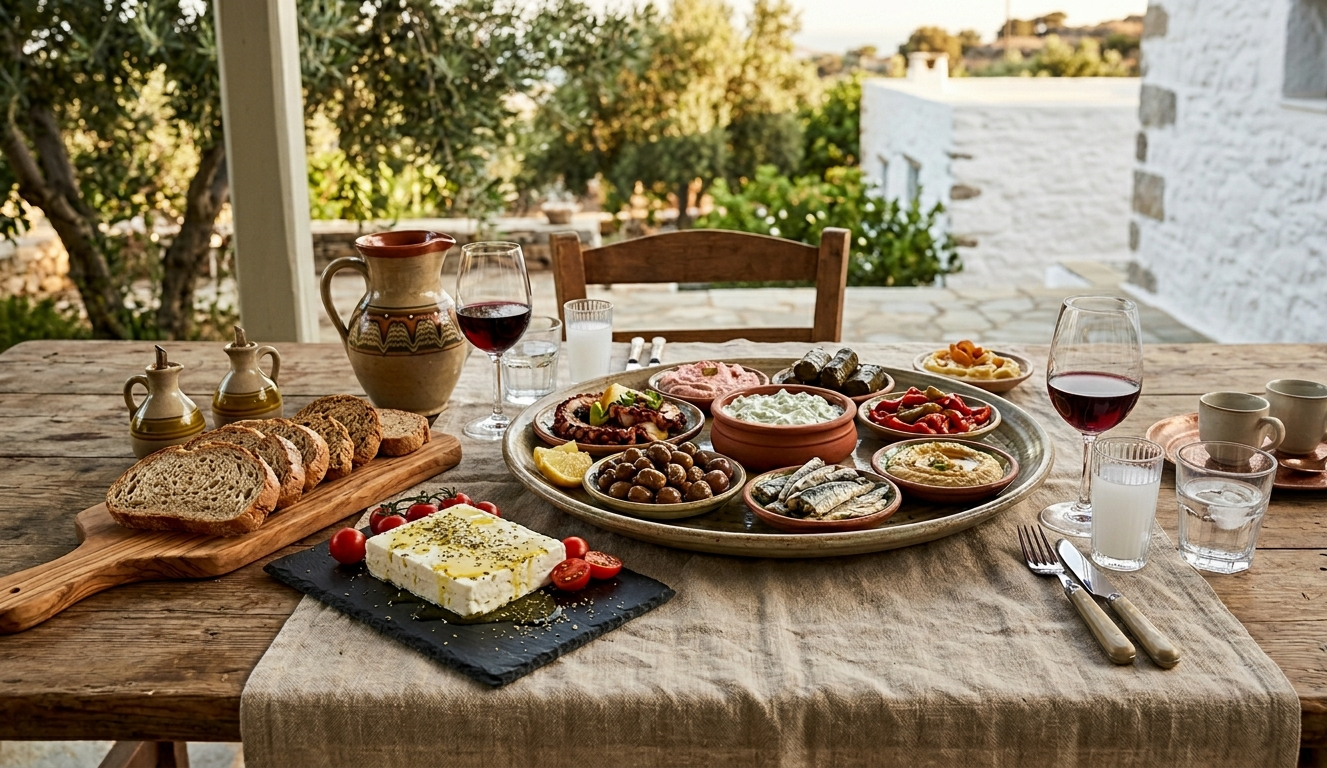
Rustic wooden dining table laden with a communal Greek meze feast, including a large central platter of small plates, a block of feta cheese on a slate board, sliced bread, a ceramic wine jug, and a glass of milky white ouzo.
The Landscape: The Meze Grid
A Greek table is built, not set. Instead of individual portions, you create a crowded, layered landscape of Meze, olives, charred octopus, and cultured dips.
The Problem: Separate plates create individual sections, forcing a subconscious rush to finish.
The Solution: The Grand Meze Platter. A massive, low profile ceramic disk that serves as the anchor for the table. It physically brings everyone together, encouraging a communal rhythm of reaching and passing. This emphasis on the communal hearth is a practice we explore further in the Monday Night: The Oaxacan Hearth ritual, where the focus shifts from the platter to the open fire.
The Acoustic: Managing the "Noise" of the Table
If dinner feels stressful, the table itself is likely too "loud." Stone, glass, and steel reflect sound, creating a high frequency buzz that keeps the nervous system on edge.
The Tool: Heavy Weight Flax.
The Result: A thick linen tablecloth is a sound absorber. When it sits between your cutlery and the wood, it kills the sharp clatter. It shifts the room from a frantic pace to a resonant, calm sanctuary.
The Spirit: Ouzo & The Louche Effect
We don't just pour a drink; we engineer a transition. Anise heavy spirits require a specific mechanical ritual.
The Ritual: Use ribbed glassware. When you add cold water to the clear spirit, the oils precipitate in a reaction known as the Louche Effect, turning the drink a milky, opalescent white.
The Geometry: The ridges on the glass act as prisms for this glow, while a secondary heavy bottomed water glass ensures a steady cycle of hydration. This transformation is the visual signal to the brain that the week is beginning with intention.
The Main Showpiece: Feta and Flame
The Feta Logic: Feta is served as a solid block drizzled in raw oil. Use a dedicated heavy stone board to signal that fat and salt are the foundation of the meal.
The Wine Infrastructure: Move away from glass bottles. Authentic Greek wine is served from ceramic jugs. These provide thermal insulation, keeping wine chilled while adding a grounded, historical weight to the pour.
The Bread Ritual: A long grain wood board for sourdough and barley rusks sits next to individual cruets. Dipping is the tactile work that keeps hands occupied during conversation.
The Main: Whether it is roast lamb or moussaka, use a deep dish stoneware baker, a thermal battery that keeps the protein warm at the center of the landscape for hours.
The Post Meal Reset: The Copper Briki
The ritual doesn't end when the plates are cleared. To transition into the evening's reflection, you need a way to mark the time.
The Tool: The Copper Briki.
The Ritual: You cannot rush Greek coffee. This long-handled pot is used to slowly foam coffee over a flame. The manual nature of the Briki forces a final slow down, signaling to your brain that the active portion of the day is over.
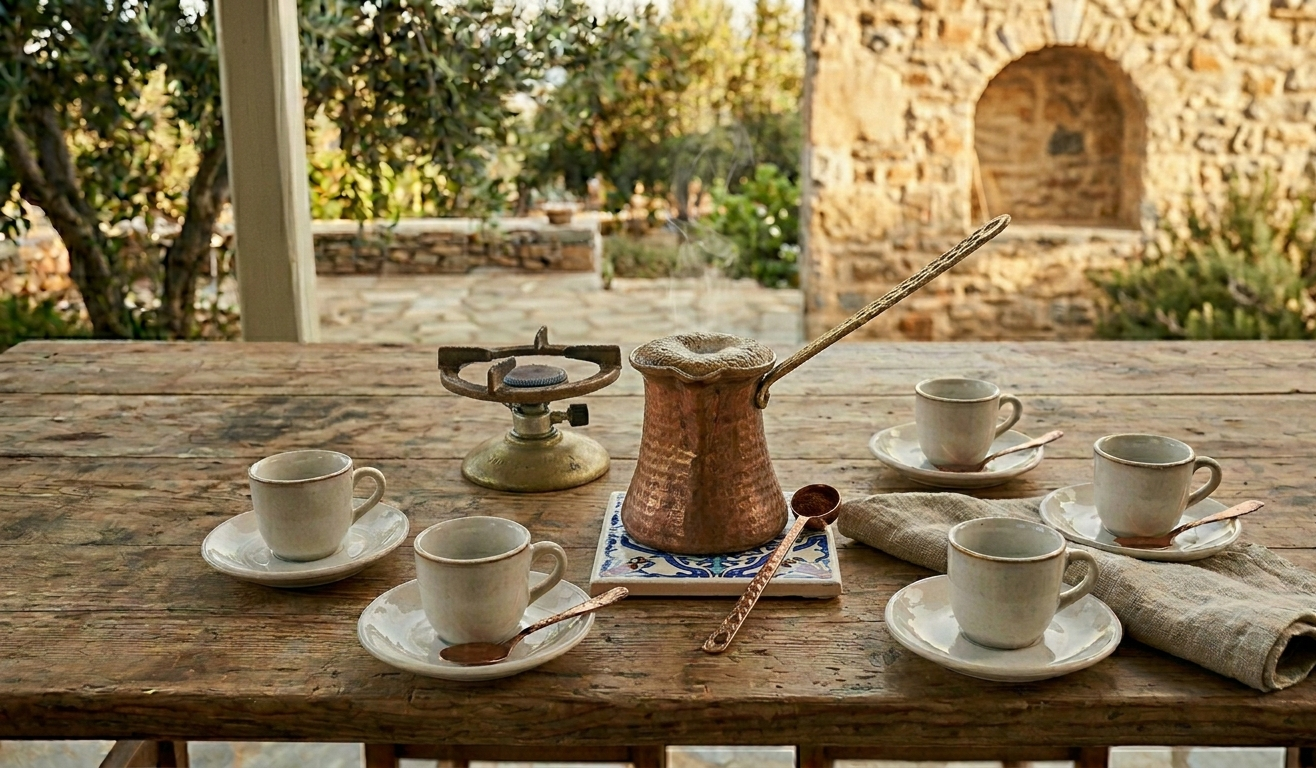
Long handle Greek coffee Briki pot. The pot sits on the table with small white ceramic demitasse cups and saucers waiting to be filled.
The Kit
The Grand Meze Platter: A ceramic stage for your small plate grid.
The Feta Stone: A heavy marble or slate slab for the oil soaked cheese block.
Ceramic Wine Jugs: Traditional vessels for thermal insulation and historical weight.
Ribbed Glassware & Water Tumblers: A paired set to manage the Ouzo ritual and hydration.
Individual Olive Oil Cruets: Small pitchers to ensure the sanctuary of each guest’s seat remains unbroken.
The Copper Briki: The long handled coffee pot for the post meal reset.
A Legacy of Intent
Your home is a living archive of how you choose to spend your time. By curating the weight of the stone, the grain of the wood, and the silence of the linen, you turn your space into a place of rest. These rituals are the backbone of a life lived with purpose.
The Home Hydro Flow
We obsess over furniture and light but ignore the water that sustains us. Learn how to treat hydrology as a vital nutrient for the home.
The Movement of the Interior
We spend weeks selecting the right stone for a kitchen island or the perfect grain for a floor, but we rarely discuss the material that actually sustains us. Water is the most intimate element of the home. It is what we drink, what we bathe in, and what we use to reset our internal clocks.
The Intuitive System treats the movement of water as a fundamental layer of the architecture, ensuring every drop is as refined as the space it flows through.
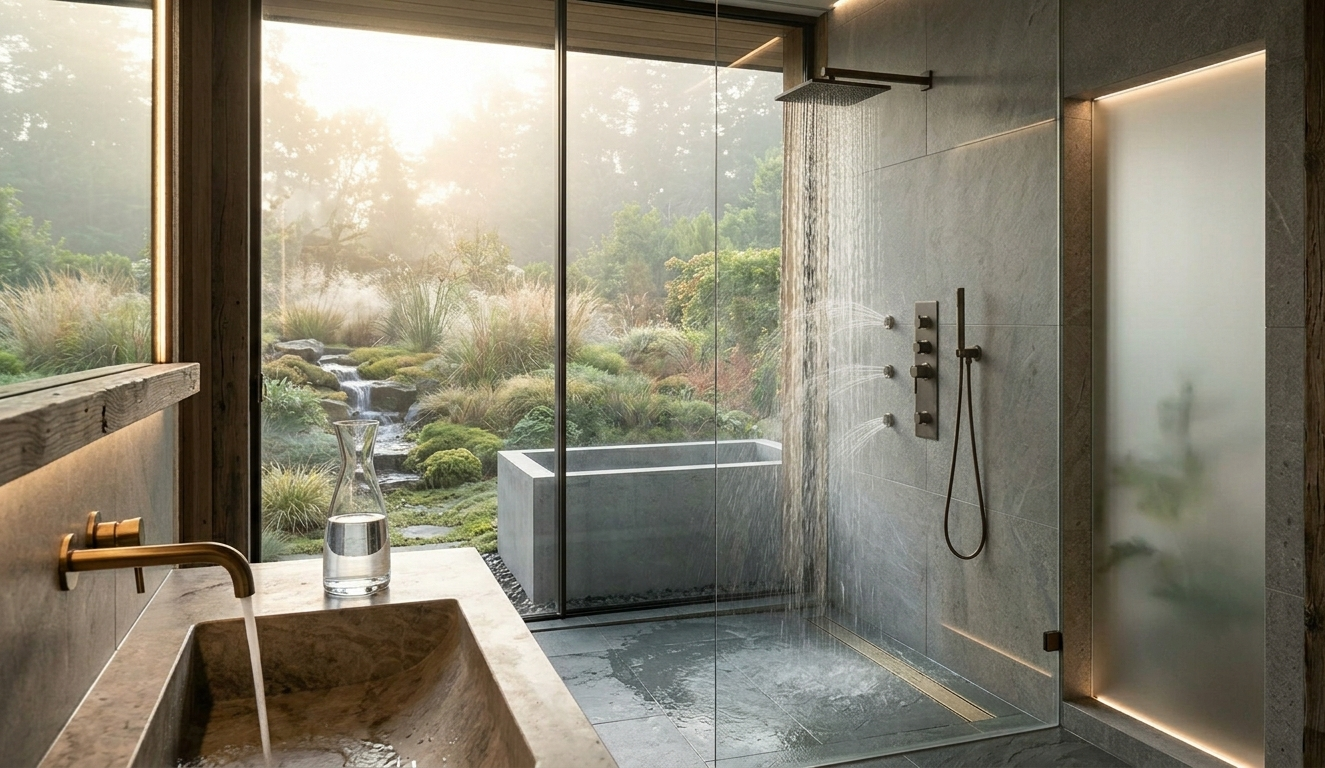
Integrated bathroom wet room, filtered water and a high flow multi jet shower.
The Morning: The Hydration Anchor
Your first interaction with the house shouldn't be a struggle, it should be a quiet, physical reset. We prioritize integrated filtration and remineralization modules to ensure that the water you start your day with is biologically active and free of the chemical profile of the city. By the time it reaches the fixtures in the kitchen or the primary suite, it has been stripped of the oxidative stress that usually accompanies unfiltered systems.
This quality extends to the shower experience where we prioritize high flow aeration and multi stage filtration heads. Standard city water often contains high levels of chlorine and heavy metals that strip the skin’s natural oils and damage the hair’s structural integrity. By utilizing vitamin C or KDF-55 filtration inserts, the house protects your skin from the drying effects of a morning shower, leaving the moisture barrier intact. This is the Hydration Anchor, a subtle but vital shift in how you begin your morning.
The Afternoon: The Thermal Recovery
As the day moves into its middle hours, the house becomes a tool for focus and recovery. Water is the most efficient way to shift the body’s state from high alert to calm. The standard includes precision controlled hydrotherapy and dedicated high flow systems. Whether you are using a custom cold plunge basin to sharpen your mental clarity or a mechanically managed thermal soak to release muscle tension, the home provides a mechanical reset. These systems work in the background, maintaining the exact temperature and pressure required for your recovery without a single manual adjustment.
The Evening: The Silent Reclamation
When the day ends, the house manages its resources with a quiet intelligence that never breaks the sanctuary of the night.
Seamless Management Through integrated leak sensing and automated shut off technology, the Digital Shadow monitors the plumbing to protect your interior finishes from the risk of silent damage.
The Cycle The water that supports your internal recovery also supports the landscape. In a truly disciplined system, excess is directed through automated subsurface irrigation to feed the garden and the perimeter.
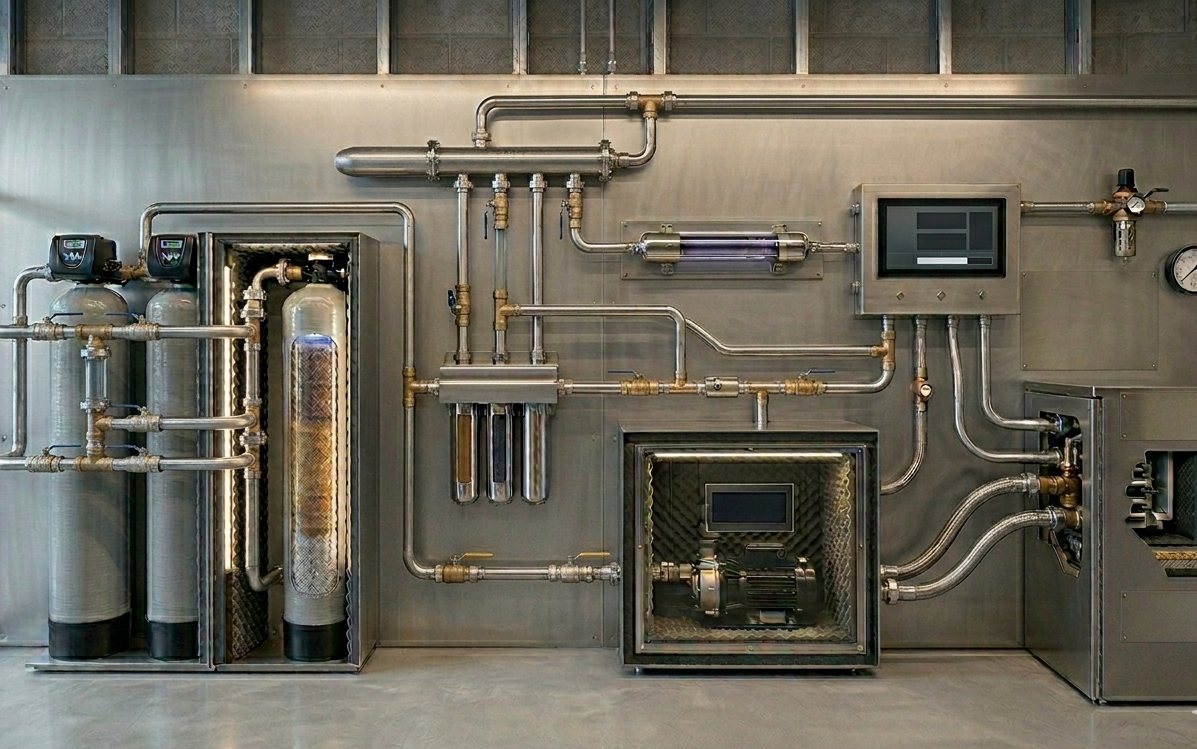
The Mechanical Silence All pumps and filtration hardware are housed in sound dampened enclosures, ensuring that the only sound you hear in the evening is the quiet of your own home. With your hydro systems fully optimized, you have achieved a complete cycle of environmental care, one that begins and ends with your well being, as we first outline in The Circadian Pulse.
Residential water filtration and remineralization system housed in a sound dampened utility room.
The Evening Standard
Water is the lifeblood of the property. When it is handled with the same discipline as the light and the air, the home becomes a truly integrated system for living.
The goal is to ensure that every drop is optimized for the person within the home.
The Luminous Boundary
A home does not begin at the front door. It begins at the property line. Learn how to use lighting to create a seamless transition and a sense of arrival at your home.
The Architecture of the Arrival
A home does not begin at the front door. It begins at the edge of the property. The driveway, the courtyard, and the garden are the first layers of your environment and they require the same level of intentionality as your interior.
Lighting the exterior is not about illumination for the sake of visibility. It is about a psychological transition. The Intuitive System uses the Luminous Boundary to define the home’s edge, creating a clear sense of arrival long before you step inside.
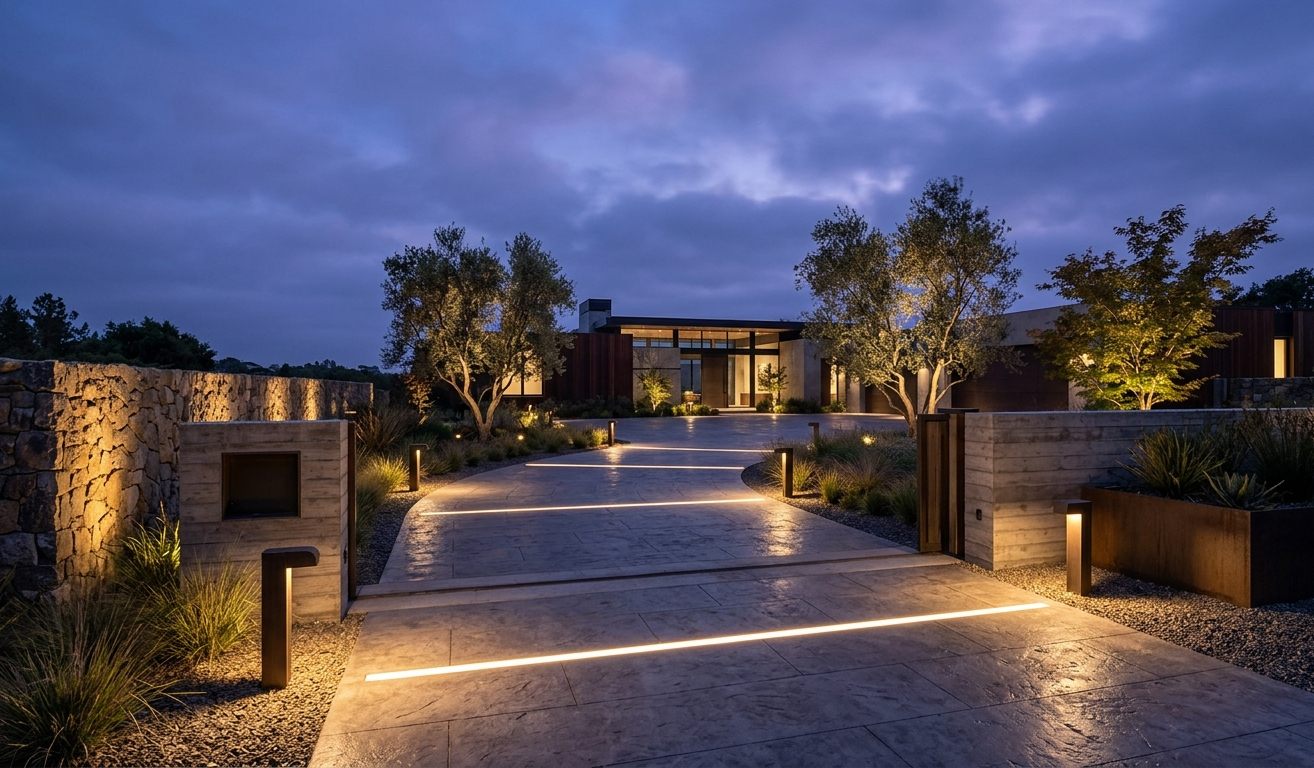
A home at twilight featuring a driveway illuminated by warm, recessed linear floor lights and bollards. An "Arrival Experience".
The Morning: The Guided Departure
As you leave the sanctuary of the home, the lighting should facilitate a smooth transition into the world. In the early hours, the focus is on clarity without glare. The priority is low level recessed path lighting and high output directional spots that graze the texture of stone and wood. By utilizing in grade linear lighting and shielded bollards, the driveway remains clear and easy to navigate while the light source stays below the eye line. This creates a "soft" boundary that feels expansive and intentional as you begin your day.
The Afternoon: The Architectural Presence
During the daylight hours, the "lighting" of the home is about the shadows and the physical hardware itself. The fixtures should not look like afterthoughts; they should look like part of the landscape. The standard includes hand cast bronze fixtures and solid stone pillars that house the hidden light sources. These materials age with the home, providing a sense of "Social Gravity" even when the lights are off. We prioritize high CRI LED modules within these fixtures so that as the sun begins to dip, the transition into the evening feels like a natural extension of the architecture rather than a digital "flip of a switch."
The Evening: The Invisible Welcome
The power of the boundary lies in its intelligence as you return to the sanctuary. A truly intuitive home prepares itself for your arrival without the need for manual switches or intrusive sensors.
Seamless Access Using low voltage control systems the house can trigger "Arrival" scenes that illuminate the path as you near the property.
The Adaptive State While you are away the "Digital Shadow" manages the exterior lighting to mimic natural human patterns, maintaining the "lived in" feel of the property.
The Material Connection All tech hubs and transformers are tucked into integrated weather rated enclosures that disappear into the landscape or the garage cabinetry.
By the time you pull into your driveway the house has already recognized your approach and prepared the light for your arrival. It is an automated welcome that requires no effort. With your transition into the property now complete, the final layer of your home's intelligence focuses on the movement of resources within your walls, specifically the vital nature of water, which we detail in The Home Hydro Flow.
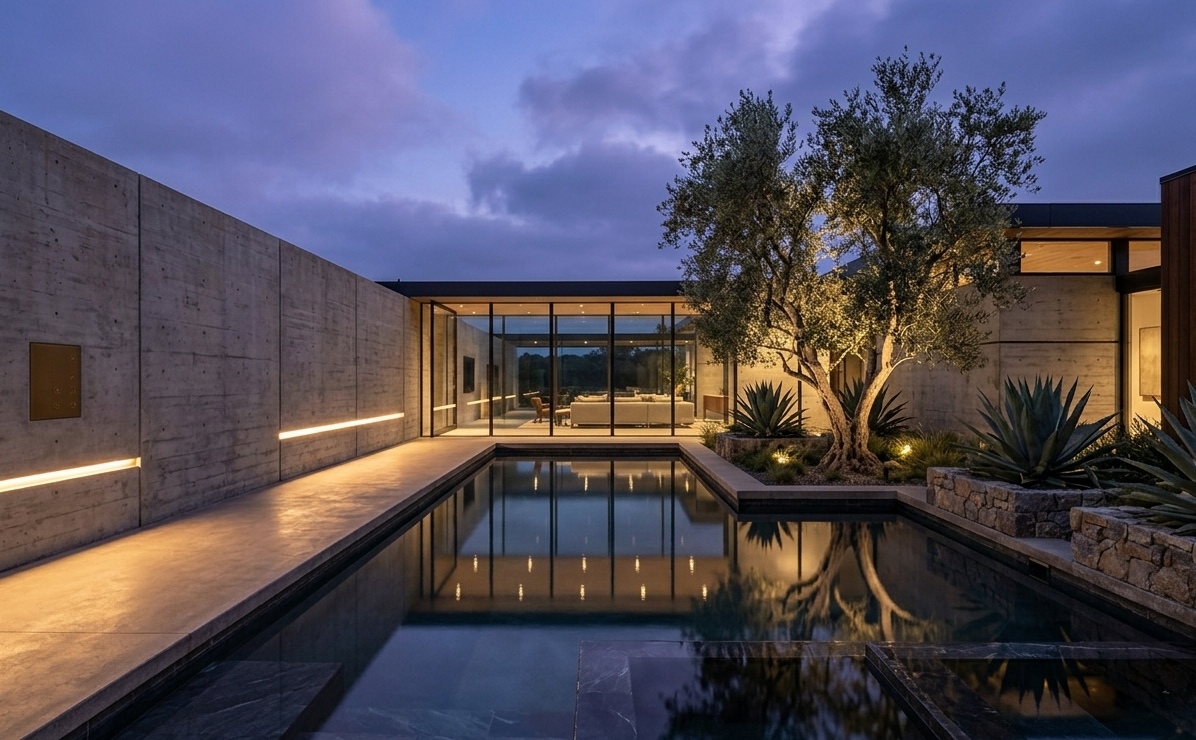
Residential courtyard with recessed linear lighting. Olive trees and desert flora are softly uplit against architectural walls.
The Evening Standard
Outdoor lighting is the first layer of the home’s hospitality. When the boundary is controlled the transition from the world to the sanctuary is seamless.
The goal is to extend the intelligence of the house to the very edge of the property.
The Digital Shadow
The highest form of technology is the kind you never see. Discover how to integrate "The Digital Shadow" and remove digital friction from your home.
How to Hide the Intelligence of the Home
A truly intuitive home shouldn't feel like a computer. In the rush to make houses "smart," many have turned their living spaces into glowing, blinking dashboards that demand constant attention. This creates a "digital friction" that prevents the mind from ever truly disconnecting.
The highest form of technology is the kind you never see. The Intuitive Estate relies on "The Digital Shadow", integrated systems that run the environment in the background so the human experience stays at the forefront.
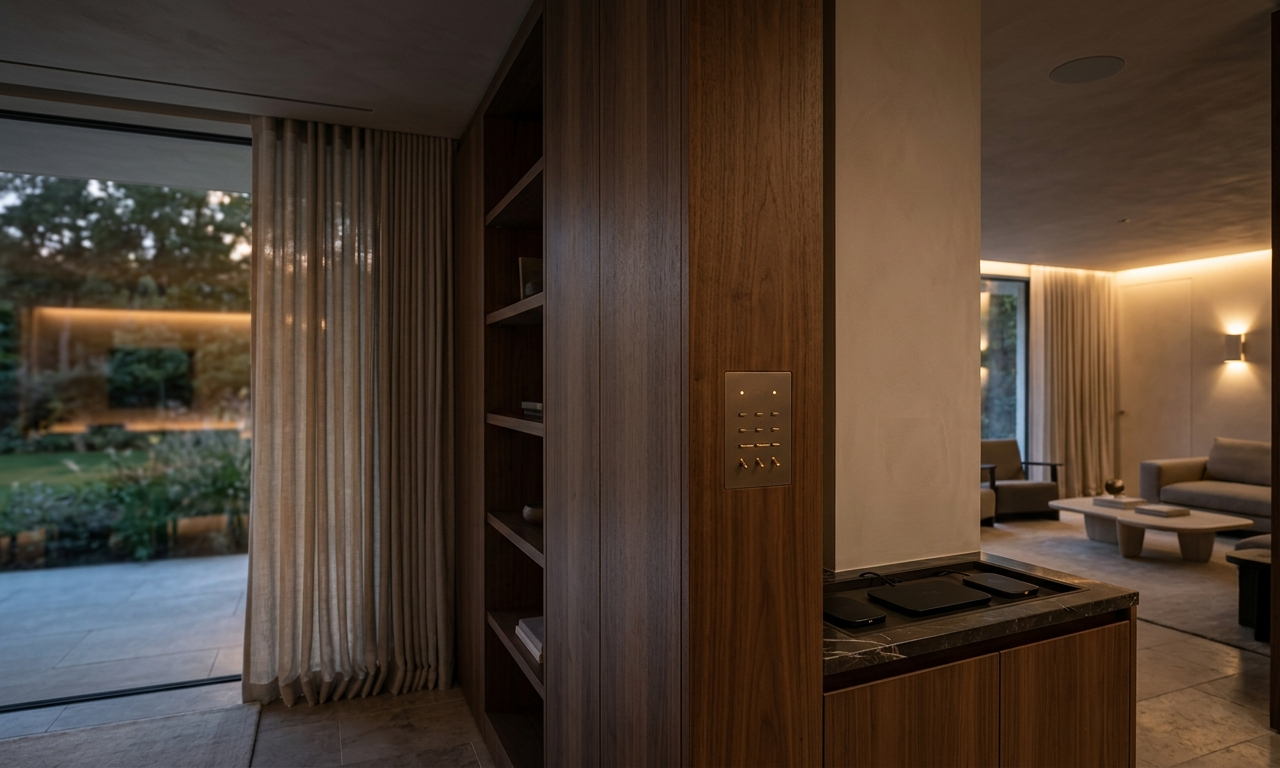
Interior showcasing "The Digital Shadow". Custom integrated brass tactile keypad. Beside it, a recessed charging station is neatly tucked into a stone countertop.
The Morning: The Seamless Start
Technology should move at the pace of your body, not the other way around. Instead of fumbling with apps or bright screens, the morning transition is handled by automated shading and silent motorized tracks. These systems pull back the darkness using natural light as the alarm. We prioritize high torque, silent drive motors that integrate directly into the architectural pocket, allowing the house to wake up with you without a single glowing LED or "smart" speaker interrupting the silence.
The Afternoon: The Invisible Workhorse
During the day, the tech that keeps the air clean and the temperature stable should be felt, not heard. The standard for a high functioning home includes in wall filtration and recessed climate sensors that disappear into the architecture. By removing the visual clutter of thermostats and bulky air purifiers, the "Digital Shadow" reduces the cognitive load on your brain. Strategic placement of high gain, hidden networking nodes ensures total connectivity without the eyesore of exposed routers and wires.
The Evening: Total Dark Mode
As the house moves into the Daily Descent, the digital world must vanish.
Hidden Hubs: All charging stations and hubs are tucked into signal shielding cabinetry with integrated power distribution. If it has a blinking blue light, it doesn't belong in your line of sight.
Tactile Control: We move away from glass screens and toward low voltage, tactile keypads or invisible gesture controls. Solid brass or stone finished toggles provide a physical connection to the home's systems, ensuring that dimming the lights feels grounded rather than digital.
By the time you are ready for sleep, the "Digital Shadow" has closed the curtains, scrubbed the air, and turned off the world. The house is "smart," but it feels profoundly analog. With the digital infrastructure now fully concealed, you can focus on the final layer of your home’s architecture, establishing the physical thresholds that dictate where one space ends and another begins, as explored in The Luminous Boundary.
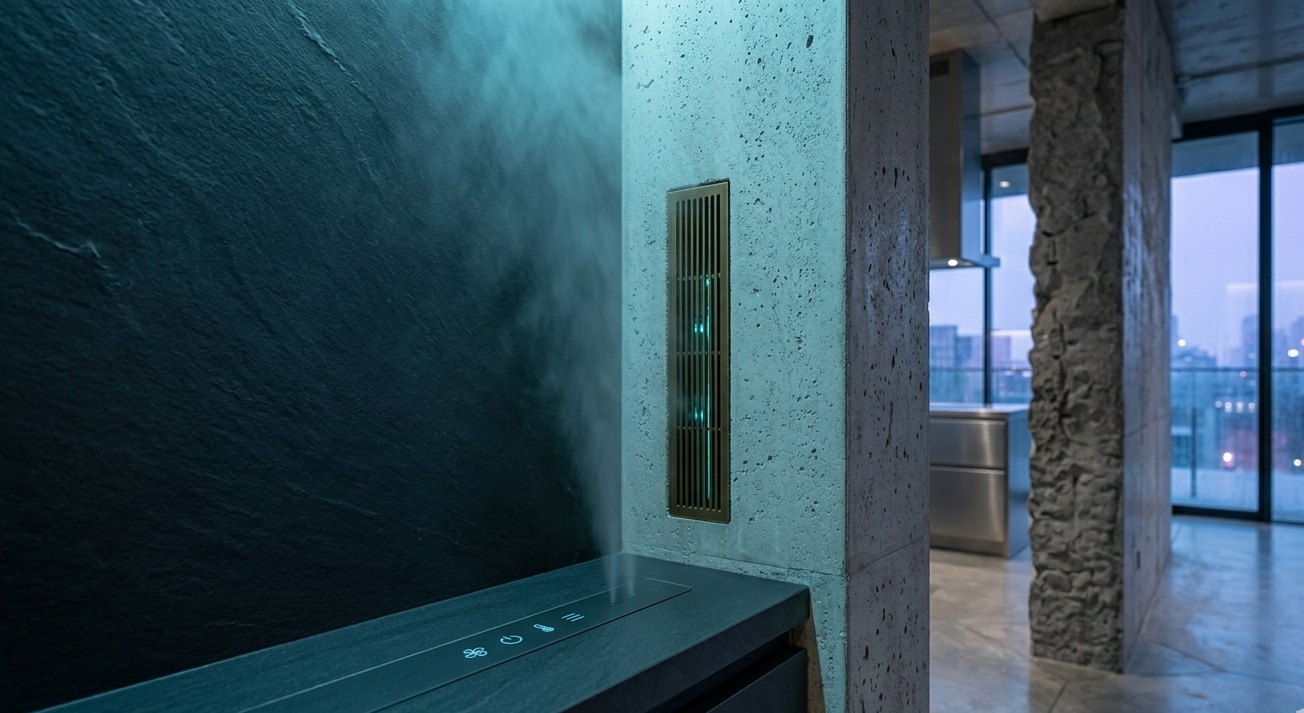
A hidden misting and filtration system. Control is managed by a sleek, black, debossed touch panel built into a dark stone ledge.
The Evening Standard
Technology should be a ghost in the machine. It should provide the comfort of modern innovation without the stress of a digital interface.
The goal is to build a home that thinks for you so you can finally stop thinking about the house.
Clean Air for Better Breathing
Air quality is the most overlooked material in a home. You can have the finest furniture, but if you are breathing stagnant air, your recovery will always be capped.
How to Build an Atmospheric Shield
Most people don’t realize that indoor air is often significantly more polluted than the air outside. We spend eight hours a night in bedrooms that trap dust, allergens, and stagnant CO2, then wonder why we wake up with a "heavy" head.
A home should be a filter, not a container. To truly rest, the environment needs to function as an Atmospheric Shield, a system that actively scrubs the air so your body doesn't have to.
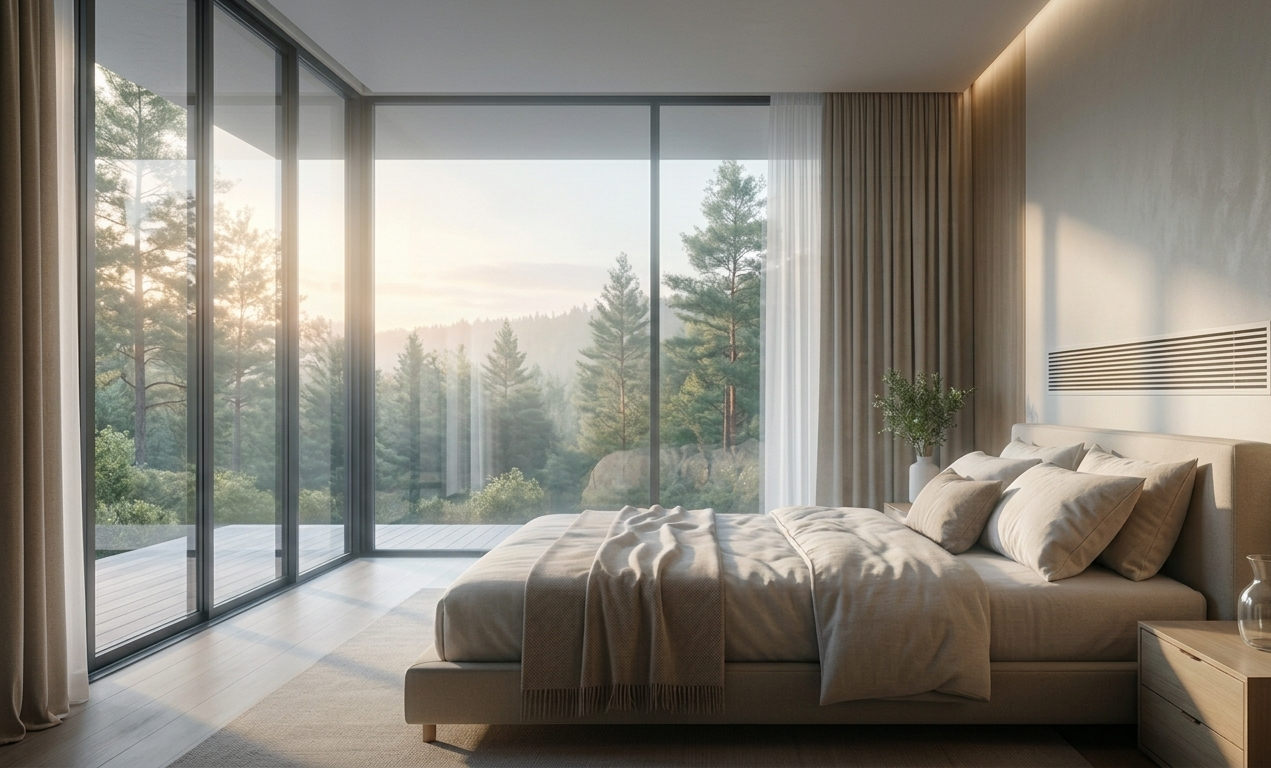
Bedroom that features a plush bed with neutral toned linens and an air purification vent integrated into the wall.
The Morning: High Volume Exchange
The first step in a functional home is the exchange. Stagnant air leads to brain fog. The priority is high efficiency filtration that runs at a higher cadence in the morning. By clearing out the settled air from the night before, the environment preps the space for the day’s focus. It’s a signal to the brain that the "recovery" phase is over and the "performance" phase has begun.
The Afternoon: Predictive Climate Control
Temperature and air quality are linked. As the sun moves, humidity levels shift, often making a room feel "heavy" by 4:00 PM. A well integrated system doesn't wait for you to feel hot, it predicts the shift. By maintaining a consistent, filtered flow throughout the afternoon, the house prevents the mid day slump that comes from poor oxygenation and rising temperatures.
The Evening: The Night Filter
The bedroom is the most critical "clean zone" in the house. During the night, your respiratory system is at its most vulnerable.
Medical Grade Standards: The focus is on HEPA standard systems that can be integrated silently. No loud, boxy fans, just a constant, invisible scrub of the air.
Scent and Humidity: The standard should always include natural, oil based diffusion, never synthetic sprays. A touch of cedar or lavender can signal the nervous system that it is safe to downshift.
By the time you lay down, the air in the room should feel "thin" and crisp. When paired with natural, breathable fibers like curated linens, the body can finally regulate its own temperature without fighting the environment. Once the air is purified, the next step in protecting your internal environment is to manage how light and data interact with your space, which we discuss in The Digital Shadow.
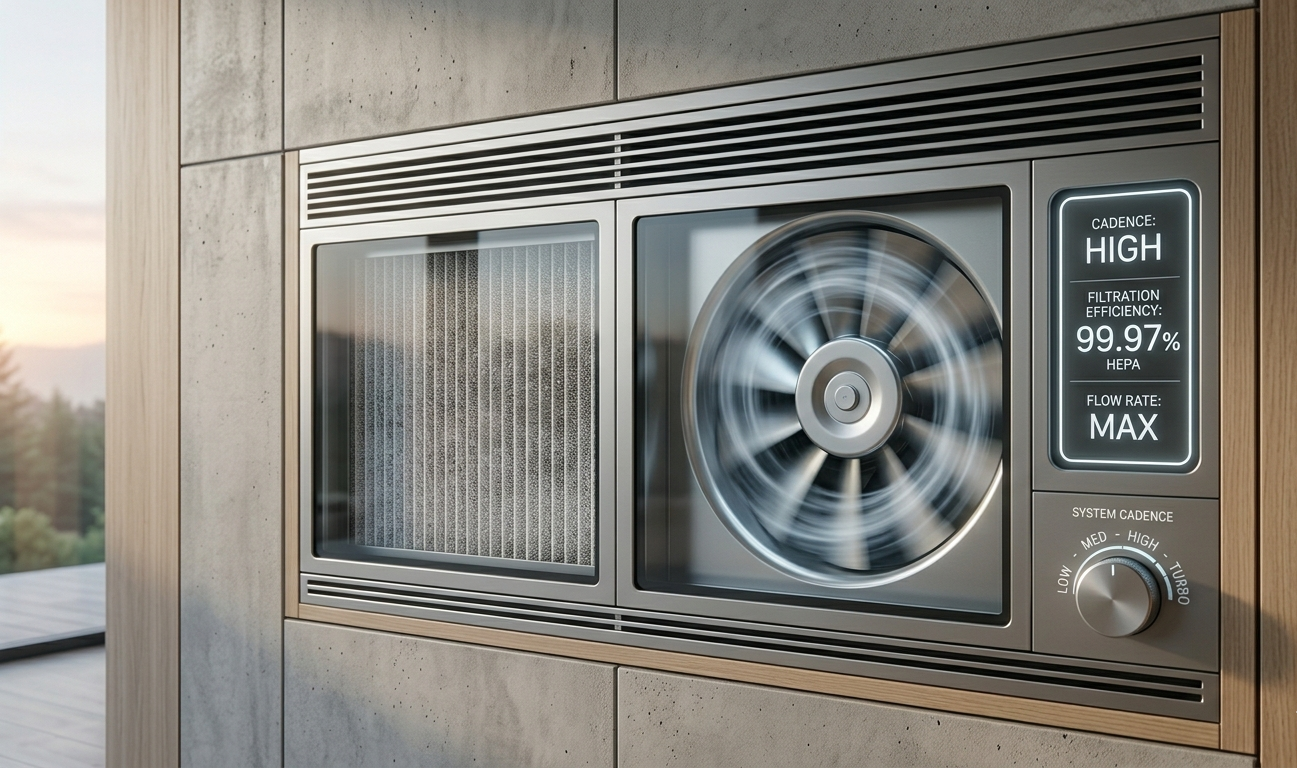
A high tech, medical grade HEPA filtration system integrated into an interior wall.
The Evening Standard
Air quality is the most overlooked material in a home. You can have the finest furniture, but if you are breathing stagnant air, your recovery will always be capped.
The goal isn't just a clean house, it’s a high functioning lung for your life.
The Circadian Pulse
A home should be more than a shelter, it should be a system that supports how you actually function. Learn how to master the "Daily Descent" and turn your lighting into a tool for recovery.
Most of us treat our homes like a box with switches. We walk in, flip a light on, and expect our brains to just keep up. But if you have bright, clinical lights blaring at 9:00 PM, you’re essentially telling your body it’s still noon.
A home should be more than just a shelter, it should be a system that supports how you actually function. We call this transition The Daily Descent.
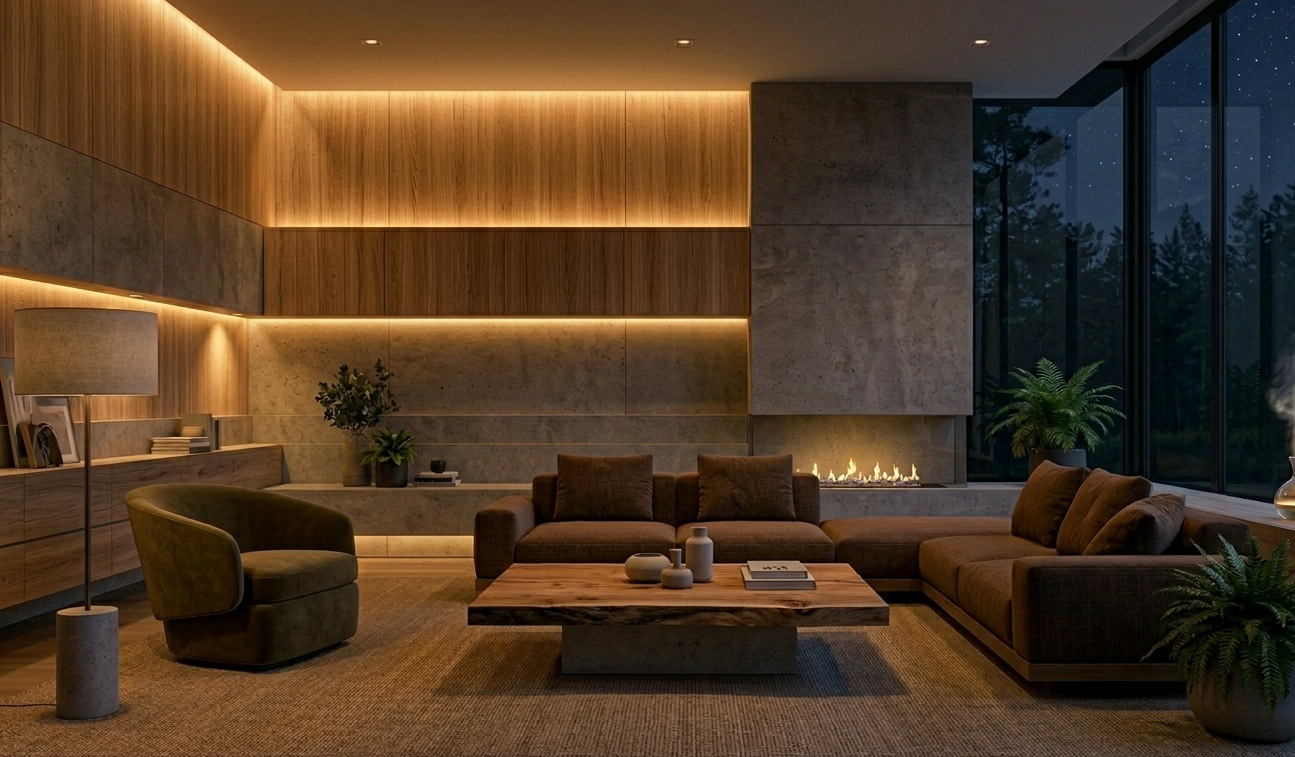
A modern, luxury living room featuring a 'Daily Descent' circadian lighting design.
Morning: The Cold Start
In the morning, your body needs clarity. This isn't just about "bright" rooms, it’s about the quality of the light. We focus on cool, crisp tones that mimic a clear morning sky. High clarity fixtures and natural northern exposure help set the baseline for the day, signaling your brain to wake up and move past that morning grogginess without the need for a "bright" shock to the system.
Afternoon: The Slow Fade
Around 3:00 PM, the house should start to settle. As the sun moves lower, your indoor light should follow suit. We pull the light down from the ceiling and move it to the walls and floor, a shift we call Social Gravity. By dimming the edges of the room and warming the center, the home naturally draws people together. It’s a subtle change that tells your nervous system the "work" part of the day is winding down.
Evening: The Amber Anchor
By 8:00 PM, the goal for every living space is a deep, amber warmth. This is the Amber Anchor phase, where we prioritize how a room feels over how much we can see.
Keep it Low: Light should come from lamps and low level sconces, never from overhead.
The Color of Rest: We choose fixtures that don't just get darker when dimmed, but physically shift to a warmer, orange tone (around 2200K) to mimic the glow of a fire.
By the time you’re ready for bed, your home has already spent three hours preparing your body for sleep. You aren’t fighting your lights to feel tired, the environment has done the work for you. To truly master these transitions, you must also define the physical limits of your space, a concept we detail in The Luminous Boundary.
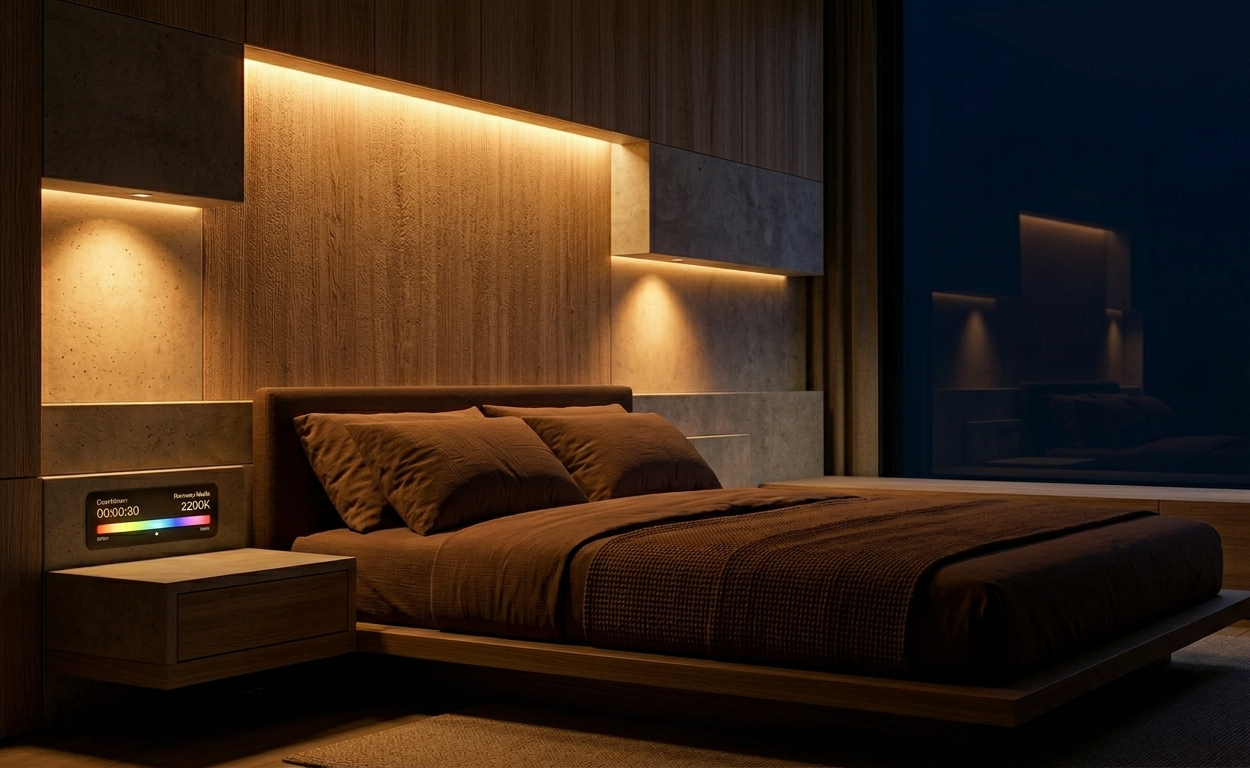
Serene bedroom designed for optimal sleep hygiene. It features rich chocolate brown bedding and a low profile natural wood platform bed.
The Evening Standard
Lighting is the most powerful "invisible" material in your home. By shifting from high clarity morning light to a low, amber glow at night, you stop fighting your biology and start supporting it. The focus isn't on visibility, it is on recovery. When the house knows it’s time to be still, you can finally do the same.
The Elemental Kitchen
The most enduring kitchens are defined by objects that possess a weight of their own. Discover the "Heavy Tools" of the hearth, from the volcanic anchor of the molcajete to the thermal conduct of hand hammered copper.
The Heavy Tools of the Hearth
The most enduring kitchens are defined by objects that possess a weight of their own. We aren't looking for temporary fixes; we are looking for the pieces with the substance to outlive the architecture itself.
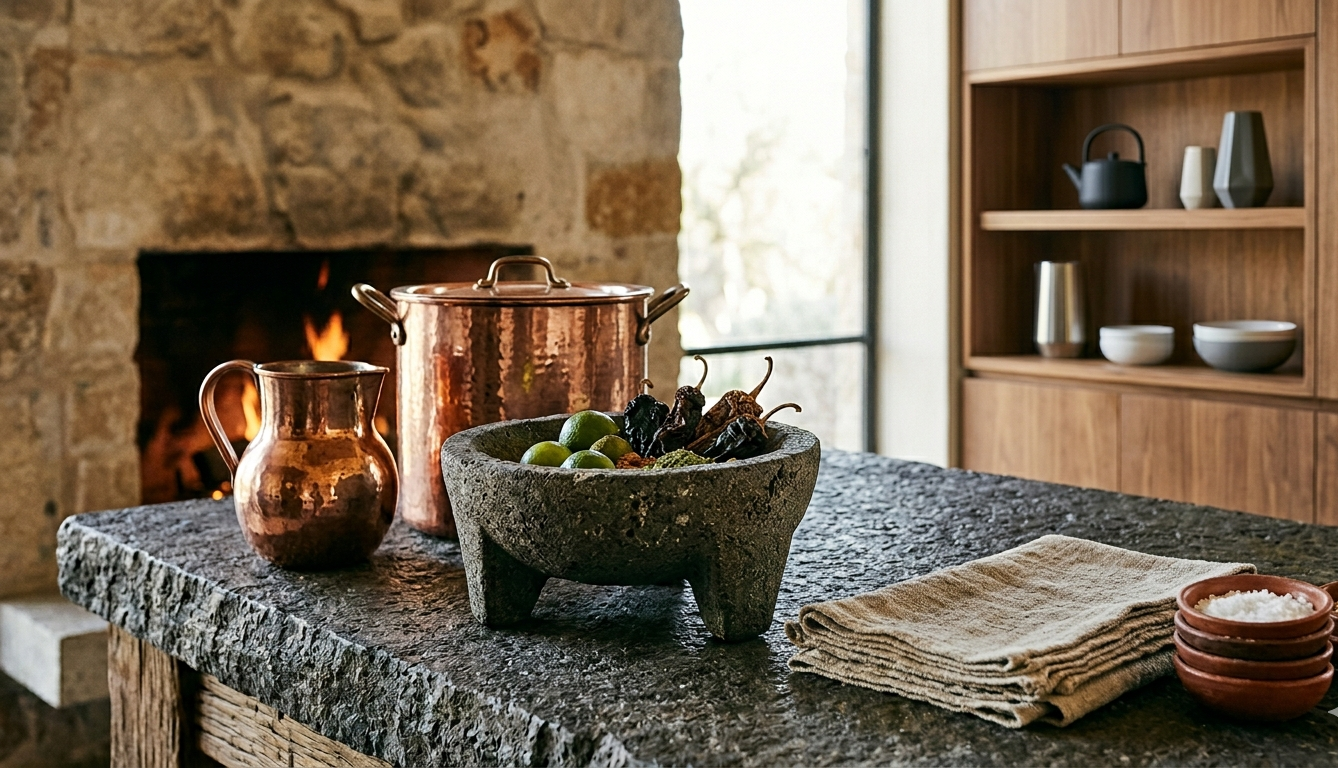
Basalt molcajete and copper cookware on a dark stone counter in a modern kitchen with a warm hearth.
The Volcanic Anchor, The Molcajete
A 10lb block of basalt is the definitive kitchen sculpture. Its porous volcanic surface is the only way to truly respect a spice or a complex emulsion, using friction rather than blades to release oils without heat. It is the "Stone Grounding" of the culinary process. Even when at rest, it serves as a textured vessel for the essentials, a handful of limes or dried peppers, anchoring the countertop with raw, volcanic weight. In an essential kitchen, a heavy basalt molcajete acts as The Hero Piece, providing a singular, high mass focal point that grounds the surrounding culinary tools and establishes a sense of permanent history on the stone island.
The Thermal Conduct of Copper
Luxury is found in the physics of heat. Hand hammered copper is the ultimate regulator, whether it is a Jug for mineral water or the massive, deep bellied pots designed for the reality of a large family meal. These vessels are built for the long simmered stews and meats of a grand gathering. The copper patinas with every fire and every touch, recording the lineage of the home in its glow. It’s the reason we focus so much on The Kitchen Anchor, because the room only starts to feel right once it’s centered by a piece that has more soul than the cabinets.
The Geometry of the Press
The perfect compression of grain is a feat of engineering. A heavy, industrial grade Masa Press, whether in cold rolled iron or a weighted wood, is a masterclass in leverage. While essential for the daily ritual of heirloom corn, its utility extends to any preparation requiring uniform, high pressure flattening, from artisanal seed crackers to heritage flatbreads. It is a reminder that the most sophisticated results come from the simplest mechanical forms.
The Hearth Tool
We source Tzalam (Mayan Walnut) for the tools that touch the hand most often. Because of its high natural oil content and extreme density, a solid Tzalam rolling pin or an oversized cooking spoon feels weighted and balanced. It is a wood that never splinters and only grows deeper in color with use, bridging the gap between the built in cabinetry and the act of preparation. When you pick up a tool with this kind of density, you finally get The Weight of Wood as a daily requirement, a physical reminder that the things you touch every day are actually built to last.
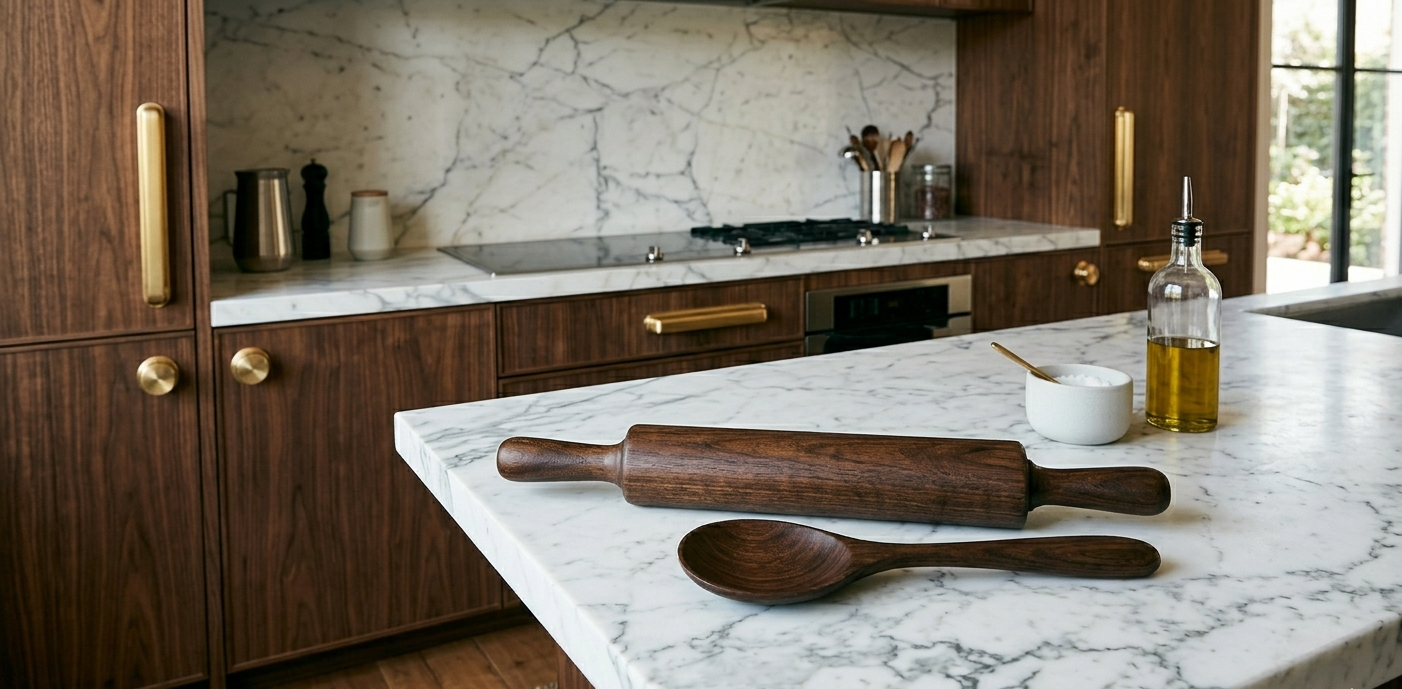
Tzalam wood rolling pin and oversized spoon on a white marble kitchen island with modern walnut cabinetry and brass hardware.
The Porous Vessel, Terracotta
There is a specific luxury in the "imperfect" line. Hand thrown ceramic dinnerware and terracotta storage vessels for grain or salt provide the sensory friction that a refined, quiet home requires. These are the Insider Signals, pieces that carry the faint fingerprint of the maker, ensuring the wares never feels sterile, but always feels curated.
Final Thought
The "Elemental Kitchen" isn't about filling space, it is about the Curation of Utility. In a world of disposable convenience, these objects represent a return to the permanent. They are the heavy, quiet tools that turn a house into an home, and a meal into a lineage.
The Rug Foundation
Luxury is a tactile conversation. It’s the shift from the structural coarseness of agave to the disciplined, hand knotted softness of highland wool.
Textural Depth and Hand Woven Quiet
In a home designed for permanence, we believe the rug isn’t just decor, it’s a sensory anchor. We look to the floor to provide that final layer of atmospheric silence. It’s about a hierarchy of fibers, moving from the rigid, sun dried pull of the agave to the dense, hand spun wool of the highlands.
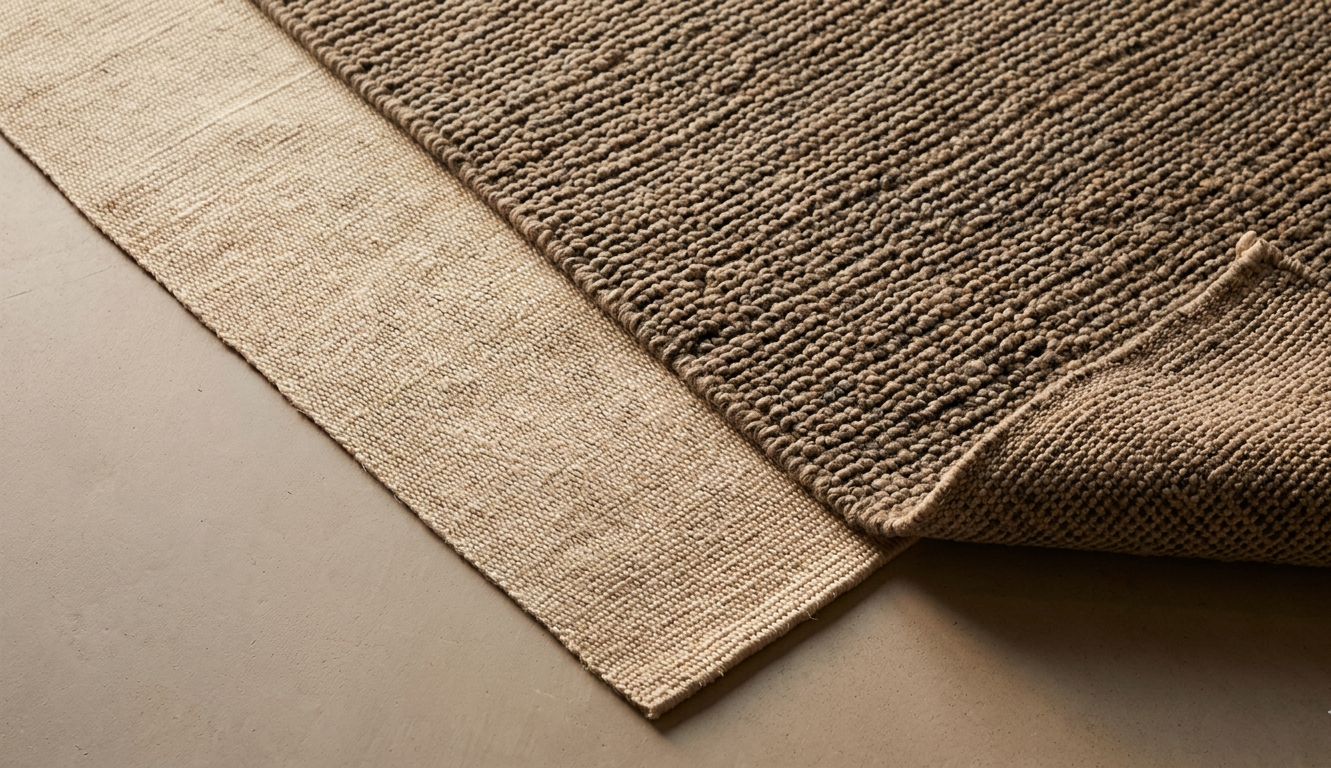
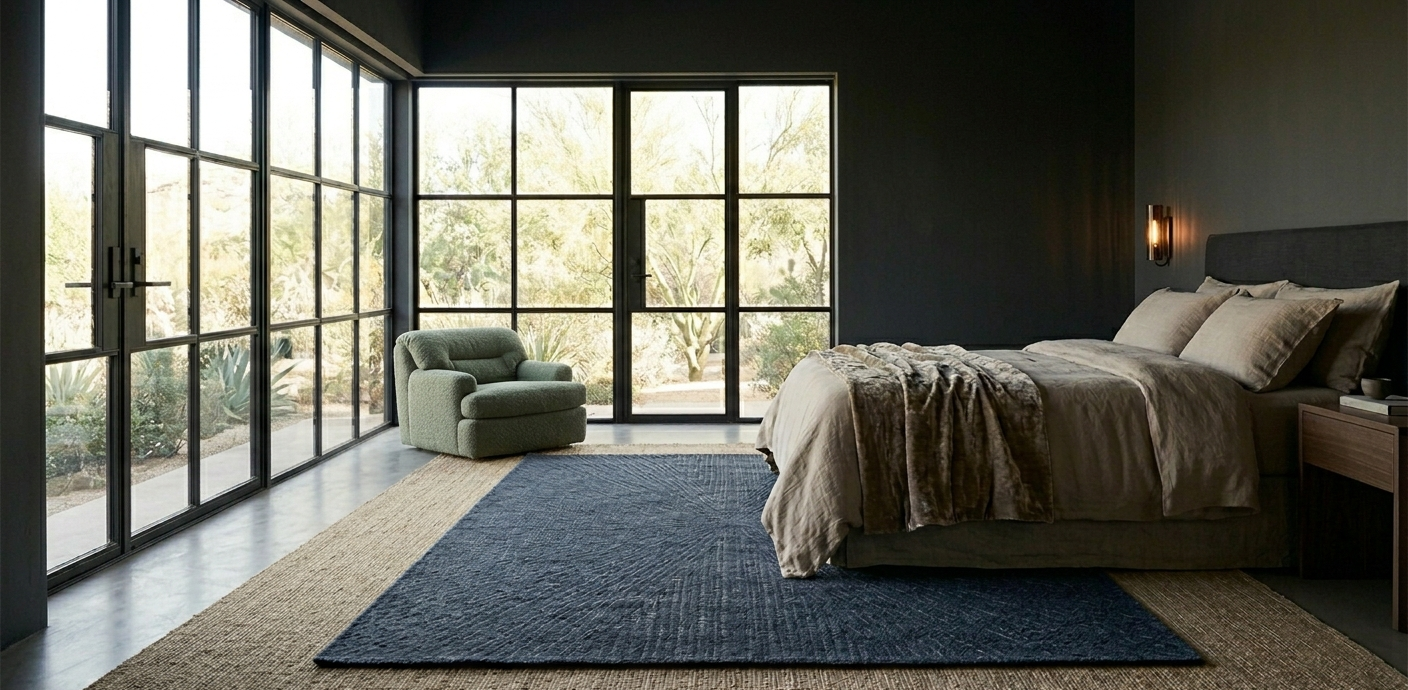
Hand knotted wool rug in a warm tobacco brown, resting atop a woven, natural toned Ixtle agave rug.
The Ixtle Weave, Agave Refined
Where heavy cordage provides the brute structure of a house, we find that Ixtle provides the nuance. Extracted from the heart of the agave lechuguilla, this fiber is thinner, paler, and carries a subtle, natural luster that defines the interior’s cooling temperature. This organic layer provides a necessary softening of The Grit of the Floor, creating a sophisticated friction between the raw, mineral density of the stone and the refined pull of the agave fiber.
The Tactile Shift: We like to use Ixtle for a smoother experience underfoot while keeping the structural integrity of a desert plant. It’s our choice for those transition spaces, hallways or nooks, where the foot tends to linger.
The Tonal Wash: Because the fiber is naturally light, it holds plant based dyes with a beautiful, watercolor like irregularity. We tend to favor washes of tobacco, indigo, and crushed stone.
Hand Knotted vs. Manufactured
We see the real difference between a handmade rug and a manufactured one not just in how they’re made, but in how they age. A manufactured rug is a static product, a hand knotted piece is a living process.
The Structural Soul: In a machine made rug, the fibers are usually held together by latex backings that eventually shed. In a hand knotted wool rug, the vertical warp and horizontal weft are locked together by thousands of individual knots. No glue here, just the honest tension of the fiber.
The Patina of Use: We also enjoy high altitude wool rich in natural lanolin. This isn’t just about the soft touch, it’s a built in defense. Unlike synthetic fibers that "crush" over time, we know that natural wool recovers. It doesn't wear out, it develops a softer, deeper character over decades.
A large master suite features a layered rug foundation, with a muted indigo hand knotted rug resting flat atop a larger, natural toned Ixtle agave base.
The Interaction of Light and Fiber
We look for rugs that possess what we call "organic vibration."
The Micro Stripe: By alternating single threads of natural cotton and raw wool, we achieve a subtle "flicker" of texture. It’s invisible from across the room, but it’s a rich discovery once we are standing on it.
Identifiable Rhythm: When we flip the rug over, we look for the soul of the weaver, tiny shifts in the knot size and a human rhythm that a machine simply can't replicate.
Final Thought
We believe the floor should be felt before it’s ever seen. By choosing fibers that respect their origin, and construction that respects the hand, we ensure the home’s foundation is as enduring as its walls.
The Social Partition
True hospitality is invisible. Discover the logic of the social partition, an architectural boundary of timber and stone that protects the atmosphere of the evening.
Hosting with Discretion
The open plan kitchen was designed for the family morning, but it often fails the evening. When hosting, the sights and sounds of preparation, the industrial glare, the frantic pace, can break the room's composure. In the Sovereign Collection, we advocate for the Social Partition, the architectural art of separating the labor of the meal from the ritual of the dinner.
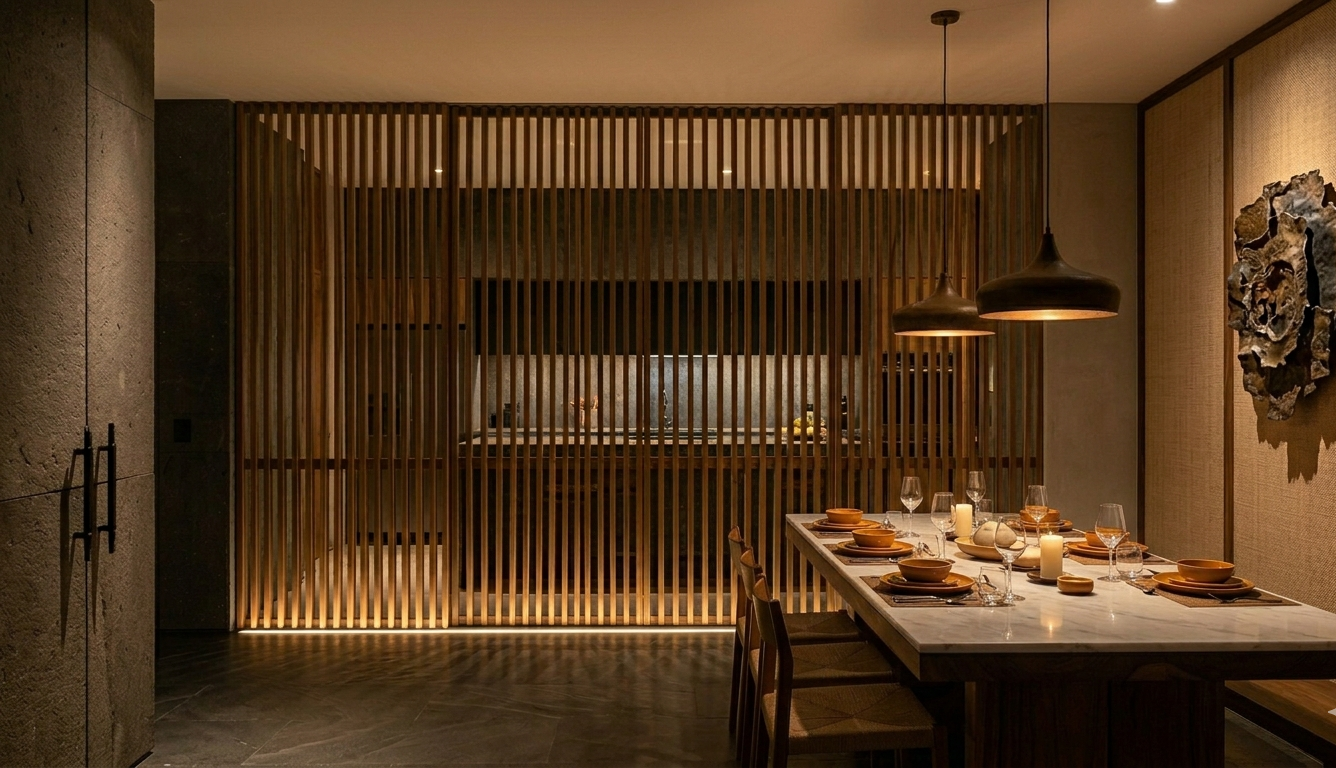
Central slatted Tzalam screen, serves as the primary visual shield, between the kitchen and dining area.
The Visual Shield of Screens and Grain
Hosting with discretion requires a physical boundary that feels like an integral part of the room’s architecture.
The Slatted Screen: We utilize floor to ceiling partitions in Tzalam. These vertical slats provide a rhythmic boundary that obscures the kitchen's "work zones" while allowing light and conversation to pass through. The choice of a Tzalam Grain, for these partitions is a strategic one, as the wood's natural density and iridescent oils provide a warm, furniture grade finish to a structural necessity.
Textured Division: For a softer, acoustic break, we look to heavy tanned leather panels or fine weave Henequen set into dark timber frames. These materials absorb the sound of the workspace, replacing it with a warm, tactile backdrop.
The Hidden Kitchen
The most effective partition is the one that transforms the room. We favor a "monolithic" approach where the kitchen becomes part of the home's permanent architecture.
The Cantera Facade: Utilizing a Cantera stone pantry or a prep wall creates a sense of profound weight. When clad in this volcanic stone, the functional areas feel like a solid extension of the exterior, hiding the energy of service behind a cool, immovable surface.
The Tactile Connection: True refinement is felt in the hands. By integrating hand forged iron pulls or sandcast bronze handles, the kitchen transforms into a quiet, architectural backdrop. These pieces act as the heavy, functional jewelry of the space.
The Zone of Light and Organic Depth
Discretion is often achieved through lighting and the choice of raw, quiet textures.
Zoned Illumination: We maintain a low, amber depth in the kitchen while focusing a warm, sharp pool of light onto the dining surface.
The Hand Cast Glow: Low slung, oxidized bronze pendants over the table create an "island of light" that draws the eye inward, naturally erasing the functional zones of the house from view.
The Organic Backdrop: To soften the transition, we like to see a hand applied Chukum or lime based plasters. The velvet matte finish captures light with an organic irregularity that feels established and permanent.
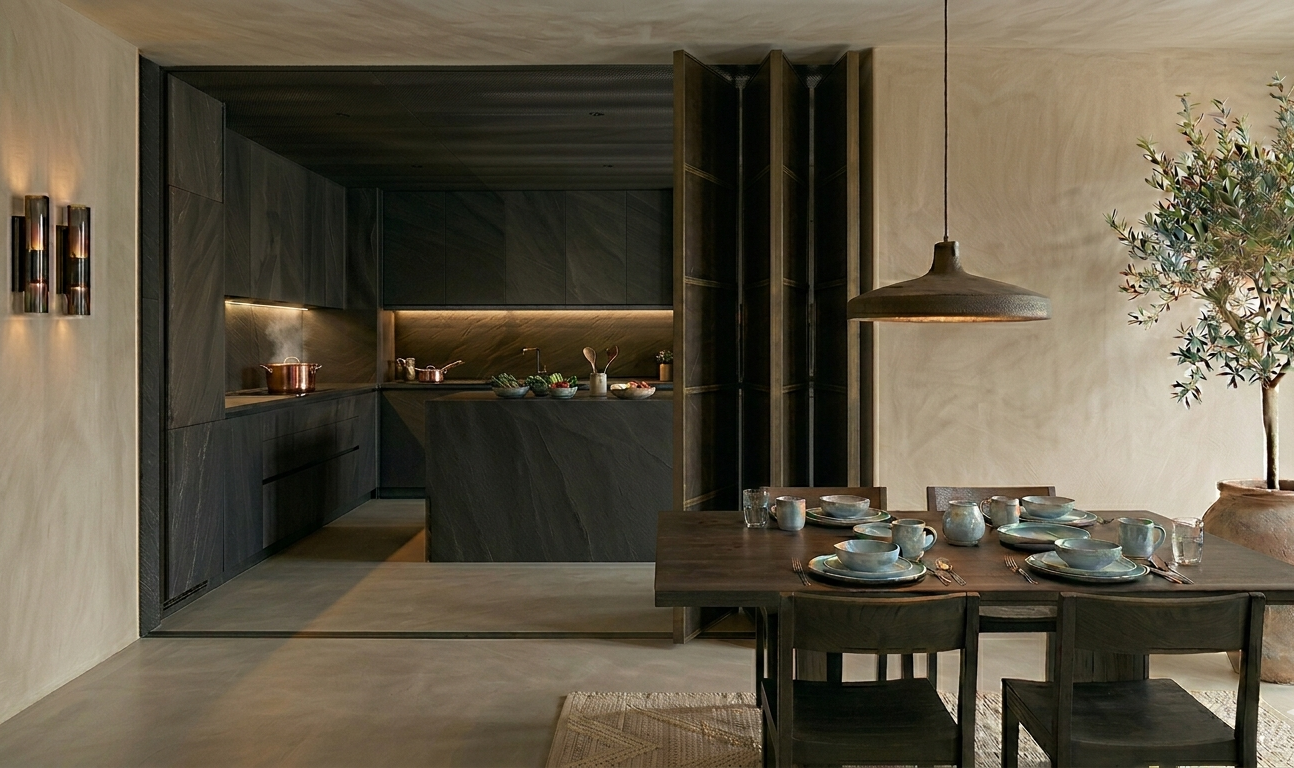
Dark leather paneled folding screen partially conceals the kitchen.
The Ritual of the Reset
The social partition allows the host to manage the "reset", the transition from the main course to dessert, without the guest ever seeing the labor involved. It provides a buffer that protects the conversation and the mood. It isn't about hiding the kitchen because it’s messy, it’s about protecting the experience because it’s sacred.
Final Thought
Luxury is the ability to control the environment. By integrating a social partition into your home's flow, you ensure that the mechanics of the house never overshadow the ritual of the evening.
The Hero Piece
Every great collection needs an anchor. Discover the power of the 'Hero Piece', a single, high caliber object that gives your surfaces a sense of direction and weight.
Anchoring the Collection
In a well lived in home, surfaces naturally accumulate the layers of a life, books, heirlooms, and daily essentials. The challenge of a refined interior isn't about keeping surfaces empty, it’s about keeping them grounded. In the Sovereign Collection, we utilize the "Hero Piece" mindset, selecting one substantial, high caliber object to act as the visual anchor for everything else around it.
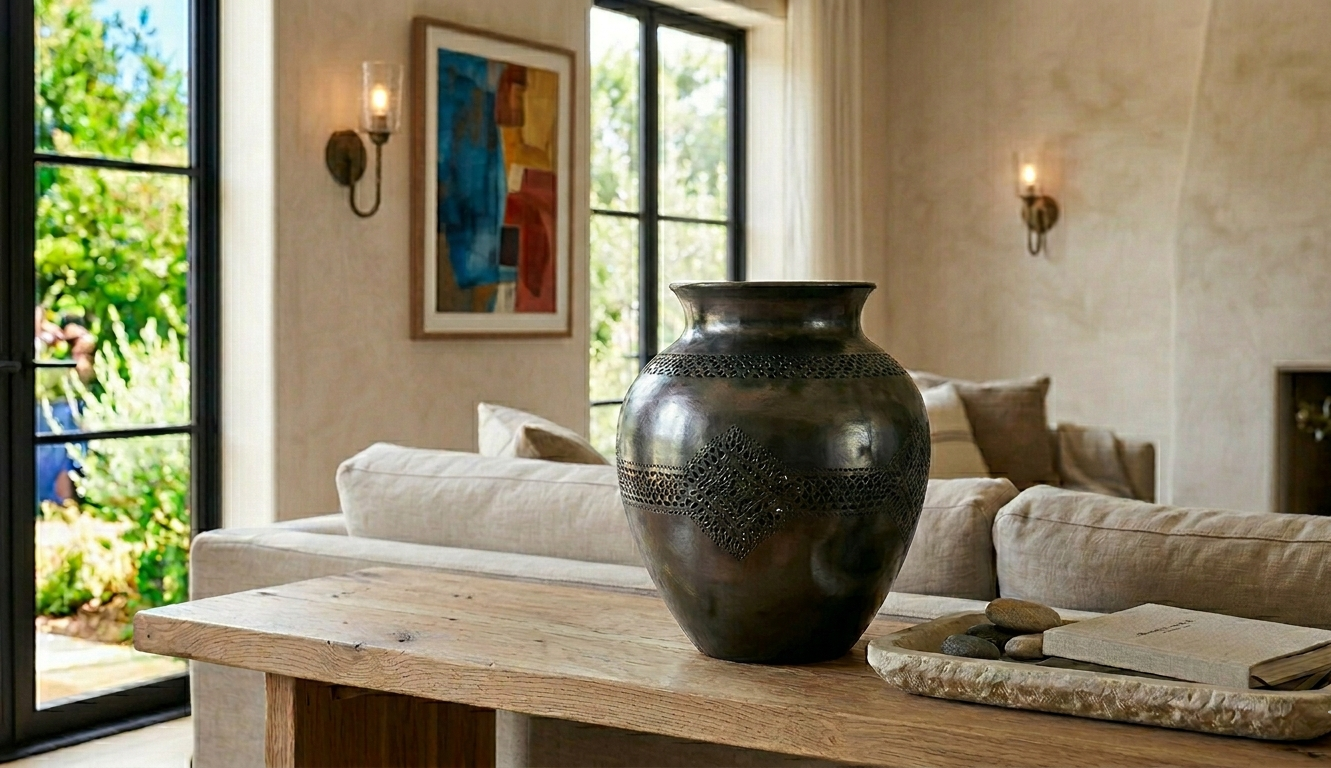
The large, matte black vessel stands as the clear focal point, grounded on a rustic wood table.
The Power of Scale
A collection of small accents can often feel scattered without a central point of focus. By introducing a piece with significant scale and material "soul," you give the rest of your objects a reason to be there.
The Dark Vessel: A large scale, pit fired Barro Negro bowl or a heavy walled ceramic jar is a masterclass in quiet presence. Its deep, matte finish absorbs light, creating a steady point on a dining table or console. It doesn't replace your other pieces, it frames them.
Material Lineage: Whether it is the carbonized surface of black clay or the cool density of honed basalt, these pieces carry a sense of history. This inherent weight allows a single vessel to stand up to the architecture of a room, providing a sense of permanence that ties the space together. By selecting objects in raw basalt or carbonized clay, you reinforce The Mineral Palette, allowing the ‘Silt’ and 'Obsidian' tones of the earth to move from the walls onto the surfaces you touch every day.
Curation through Gravity
The "Hero Piece" is about investment in impact. It’s the idea that a single, museum quality object can elevate the entire atmosphere of a room.
Creating a Focal Point: A large scale object creates a sense of intentionality. It tells the eye where to land first. Whether it’s a heavy ceramic jar or a solid stone plinth, these pieces act as the "north star" for your interior styling. When you get the scale right, you realize that The Architecture of the Accent, isn’t about decorating a surface, it’s about giving the entire room a reason to stop and look.
Tactile Character: These objects invite the hand. Whether it is the porous texture of Cantera stone or the smooth, metallic finish of hand worked clay, the material should feel substantial. It is a functional part of the daily ritual, meant to hold the light of the room just as much as it holds your physical belongings.
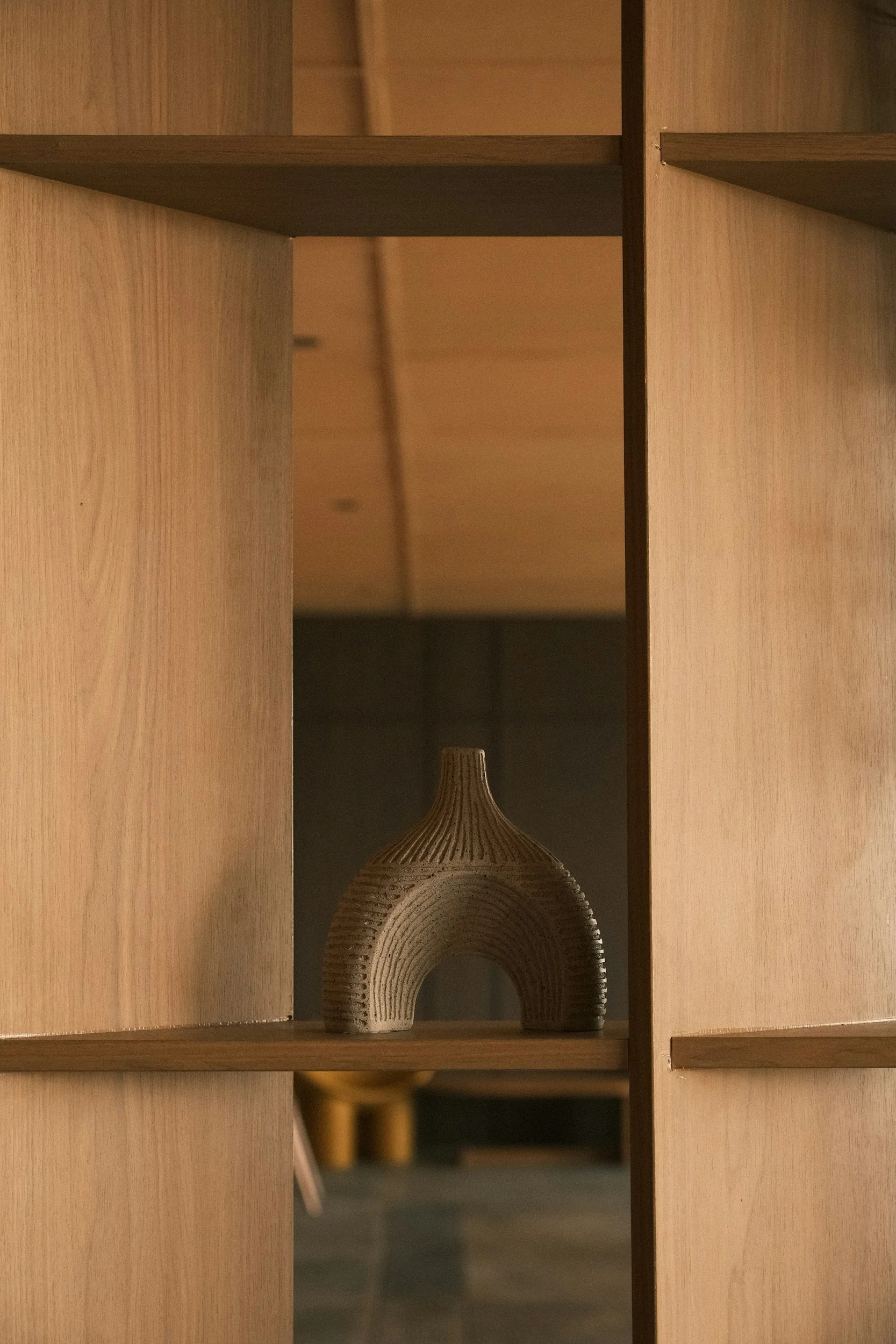
Hand crafted vessel sitting alone on a wood shelf.
Versatility across the Home
High caliber stone and clay pieces are the universal signals of a refined interior. They provide a common thread that connects different rooms:
In the Kitchen: A heavy clay bowl provides a textured contrast to a stone island.
In the Bedroom: A small stone vessel on a timber ledge provides an earthy anchor to a lighter textile palette.
In the Entryway: A tall, hand thrown jar establishes the home’s material lineage the moment you cross the threshold.
Final Thought
A room feels most complete when its objects have a sense of hierarchy. By choosing one high caliber hero piece to anchor your surfaces, you allow your entire collection to breathe. A single, well chosen vessel isn't about having "less", it’s about giving everything you have more character.
Courtyard Living
A courtyard shouldn't feel like an empty void. It should be a room without a ceiling. Discover how to use solid stone slabs and hand cast bronze to turn the center of your home into its most lived in sanctuary.
A Private Space of Stone and Sky
The most intentional homes are built around a void. This central opening is an architectural lung that allows the house to breathe. But to turn this space into a functional Living area, it requires more than just light, it requires visual weight. By layering heavy textures and sculptural comforts, the courtyard becomes a grounded extension of the interior that pulls the sharp, clean lines of the house into the open air.
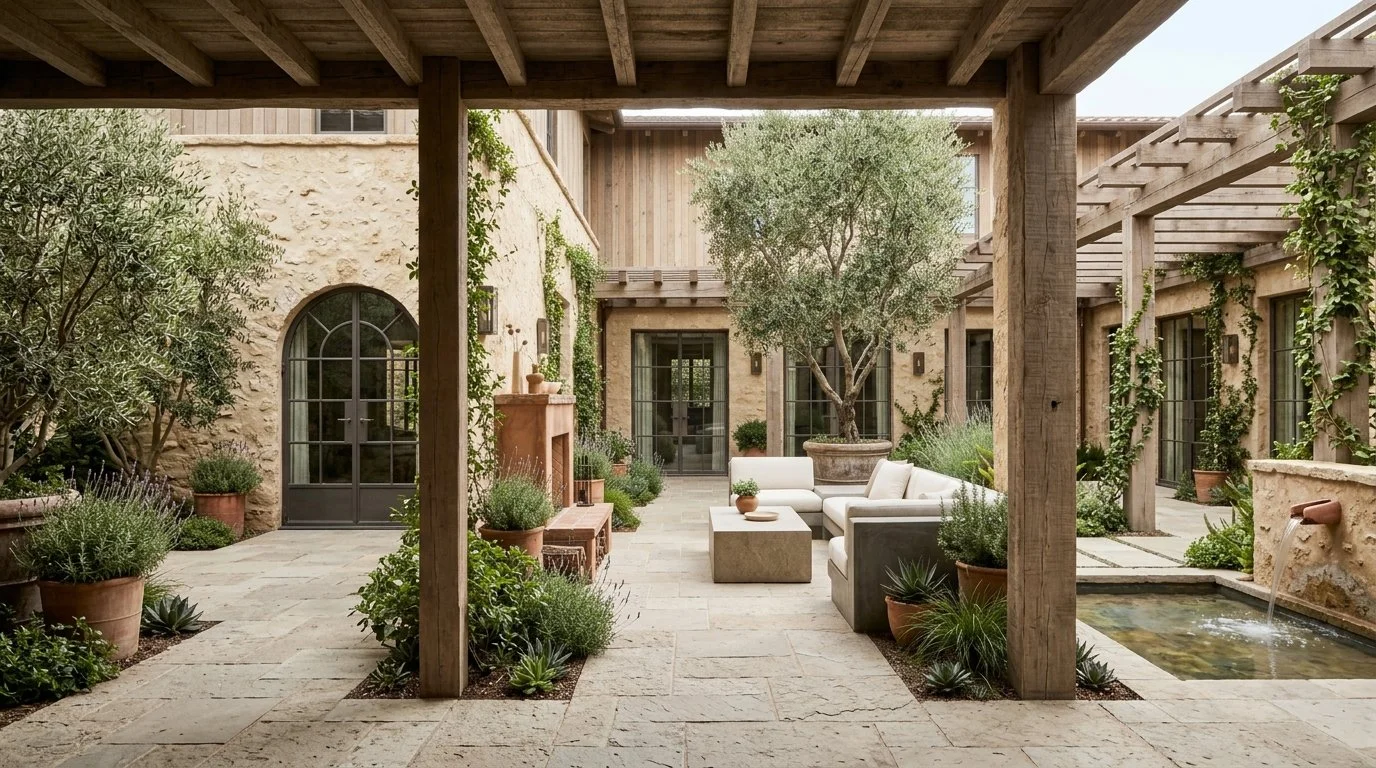
Courtyard with continuous stone flooring, outdoor seating, a central olive tree, a terracotta hearth, and a small water feature framed by wooden beams and stone walls.
The Hearth of the Void
For crisp nights under a clear sky, the courtyard requires a focal point of warmth. We advocate for a Terracotta Fireplace, a clean lined, high fired clay structure that offers the primal comfort of a wood fire. We move away from traditional masonry in favor of a unpretentious geometric hearth that radiates heat long after the sun sets, turning the open air into a functional evening lounge.
The Curator’s Edit: For an effortless evening, consider fire features and blackened steel toolsets that maintain a clean, modern silhouette while serving a primal purpose.
Solid Surfaces and Sculptural Seating
Comfort in a private retreat requires furniture with a soul and a sense of permanence. In the right setting we move away from traditional patio sets in favor of sculptural outdoor seating and heavy solid slab surfaces.
Low Slung Lounging: Deep, architectural chairs in weather resistant hardwoods or matte finished metals, paired with high performance cushions that offer an interior grade "sink." These pieces are designed for laying, their heavy silhouettes holding their own against the expansive stone floors. This seamless flow relies on The Grit of the Floor, where the same honed limestone used in the Great Room extends into the courtyard to blur the boundary between shelter and sky.
The Stone Block: Instead of traditional tables, we utilize solid stone slabs, often volcanic rock or honed limestone, to create low, architectural surfaces. This provides a cool, tactile place for morning coffee or evening cocktails, mirroring the clean geometry of an interior.
The Curator’s Edit: Look for performance grade textiles and honed stone surfaces that bridge the gap between indoor luxury and outdoor durability.
The Weight of the Accent, Bronze and Tonal Tile
To give the center of the home a sense of permanence, we utilize accents with significant physical weight and refined, modern finishes.
Hand Cast Bronze: Weighted bronze candlesticks and hand forged metal lanterns provide a low flicker ambiance that won't succumb to a cross breeze. These pieces develop a deep, dark patina over time, echoing the evolution of the metals found throughout a home.
Modern Tilework: We incorporate hand glazed tonal tiles in a modern, vertical stack on low profile accent walls or water features. This adds a rhythmic, artisanal texture without the "busy" look of traditional patterns.
The Curator’s Edit: Elevate the atmosphere with hand forged bronze accents and weighted candleholders designed to withstand the elements without losing their composure.
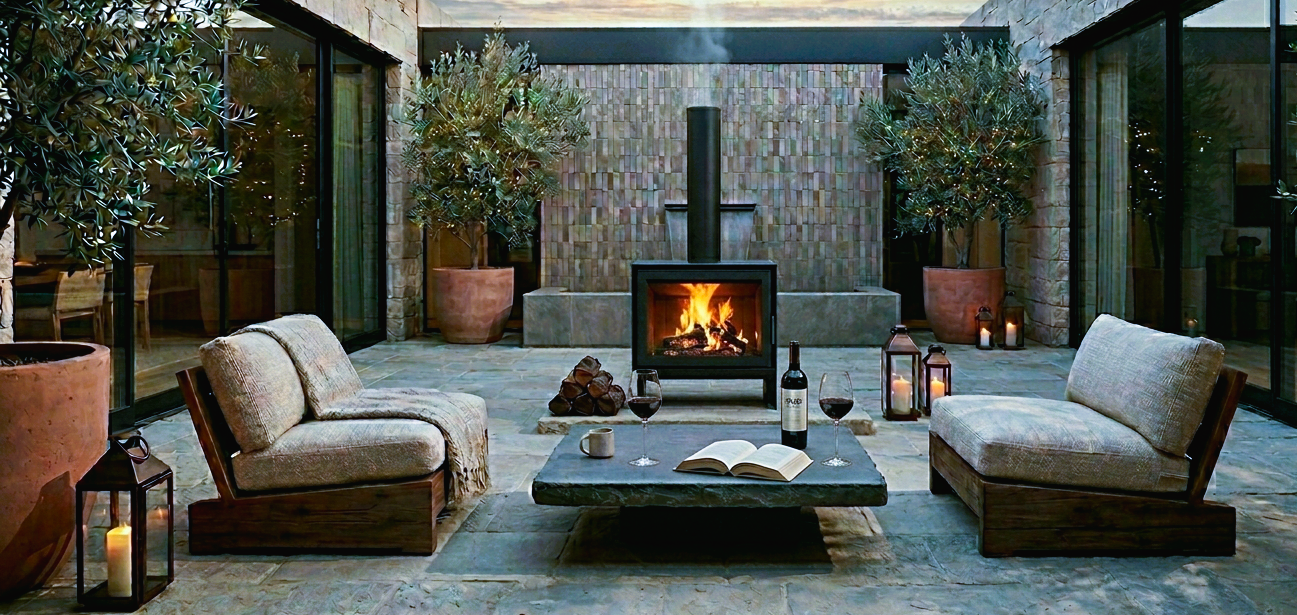
Modern courtyard at dusk with a chiminea, two plush lounge chairs, potted olive trees, and a central stone table.
The Living Architecture, Olive and Earth
No retreat is complete without a connection to the living world. We use oversized walled terracotta planters, thrown by hand with a raw, matte finish, to house mature, silver leafed olive trees. These "living sculptures" provide soft, filtered shade during the day and a structural silhouette against the stars at night, grounding the modern lines of the furniture in the natural world.
The Atmosphere of Transition
By mixing these heavy, raw materials with soft outdoor textiles and plush, hand loomed throws, the transition from the interior of the home to the courtyard becomes invisible. You aren't "going outside", you are simply moving into a different version of your home, one where the walls are made of light and the air is always moving.
Final Thought
Luxury is found in the objects that ground us. By choosing solid stone slabs, weighted metal accents, and the warmth of a modern clay hearth, you transform a simple courtyard into the most lived in room of the house.
The Sky Level Window
Direct sunlight is the enemy of organic materials. Discover the 'Sky Gap', the architectural standard for illuminating a room with high level light while protecting your rare wood and leather furniture from the elements.
Lighting the Collection
The greatest threat to a well composed room isn't time, it’s the sun. While we design for light, we must also design for preservation. Floor to ceiling glass looks striking in a gallery, but for a living space filled with high end organic materials, direct UV exposure can be a slow death. We advocate for a design standard known as the Sky Gap in regions where the sun is in abundance.
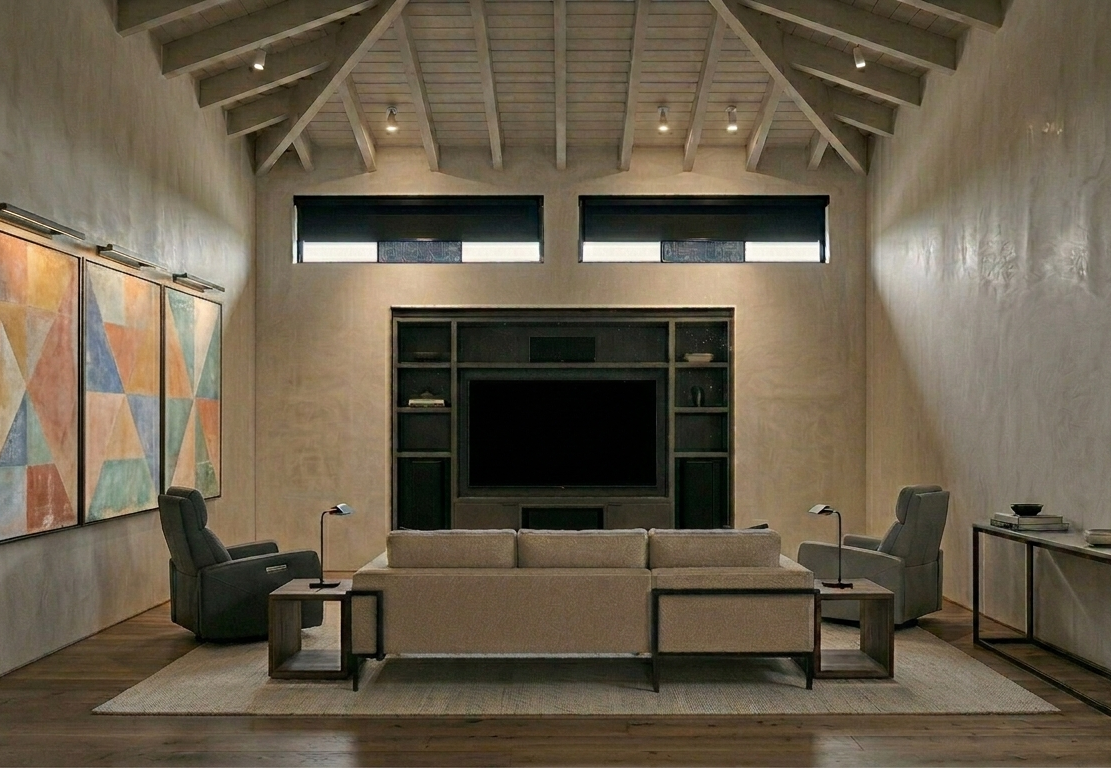
Home media room with motorized blackout shades in sky level windows.
Safeguarding the Grain
In our previous look at The Living Surface, Tzalam Wood, we discussed its deep, oily luster and the way it matures over decades. However, constant, direct solar heat can strip those natural oils, leading to warping or "bleaching" of the heartwood. By utilizing Sky Level Windows, openings placed high on the wall, near the ceiling, the light enters from above and bounces off the roof's interior.
This creates a "museum grade" glow. It illuminates the architectural grain of your investment pieces without the harsh, concentrated heat that compromises the wood's structural integrity over time.
Preserving the Pulse of Leather
Similarly, the Blackened Iron and Oxblood Leather in our collection is built on a "living" material foundation. Because the leather is aniline dyed and vegetable tanned, it remains porous so it can develop a rich, personal patina. But those same pores are vulnerable to UV rays, which can cause the deep crimson pigment to fade into a dry, dusty orange.
By lifting the light source above eye level, you aren't just gaining privacy, you are ensuring that your home stays in the "safe zone." As we explored in The Shape of a Shadow, managing light is about more than just visibility, it’s about using contrast to protect the soul of the room. You get the visual heat of the color without the physical damage of the sun.
Atmospheric Tech, The Smart Shield
Because these high level openings are often out of reach, they are the ideal staging ground for integrated home technology. To truly master the atmosphere and protect your investment, we recommend incorporating:
Motorized UV Filtering Shades: Sophisticated, automated screens that adjust based on the sun’s position to ensure your furniture is never in the direct line of fire.
Smart Tinting Glass: High performance glazing that shifts from clear to opaque as the temperature rises, acting as a silent thermostat for your interior.
Automated Venting: Using the sky gap as a thermal chimney to pull heat out of the house naturally, maintaining the humidity levels your wood and leather require to stay supple.
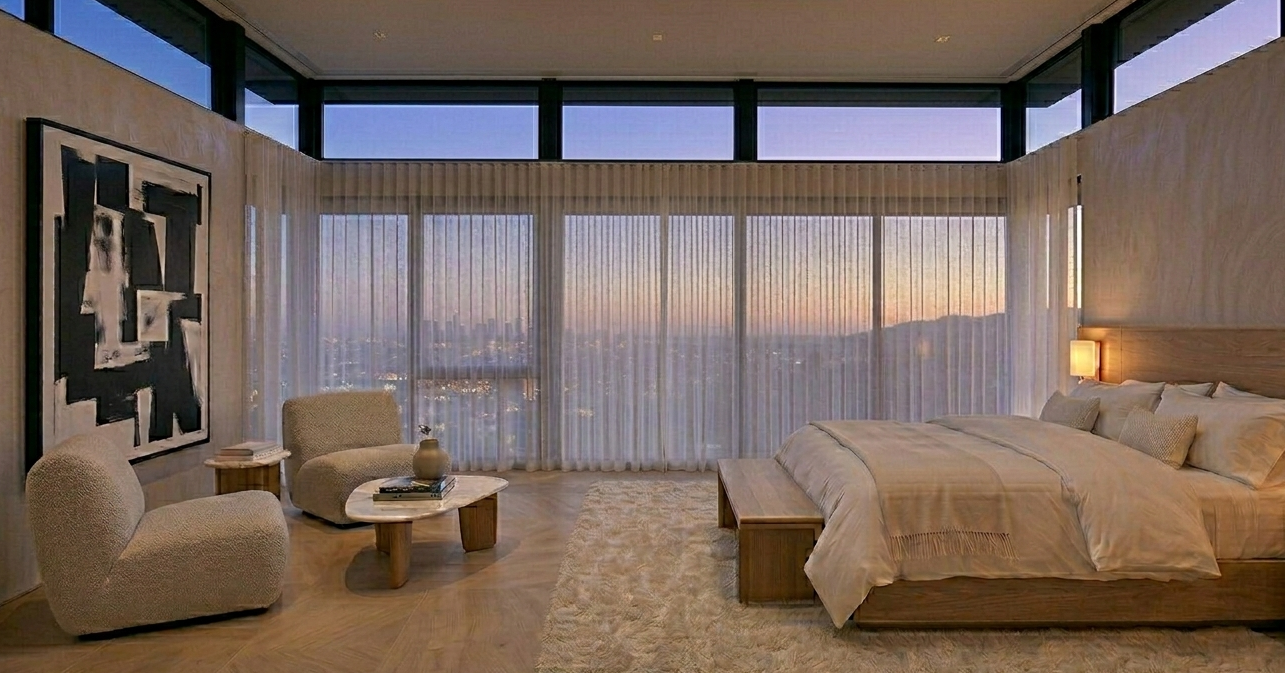
Bedroom at dusk, featuring sky level windows and shear loomed curtains revealing a soft city skyline view.
Accents, Tuning the Glow
Even if your architecture doesn't allow for structural changes, you can achieve a similar "protected glow" through Textile Selection. We utilize heavy, hand loomed linens with a dense, irregular weave. When hung high and wide, these artisan fabrics act as a secondary "skin" for the room. They filter out the damaging rays while allowing a soft, ethereal light to pass through, giving your furniture the spotlight it deserves without the risk.
Final Thought
Design is as much about what you keep out as what you let in. By embracing the Sky Level Window, you aren't just lighting a room, you are protecting an investment. It is the difference between a house that looks good for a season and a home that matures with grace.
The Shape of a Shadow
Light isn't just about visibility, it's about contrast. From ancestral backstrap loomed linens to the sharp geometry of an architectural sun slit, discover how we treat the sun as a raw material to paint a composed, intentional wall.
Painting with the Sun
In most homes, lighting is treated as a utility, you flip a switch to see. But we like to treat light as a raw material. Specifically, we look at the Shape of a Shadow. A room with uniform, flat lighting feels lifeless. To give a space real depth, you have to embrace the dark.
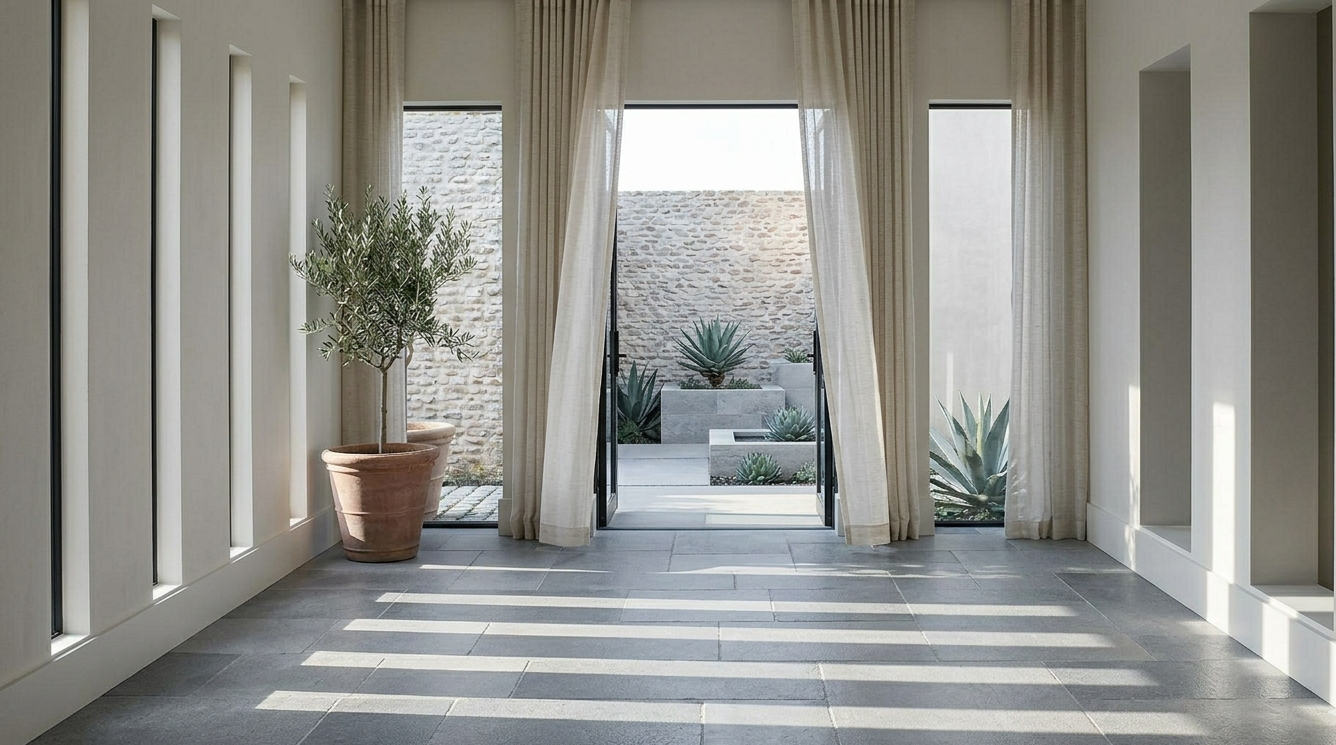
Windows cast shadows on a stone floor with natural fiber window treatments on an open door heading to a private courtyard.
The Composed Wall
When you have a clean, architectural wall, you don't need art to fill it. You need the sun. By positioning openings to catch the movement of the day, the wall becomes a canvas. As the sun moves, the shadows shift, elongating and sharpening. The room is never the same at 10:00 AM as it is at 4:00 PM. As these shadows stretch across the room, they highlight The Grit of the Floor, catching the micro textures of the stone to reveal the honest, geological depth of the foundation. This is how we create a house that feels alive.
Contrast as Comfort
There is a psychological comfort in contrast. A room that is perfectly bright in every corner feels exposed and clinical. Shadows provide a sense of scale and privacy. They define where a hallway ends and a sanctuary begins. By intentionally designing for "dark pockets," we allow the eye to rest and the mind to settle.
The Architecture of the Sundial
We don't just look for "big windows." We look for intentional light. Whether it’s a narrow vertical slit or a deep set niche, the goal is to control how the light enters. When you control the entry point, you control the shadow. You aren't just letting the sun in, you are using it to draw lines across the floor and texture across the surfaces.
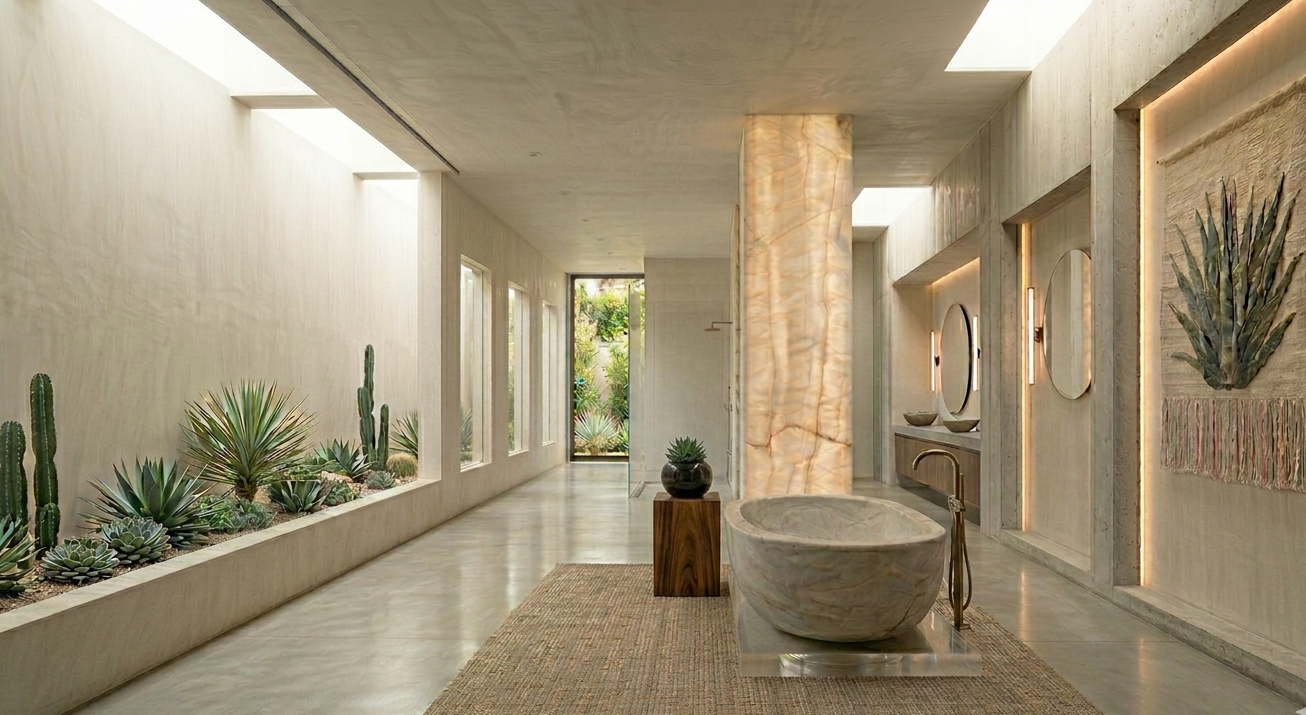
Bathroom featuring a stone tub and desert plants, natural shadows.
Manipulating the Light
Even without structural changes, you can still use this principle through Home Accents. The right window treatments aren't just for privacy, they are the filters we use to "tune" the room.
For a soft, organic atmosphere, we look toward ancestral hand loomed textiles. Fabrics created on a traditional backstrap loom or a heavy treadle loom carry a slight irregularity in the weave that catches the light differently. These natural fibers, like agave based linens and hand spun cotton, soften a harsh afternoon glare, turning a sharp shadow into a diffused, warm glow.
For a more technical approach, integrated motorized blinds allow you to automate the atmosphere, shifting the "shape" of the room with the touch of a button. Whether it’s a sheer artisan weave that catches the wind or a blackout blind that creates a total retreat, these are the tools we use to master the sun.
Final Thought
Light is free, but its impact is priceless. By focusing on the shape of the shadow rather than just the brightness of the bulb, we create a house that feels grounded and intentional. In this house, we don't just build walls, we let the sun paint them.
Blackened Iron and Oxblood Leather
Stop playing it safe with neutral tones. Discover how we use vegetable tanned oxblood leather and blackened iron to give a modern room the weight, depth, and permanence it’s missing.
The Foundation Tones
Most people are terrified of dark colors. They spend years painting everything white and buying "light and airy" furniture because they’re afraid a room will feel too small or too heavy. But here’s the truth, if a room doesn't have any weight, it doesn't have any soul. To get a space to feel grounded, it needs a pulse. That pulse is found in the pairing of Oxblood and Iron.
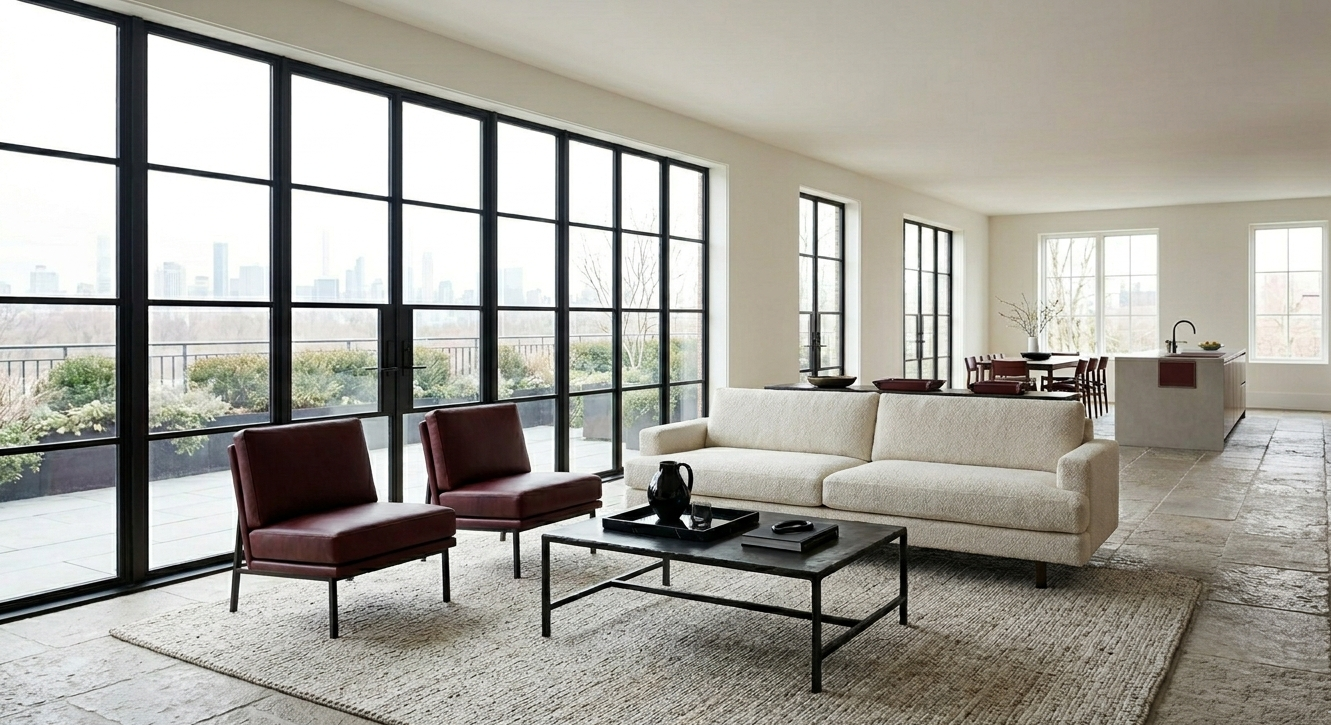
Black iron window frames and coffee table, in an expansive open floor plan with oxblood sitting chairs and oxblood accessories.
The Weight of Oxblood
When we talk about Oxblood, we aren't talking about a literal animal product, we are talking about a depth of pigment. Specifically, we use a full grain, vegetable tanned saddle leather that has been aniline dyed to a deep, earthy crimson. This process ensures the color is soaked all the way through the hide, rather than just painted on top like cheap, corrected leathers.
This isn't the distressed, "old world" leather of a 1940s hacienda. We use a refined, matte finish hide that feels architectural and clean. It’s a "living" material that changes with you. Because the leather is left natural and unsealed by plastic coatings, it breathes. In the spots where you rest your arms or work at your desk, the leather will absorb the oils of your touch and darken into a deep, bruised plum. It provides a kind of "visual heat" that makes a large, modern room feel inhabited and warm without needing to clutter the space.
The Honesty of Iron
If leather is the skin of the room, iron is the bone. We prefer hand forged, blackened iron for frames and supports because it’s honest. But we don't do ornate scrolls or rustic textures. We focus on precision.
Think of sharp, industrial angles and slim, high strength profiles. Unlike chrome or stainless steel, which can feel like they belong in a lab, iron has a raw, matte texture that feels substantial. It gives a sharp, dark line to a room, telling the eye exactly where the furniture begins and ends. It’s the "anchor" that holds a essential space down. This architectural precision is the perfect structural partner for Obsidian Light, where the slim iron profiles disappear into the deep shadows of the glass, letting the view take center stage.
Accents, Adding Depth Without the Commitment
We understand that not every space is ready for a full scale iron frame or a leather wrapped surface. But there is always a way to add weight. If a modern room feels too "thin" or clinical, we suggest introducing these tones through Home Accents.
A single hand forged iron tray on a coffee table or a heavy oxblood leather blotter on a desk can change the entire gravity of a room. These smaller touches act as a visual "tether," giving a light, glass filled space a sense of history and substance without losing its modern edge. It’s about using small, high impact pieces to ground the light.
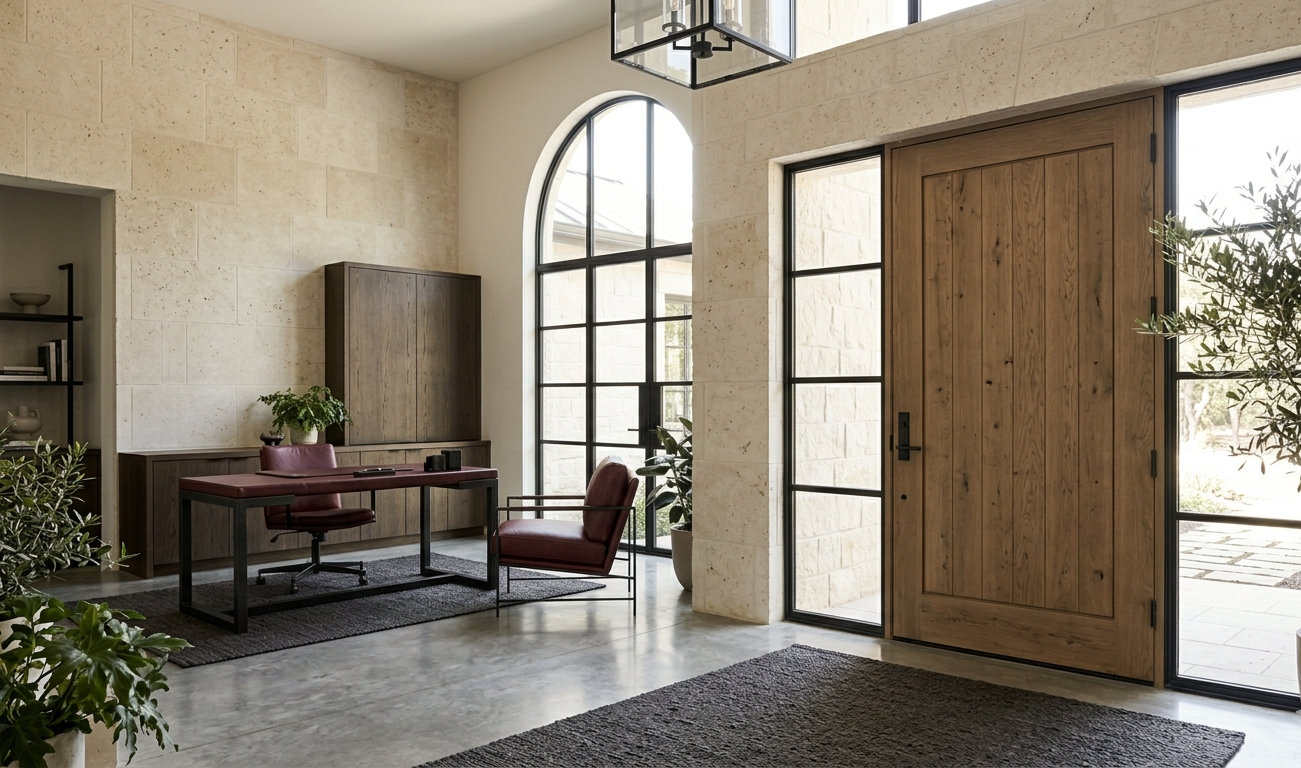
Black iron desk wrapped in oxblood leather and oxblood desk chair in an open home interior foyer.
Why They Belong Together
The magic is in the tension, the "soft," organic heat of the leather pressed against the "hard," industrial cold of the iron. By keeping the lines clean and the textures matte, we avoid the "antique" trap. Instead, it feels stable, permanent, and undeniably current.
Beyond the Trends
"Colors of the year" come and go, and usually, they look dated by the time the paint is dry. But earth and metal are immune to fashion. Whether it’s a modern glass loft or a clean architectural gallery, this combination always feels relevant because it’s based on materials, not trends.
Quick Question - Do you want a home that feels Light and Temporary, or are you looking for something Grounded and Substantial?
Final Thought
Real quality is found in the weight of the materials you live with. By anchoring a room with the deep tones of oxblood and the raw strength of iron, we aren't just decorating a space. We are building a stronghold.
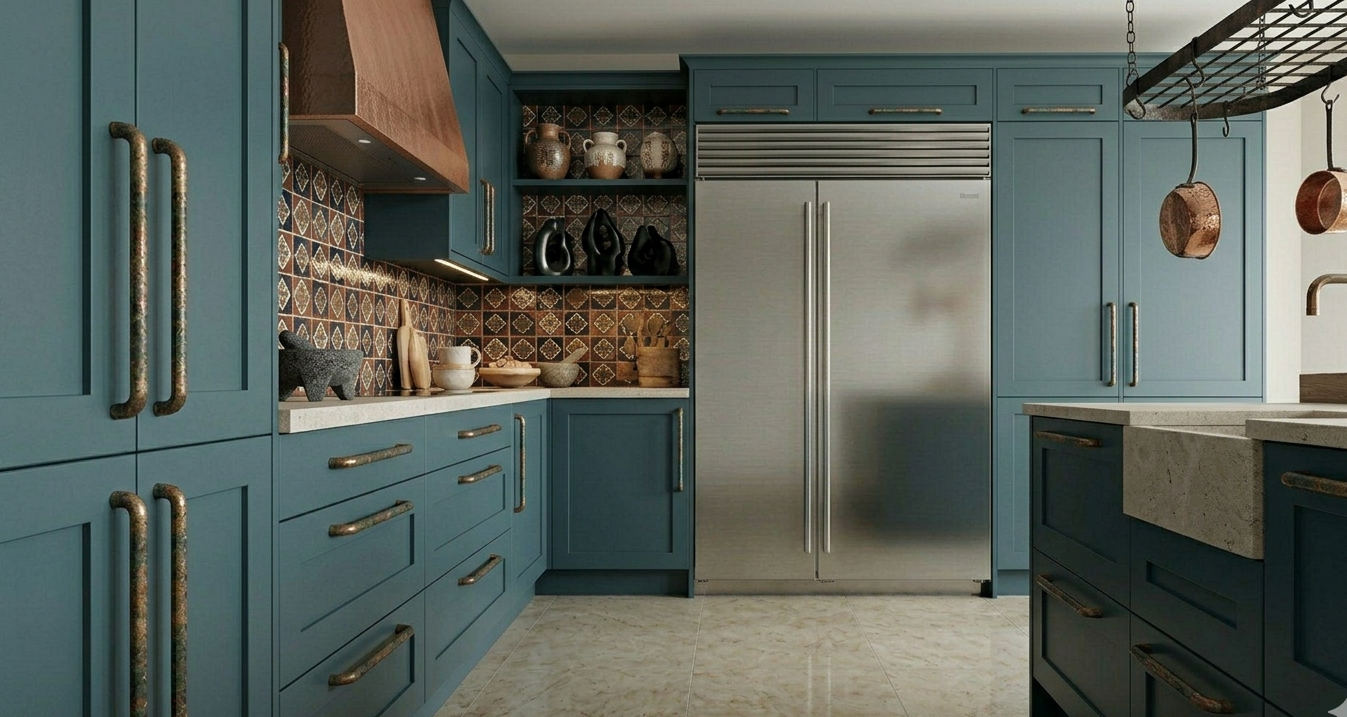
Living Bronze
Most hardware is coated in plastic to keep it from changing. We prefer a metal that actually responds to you. Discover why living bronze is the only choice for a house that ages well.
The Hardware of the Fingerprint
Most hardware is designed to stay exactly the way it looked in the store. Manufacturers coat it in a thin layer of plastic lacquer so it never changes. The problem is that when that plastic eventually cracks or wears off, the handle looks cheap. We don't use fake finishes. We use Living Bronze.
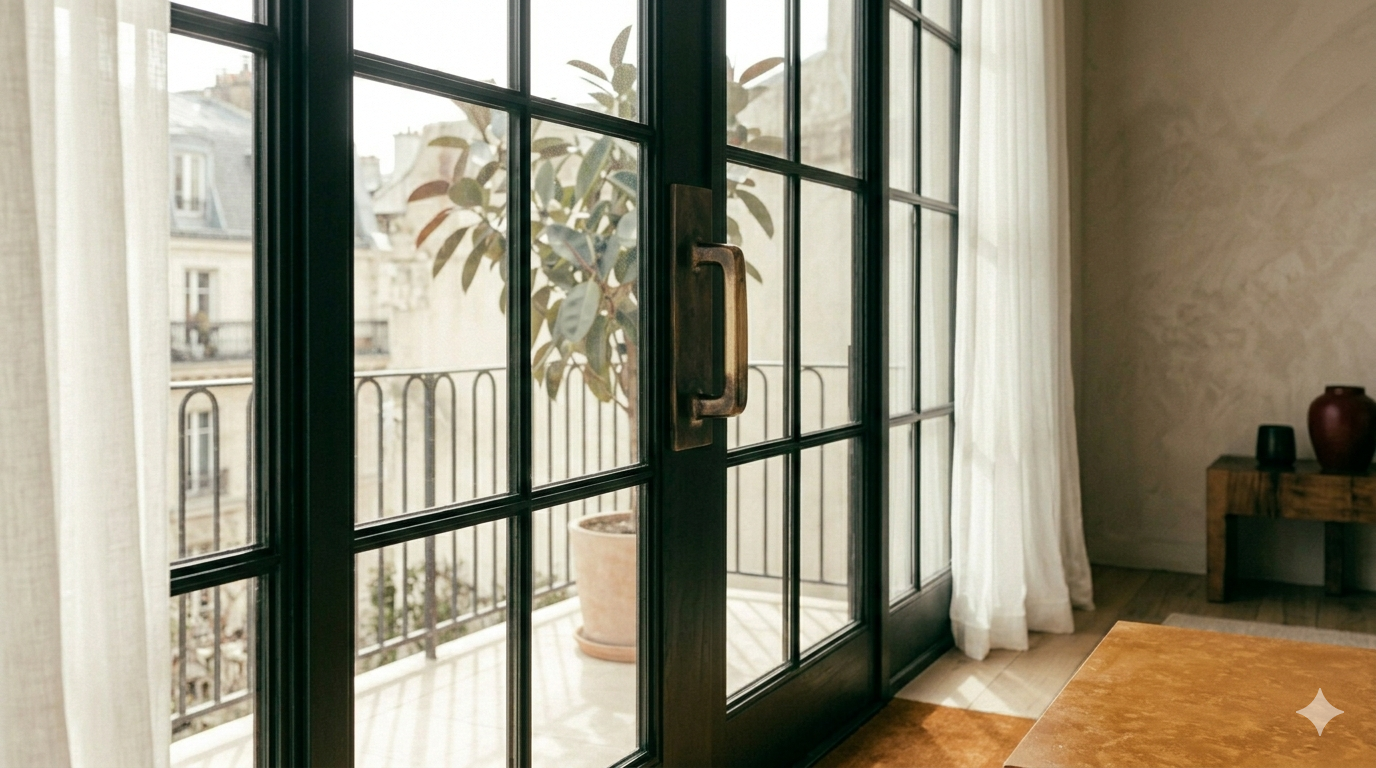
Solid brass door handle.
The Unlacquered Standard
Living bronze is just "naked" metal. It doesn't have a protective spray on it because it doesn't need one. It’s a material that is supposed to change. When it’s brand new, it has a raw, warm glow. But the second you start living with it, it begins to react to the air and, more importantly, to your hands.
How It Changes
Every time you open a door or pull a drawer, the oils from your skin hit the metal. In the spots you touch every day, the bronze stays bright and polished. In the corners you never touch, it turns a deep, dark brown.
The hardware eventually develops a map of how you actually live. You can see which doors get used the most and which drawers are the favorites. It’s not "wearing out", it’s maturing. This is really the whole point of The Ritual of Care, we choose materials like this because we want a house that actually looks better the more you use it, not one that starts falling apart the moment you move in.
Why This Matters
We don't want a house that looks like a sterile showroom. We want a house that feels lived in and solid. By using unlacquered bronze, we let the house breathe. You don't have to worry about scratching a "finish" because there is no finish to scratch. The metal is the same all the way through.
Solid brass kitchen cabinet handles.
The Feel of the House
There is a specific weight to a bronze handle that you just don't get with cheaper alloys. It feels heavy and cool in your hand. It’s the small detail that anchors a room. It makes a simple act, like opening a door, feel intentional and permanent. This tactile weight is a requirement for The Heavy Door, where the cold, solid touch of a bronze handle provides the first signal that you have entered a sanctuary.
Final Thought
Real quality isn't about keeping things "new." It’s about choosing materials that look better ten years from now than they did on day one. By choosing living bronze, you aren't just buying a doorknob, you're choosing a material that grows with you.
Tzalam and the Living Grain
In a home, furniture isn't an accessory, it’s a legacy. Discover the dense, oily grain of Tzalam and why it is the anchor for a room designed to last a century."
In a world of mass produced, veneered furniture, there is no substitute for the density of a true tropical hardwood. When a room requires a table or a structural partition with real presence, we don't look for a "finish" that sits on top of the wood. We look for the life inside the grain. This is the role of Tzalam.
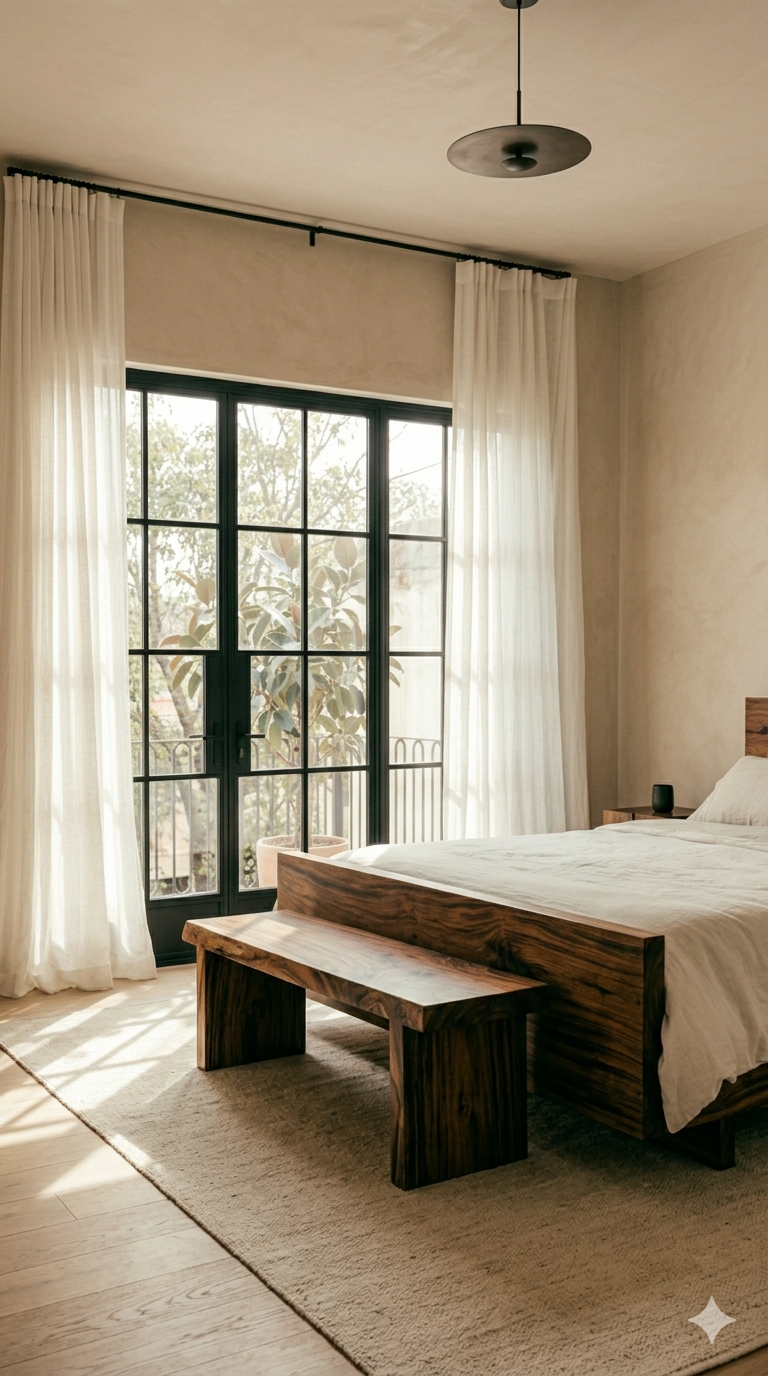
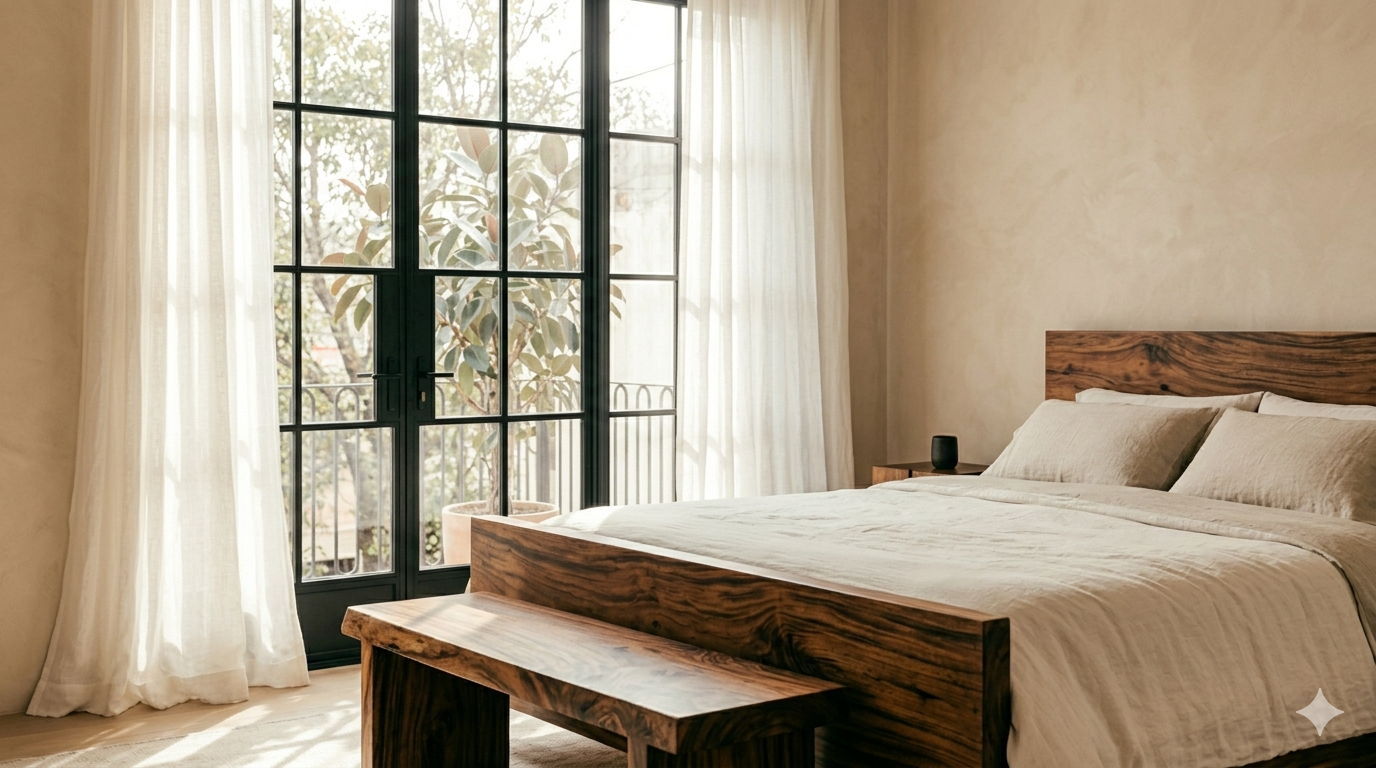
Tzalam wood bedframe and matching bed bench, in a bedroom of natural sunlight.
The Mexican Walnut
Often called Mexican Walnut, Tzalam is a wood of incredible weight and resilience. It is a dense, oily hardwood that carries a rich spectrum of reddish browns and deep chocolates. Unlike temperate woods that can feel dry or brittle over time, Tzalam has a high natural oil content. This means the wood doesn't just look deep, it feels substantial to the touch.
Beyond the Varnish
Most furniture is sanded down and sealed under a thick layer of plastic based varnish. We prefer to let the material breathe. Because Tzalam is naturally oily, it requires very little intervention. We use natural waxes that bond with the fibers rather than coating them. The result is a surface that feels like wood, not a chemical film. It is a material that responds to the light of the room, aging with a grace that lighter woods cannot match.
Built for the Century
A home shouldn't be designed for the next five years. It should be designed for the next hundred. Tzalam’s density makes it resistant to the dings and scratches that ruin softer woods. Instead of a chip in a veneer, a mark on a Tzalam table becomes part of its history, a small detail in a piece that will eventually be passed down. It provides a sense of permanence that you can feel the moment you sit down.
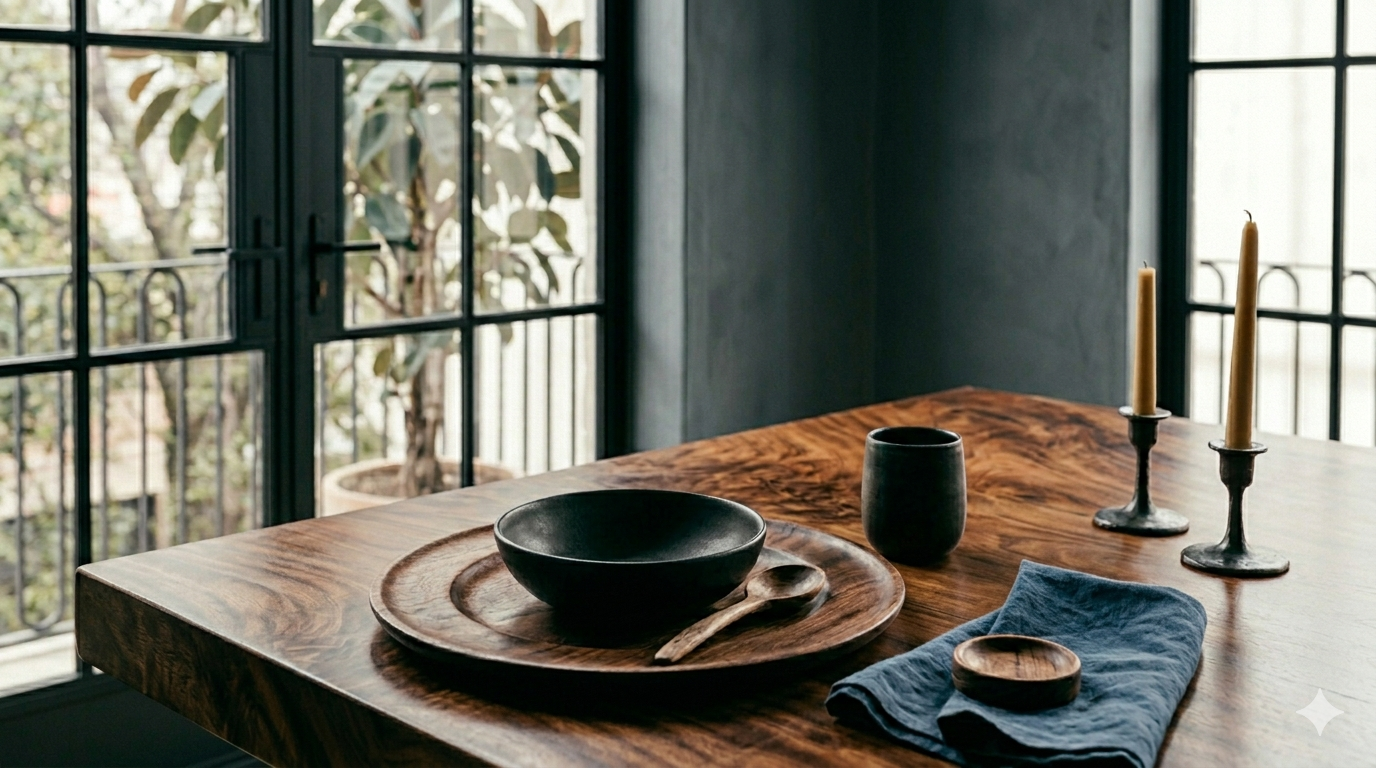
Tzalam kitchen table and Tzalam place setting.
The Architectural Weight
There is a specific resonance to a room that features Tzalam. Because of its dark, variegated grain, it works as a bridge between the light mineral walls of the foundation and the darker metals of the hardware. It provides the "visual heat" necessary to make a large, open space feel inhabited and warm. When utilized in The Social Partition, Tzalam transforms a structural necessity into a warm, organic boundary that directs the flow of the home without closing it off.
Final Thought
The value of a material isn't found in a trend, it's found in its lifespan. By choosing a wood as resilient and rich as Tzalam, we aren't just placing furniture, we are installing a legacy. In this house, we don't buy for the season, we build for the century.
The Leather Patina
Most luxury surfaces are designed to stay perfect, we prefer surfaces that learn. Discover the art of the leather patina and why friction is the ultimate finish.
Why Friction is the Final Finish
Most high end interiors are designed to be "frozen in time." There is a constant, quiet anxiety about scratching a floor or staining a sofa. But a house that demands perfection from you isn't a sanctuary, it’s a museum. We prefer materials that are designed to fail the "perfection test" beautifully.
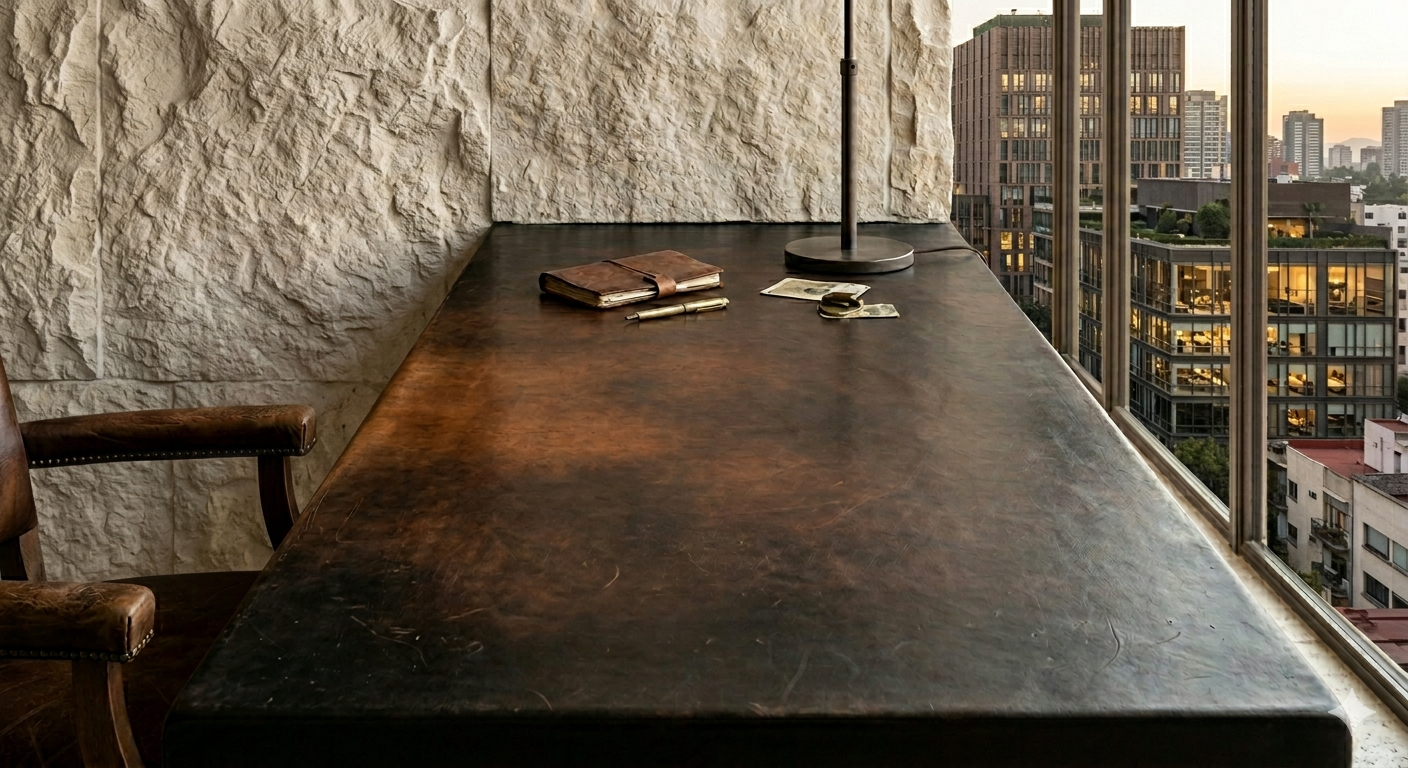
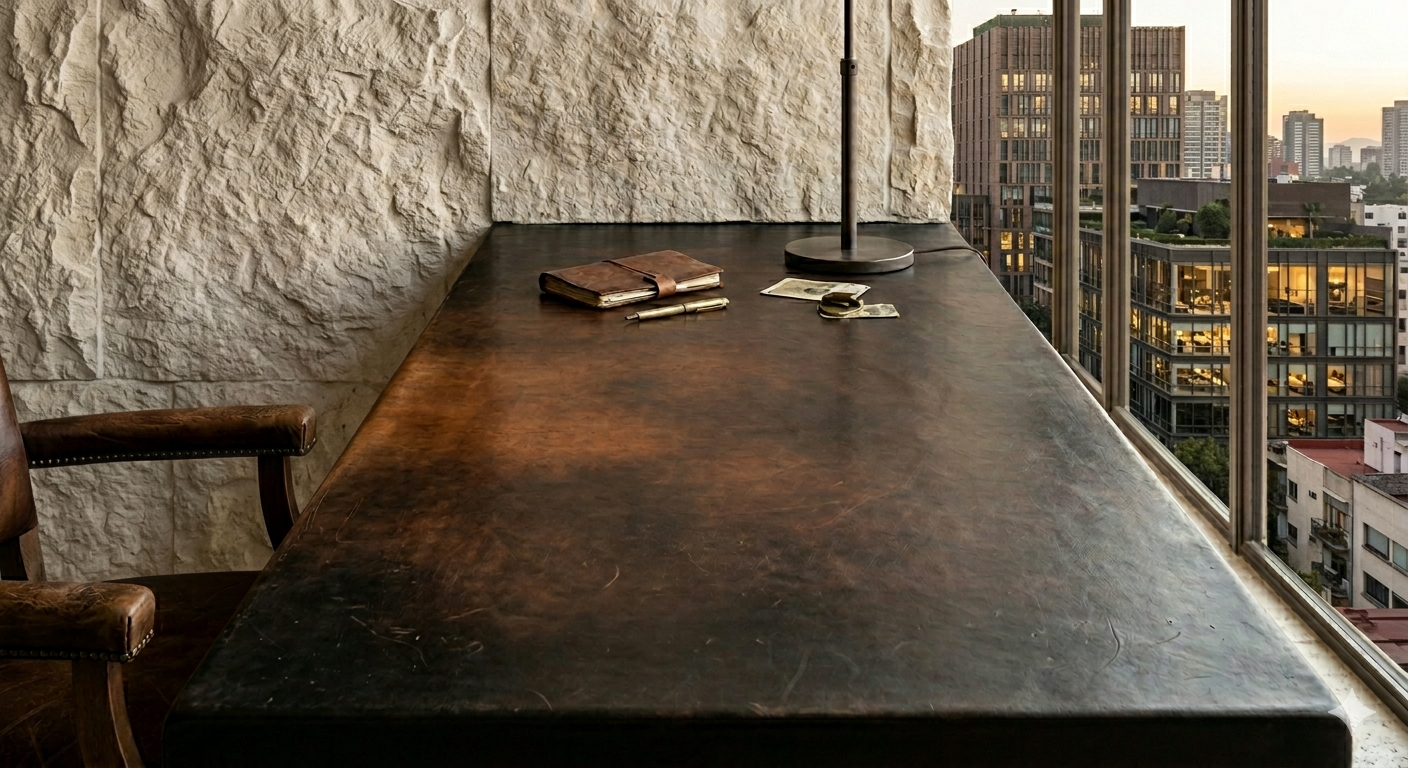
Dark leather wrapped desk.
The Record of a Life
We choose heavy, full grain saddle leathers for the surfaces you touch the most, desk tops, door pulls, and bench seating. These aren't the plastic coated, corrected leathers you find in a standard showroom. These are "naked" hides sourced specifically for their ability to absorb the history of the room.
When you rest your hands on a leather wrapped desk or pull a hand stitched handle, the heat and pressure of your touch begin to change the material. It darkens. It softens. It develops a natural glow in the areas where it’s used most. The furniture becomes a physical record of how you move through the space.
Tobacco and Cured Hides
The palette stays within a specific spectrum, tones that range from burnt honey to deep, blackened espresso. These colors have an inherent honesty. A lighter "tan" can look weathered in a way that feels unfinished, but a deep, cured hide simply looks more seasoned with age. It carries the weight of the room, providing the "soft" texture that balances the "hard" stone and steel.
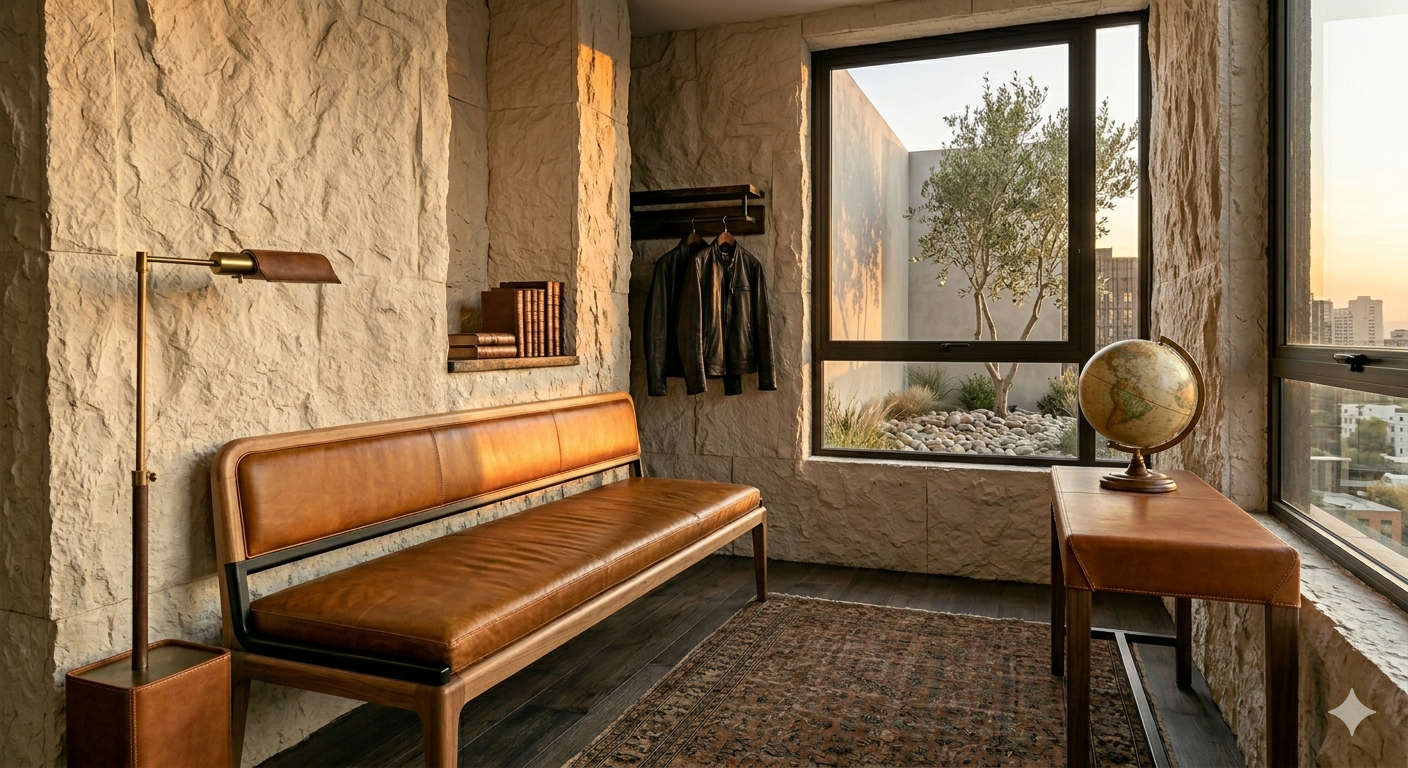
Leather sitting bench in a burnt honey color.
Friction as a Finish
The industry usually treats "wear and tear" as a defect. We treat it as the final finish. Friction is what polishes the leather over time. After a decade, a leather wrapped railing or a library chair will develop a depth of color that no factory could ever replicate. It is a surface that gets better the more you use it. It stops being a product and starts being an heirloom.
The Tactile Shift
There is a psychological shift that happens when you stop worrying about "ruining" your home. When the surfaces are designed for friction, you move through the house with more freedom. You aren't a guest in a gallery, you are the inhabitant of a living environment.
Final Thought
Luxury is often defined by what stays new. We define it by what lasts. By choosing leather that responds to your touch, you’re investing in a material that actually values your presence. Your life doesn't wear the furniture out, it wears it in.
The Mineral Palette
In a sanctuary, color isn't something you apply, it’s something you reveal. Discover why we move away from synthetic paint and toward a permanent foundation of Bone, Sand, and Silt.
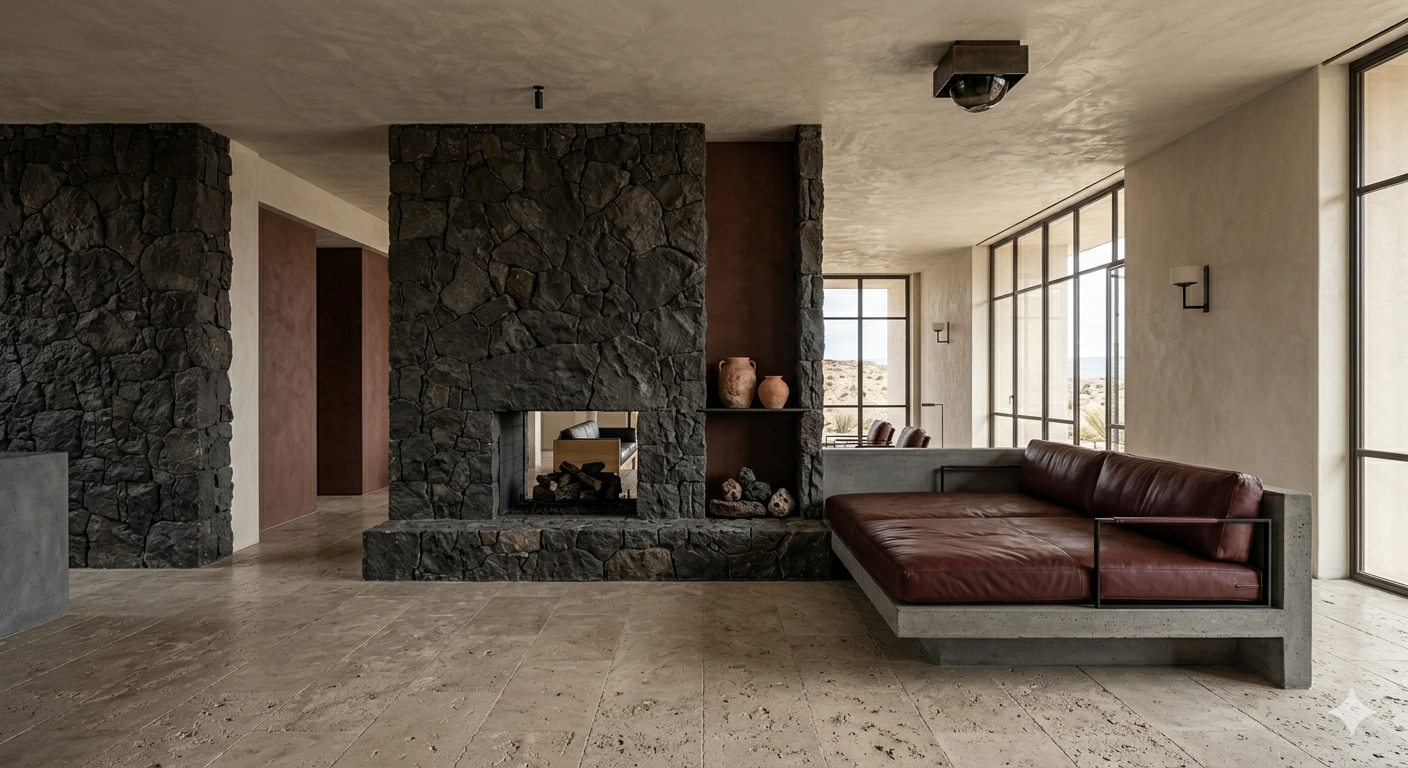
When you step into a space that feels truly permanent, you aren't looking at "color", you are looking at the earth itself. We don't bother with thousands of paper swatches, we look to the geological layers of the landscape to find the palette. To build a sanctuary with real gravity, we use materials that have already stood the test of time, Bone, Sand, and Silt.
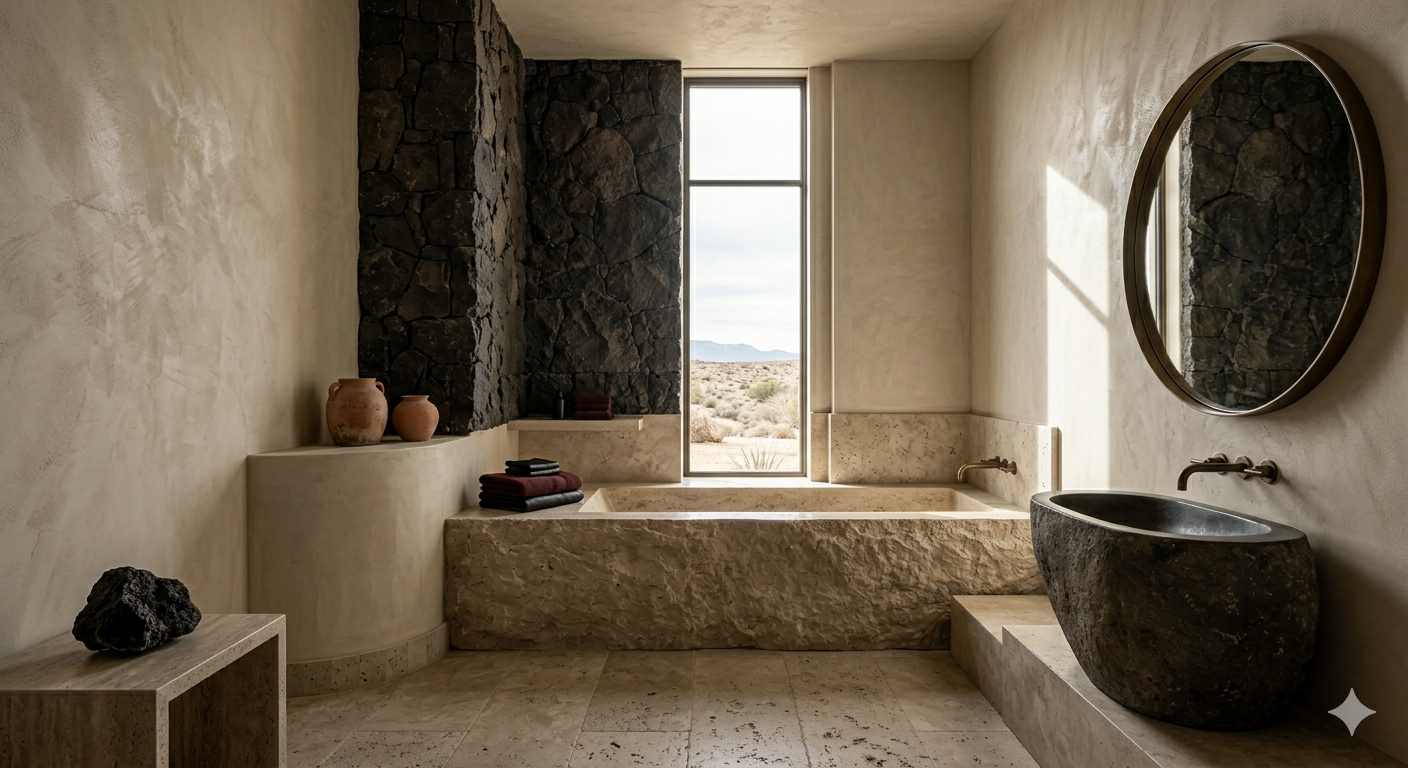
Stone bathroom, volcanic rock, carved bath, with limestone walls.
The Depth of the Stone
Standard paint is a flat, it sits on the surface of the wall. Mineral tones, the actual bones of the landscape, have a living quality. Whether it’s a lime washed wall or a hand troweled plaster, these surfaces have a natural movement. They shift from a warm ivory in the morning to a deep, textured shadow at dusk. It’s a palette that belongs to the landscape.
The Pillars of the Palette
While we pull from the entire geological spectrum, we always return to these core anchors.
1. The Light: Bone and Chalk
Pure white can be aggressive and clinical. Instead, we look to Bone, the tone of sun bleached limestone or raw plaster. It has a soft, matte texture that absorbs light rather than bouncing it around. It gives a room a sense of age and permanence the moment the sun hits the walls.
2. The Anchor: Sand and Silt
The neutrals of a home are found in the weight of the floor and the heavy masonry. These are the soft, dusty tans found in raw travertine or the deep, rich silts of a riverbed. These tones provide the necessary gravity, ensuring the space feels like it’s sitting on solid ground rather than floating in a void.
3. The Shadow: Obsidian and Clay
We don't fear the dark. We use the deep charcoals of volcanic rock and the oxidized reds of raw clay to create points of tension. These aren't "accent colors", they are structural shifts. They provide the cinematic depth that makes a large, open space feel intimate and protected. This mastery of darkness is best realized through Obsidian Light, where high mass glass acts as a structural lens to deepen the natural shadows of the interior.
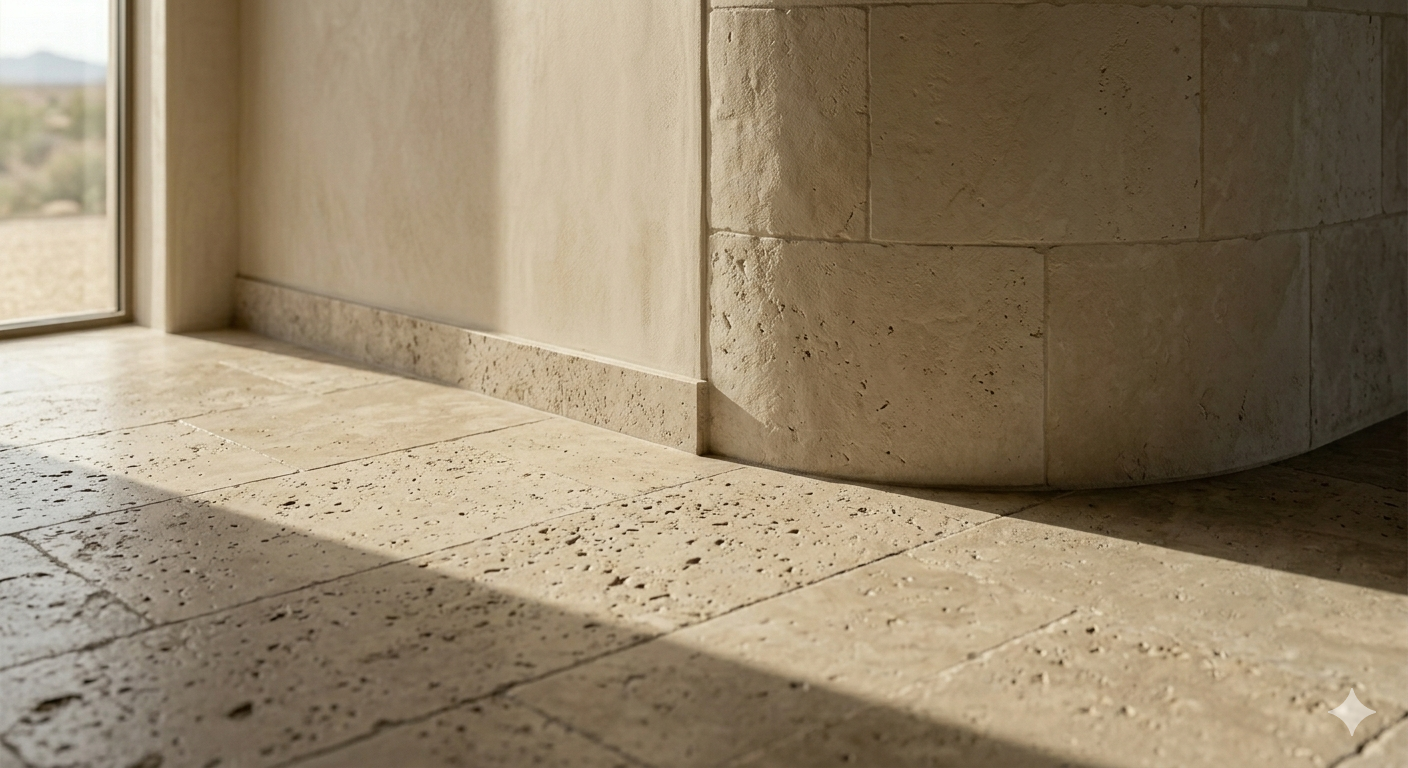
Stone flooring with limestone wall and stone accent.
Why it Works
The secret is Mineral Consistency. We move away from loud, high contrast transitions. By keeping the walls, floors, and ceilings in visual harmony with one another, you remove the "noise" of a room. The space feels larger and more composed. You aren't distracted by the decor because the architecture itself is the statement.
Expansive living area, stone floors, volcanic rock fireplace, limestone walls and celling.
Final Thought
A house shouldn't compete with the landscape; it should be an extension of it. When you strip away the trends and return to a palette of earth and stone, you create a canvas that never tires the eye. Color isn't something we add, it’s something we reveal.